School of Biological Sciences, The University of Hong Kong, Pok Fu Lam Road, Hong Kong, China.
Zodiac Pet & Exotic Hospital, Shop 101A to 103A, 1/F, Victoria Centre, 15 Watson Road, Fortress Hill, Hong Kong, China.
PLoS One. 2024 Sep 6;19(9):e0306528. doi: 10.1371/journal.pone.0306528. eCollection 2024.
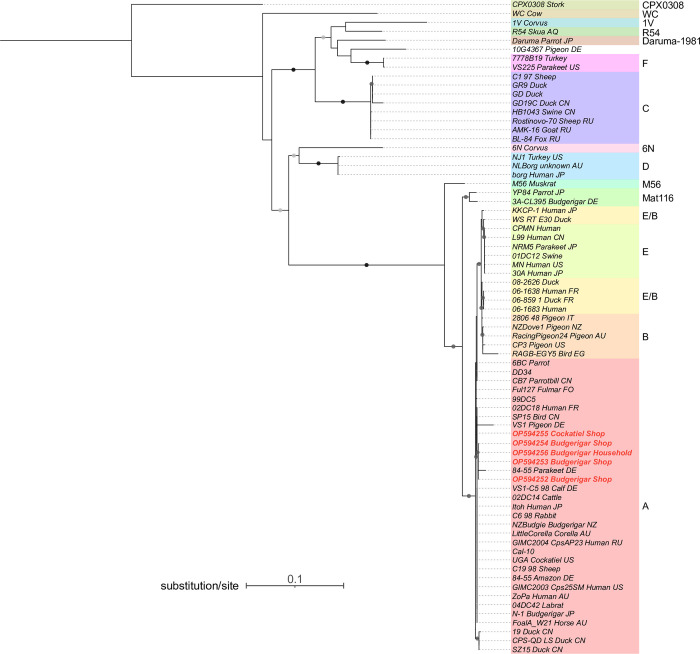
Psittacosis, or parrot fever, is a zoonotic disease caused by Chlamydia species associated with birds. One of the causative agents of the disease is Chlamydia psittaci, which is commonly carried by psittacine and other bird species, can be highly pathogenic and virulent to humans. In Hong Kong, a city with high population density, psittacosis is a notifiable disease with over 60% of cases in the last decade resulting in hospitalization. However, the sources of transmission of C. psittaci and its prevalence in pet birds in Hong Kong are currently unknown. To evaluate the risks of psittacosis transmission through pet birds, we tested the presence of C. psittaci and determined its genotypes in samples obtained from 516 captive birds from households, pet shops, and a veterinary hospital in Hong Kong. Results revealed that five samples (0.97%), collected from budgerigars and cockatiels, were C. psittaci-positive, while four (80%) of them were obtained from pet shops. Our phylogenetic analysis revealed that all identified strains belonged to Genotype A and showed high similarity to other sequences of this genotype obtained from various geographical locations and host species, including mammals. Our findings provide evidence for the presence of Chlamydia psittaci and shed light on its sources in captive birds in Hong Kong. They highlight the potential zoonotic risks associated with this pathogen, which can affect both humans and wild birds.
鹦鹉热,又称鸟疫,是由衣原体属与鸟类相关的病原体引起的人畜共患病。该疾病的病原体之一是鹦鹉热衣原体,它通常由鹦鹉和其他鸟类携带,对人类具有高度致病性和毒力。在人口密度较高的香港,鹦鹉热是一种法定须呈报的疾病,过去十年中超过 60%的病例需要住院治疗。然而,目前尚不清楚 C. psittaci 的传播源及其在香港宠物鸟中的流行情况。为了评估通过宠物鸟传播鹦鹉热的风险,我们对来自香港家庭、宠物店和兽医医院的 516 只笼养鸟的样本进行了 C. psittaci 的检测和基因型鉴定。结果显示,从虎皮鹦鹉和鸡尾鹦鹉中采集的五个样本(0.97%)为 C. psittaci 阳性,其中四个(80%)来自宠物店。我们的系统发育分析表明,所有鉴定的菌株均属于基因型 A,与从不同地理位置和宿主物种(包括哺乳动物)获得的其他该基因型序列高度相似。我们的研究结果提供了 C. psittaci 在香港笼养鸟中存在的证据,并阐明了其在这些鸟类中的来源。这些结果强调了与这种病原体相关的潜在人畜共患病风险,它可能会影响人类和野生鸟类。