Department of Physics, University of Illinois Urbana-Champaign, Urbana, IL, 61801, USA.
Center for Biophysics and Quantitative Biology, University of Illinois Urbana-Champaign, Urbana, IL, 61801, USA.
Nat Commun. 2024 Sep 6;15(1):7814. doi: 10.1038/s41467-024-51913-6.
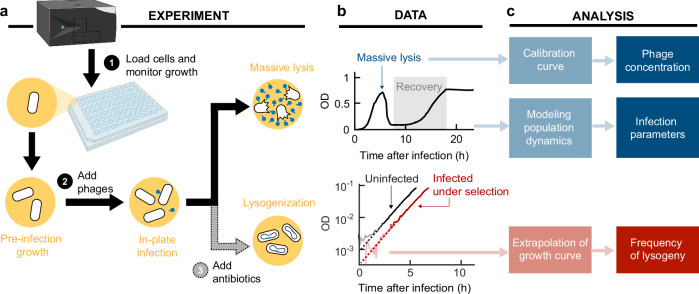
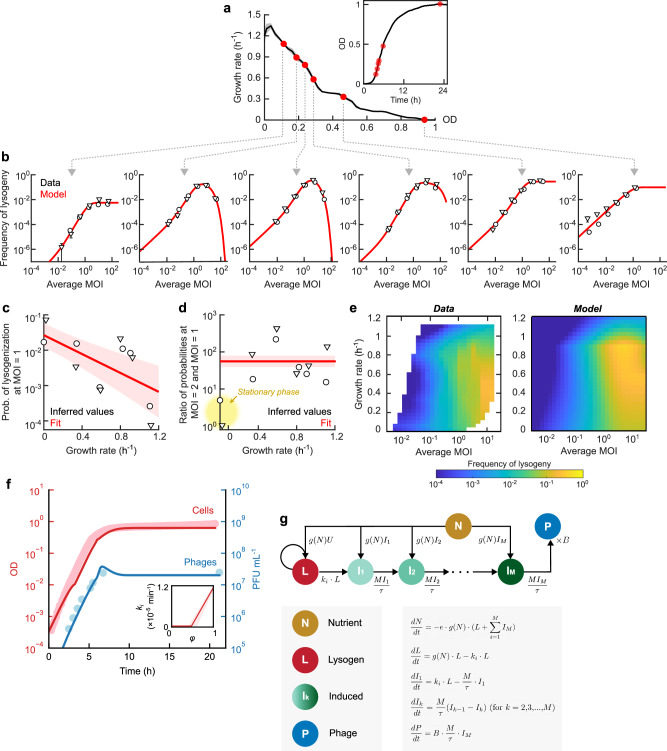
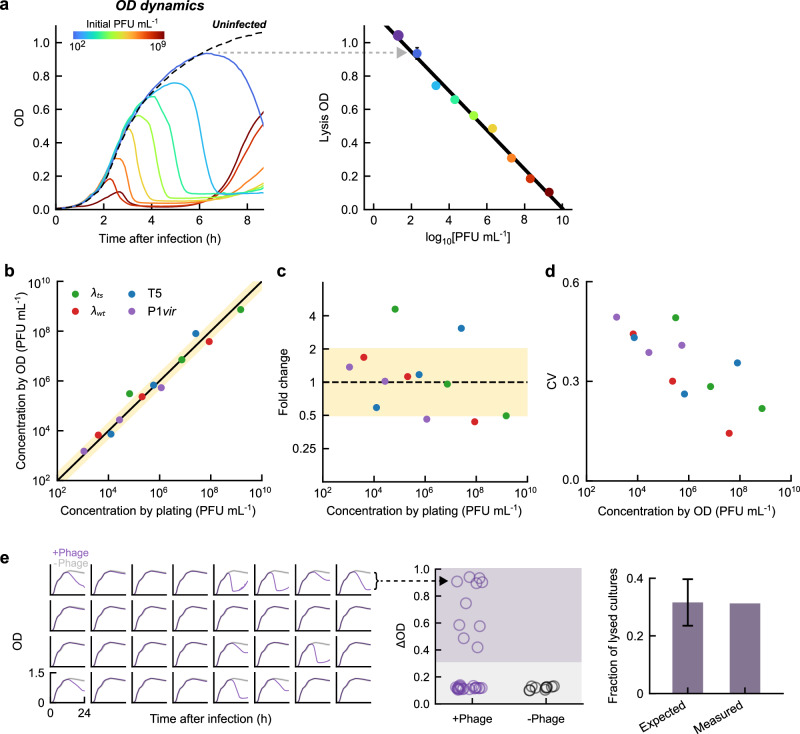
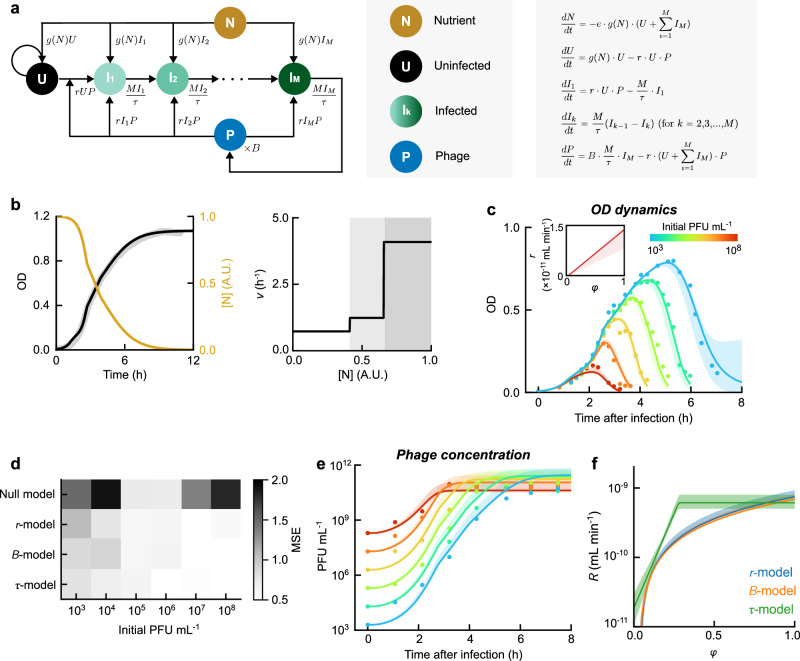
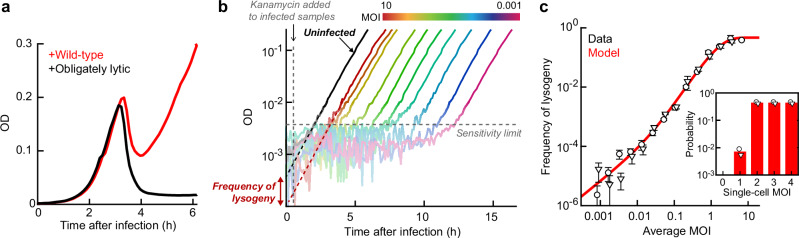
Traditional assays for counting bacteriophages and their lysogens are labor-intensive and perturbative to the host cells. Here, we present a high-throughput infection method in a microplate reader, where the growth dynamics of the infected culture is measured using the optical density (OD). We find that the OD at which the culture lyses scales linearly with the logarithm of the initial phage concentration, providing a way of measuring phage numbers over nine orders of magnitude and down to single-phage sensitivity. Interpreting the measured dynamics using a mathematical model allows us to infer the phage growth rate, which is a function of the phage-cell encounter rate, latent period, and burst size. Adding antibiotic selection provides the ability to measure the rate of host lysogenization. Using this method, we found that when E. coli growth slows down, the lytic growth rate of lambda phages decreases, and the propensity for lysogeny increases, demonstrating how host physiology influences the viral developmental program.
传统的噬菌体及其溶原菌计数方法既繁琐又容易对宿主细胞造成损伤。在这里,我们在微孔板读数器中提出了一种高通量的感染方法,通过光密度(OD)测量感染培养物的生长动态。我们发现,培养物裂解时的 OD 值与初始噬菌体浓度的对数呈线性关系,这为测量噬菌体数量提供了一种方法,范围涵盖了九个数量级,甚至可以达到单噬菌体的灵敏度。通过使用数学模型解释测量的动力学,我们可以推断出噬菌体的生长速率,这是噬菌体-细胞相遇率、潜伏期和爆发大小的函数。添加抗生素选择提供了测量宿主溶原化率的能力。使用这种方法,我们发现当大肠杆菌生长速度减慢时,lambda 噬菌体的裂解生长速率降低,溶原化的倾向增加,这表明了宿主生理学如何影响病毒的发育程序。