Department of Biomedical Engineering, Johns Hopkins University, 720 Rutland Ave, Traylor 504, Baltimore, MD, 21205-2109, USA.
Departments of Otorhinolaryngology-Head and Neck Surgery, Biochemistry and Molecular Biology, Ophthalmology, University of Maryland School of Medicine, Baltimore, MD, USA.
Sci Rep. 2024 Sep 8;14(1):20914. doi: 10.1038/s41598-024-71665-z.
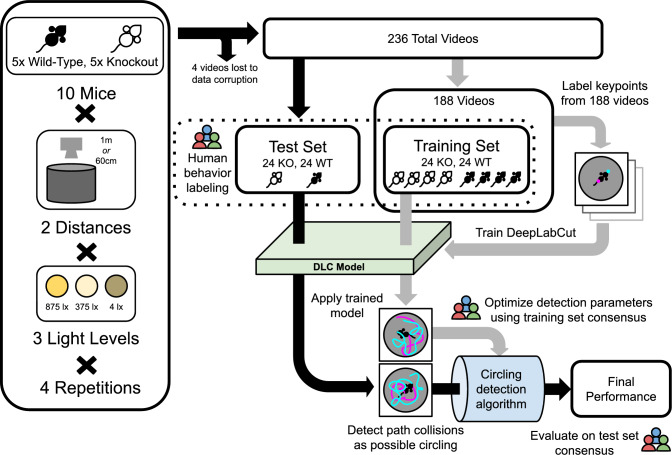
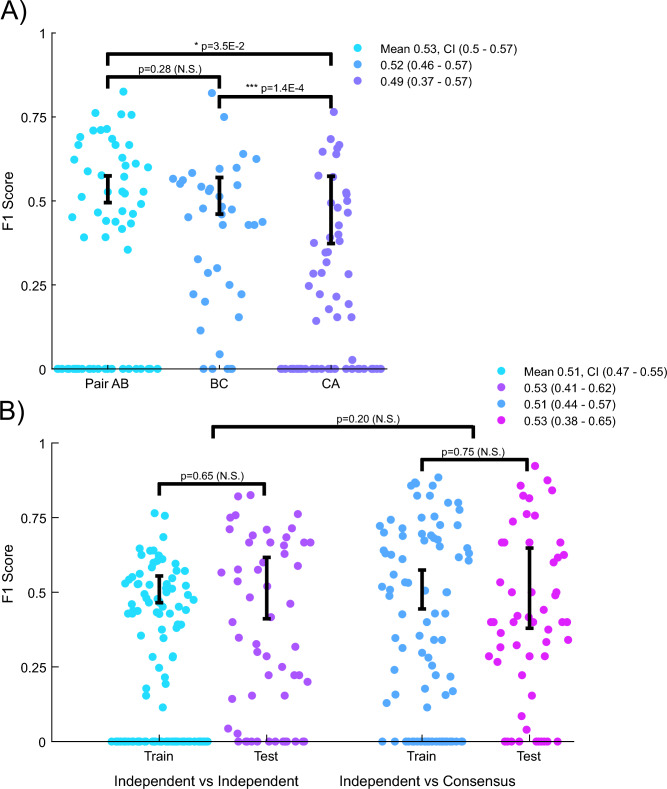
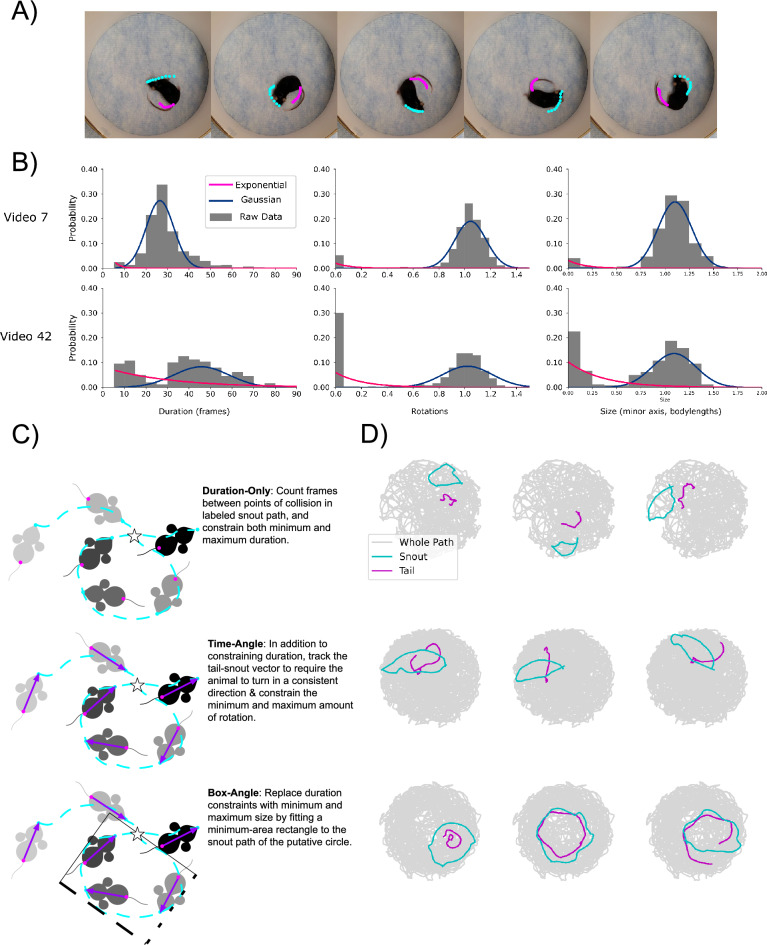
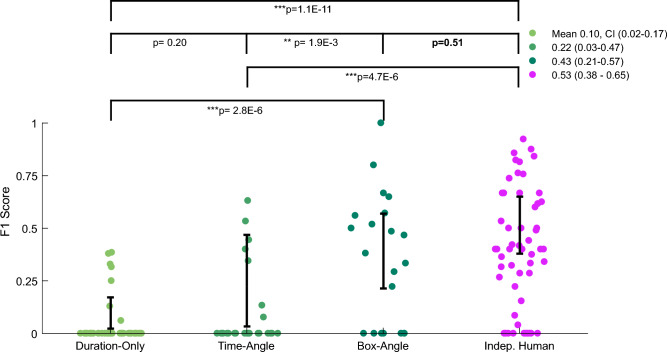
Quantitatively relating behavior to underlying biology is crucial in life science. Although progress in keypoint tracking tools has reduced barriers to recording postural data, identifying specific behaviors from this data remains challenging. Manual behavior coding is labor-intensive and inconsistent, while automatic methods struggle to explicitly define complex behaviors, even when they seem obvious to the human eye. Here, we demonstrate an effective technique for detecting circling in mice, a form of locomotion characterized by stereotyped spinning. Despite circling's extensive history as a behavioral marker, there currently exists no standard automated detection method. We developed a circling detection technique using simple postprocessing of keypoint data obtained from videos of freely-exploring (Cib2;Cib3) mutant mice, a strain previously found to exhibit circling behavior. Our technique achieves statistical parity with independent human observers in matching occurrence times based on human consensus, and it accurately distinguishes between videos of wild type mice and mutants. Our pipeline provides a convenient, noninvasive, quantitative tool for analyzing circling mouse models without the need for software engineering experience. Additionally, as the concepts underlying our approach are agnostic to the behavior being analyzed, and indeed to the modality of the recorded data, our results support the feasibility of algorithmically detecting specific research-relevant behaviors using readily-interpretable parameters tuned on the basis of human consensus.
在生命科学中,将行为与基础生物学定量相关联至关重要。尽管关键点跟踪工具的进步降低了记录姿势数据的障碍,但从这些数据中识别特定行为仍然具有挑战性。手动行为编码既费时又不一致,而自动方法即使对于人类来说很明显,也难以明确定义复杂的行为。在这里,我们展示了一种用于检测小鼠转圈行为的有效技术,这种行为是一种以刻板旋转为特征的运动形式。尽管转圈作为一种行为标记已经有很长的历史,但目前还没有标准的自动化检测方法。我们使用从自由探索(Cib2;Cib3)突变小鼠的视频中获得的关键点数据的简单后处理开发了一种转圈检测技术,该品系以前被发现表现出转圈行为。我们的技术在基于人类共识的匹配发生时间方面达到了与独立人类观察者的统计一致性,并且能够准确地区分野生型小鼠和突变体的视频。我们的流水线提供了一种方便、非侵入性的定量工具,用于分析转圈小鼠模型,而无需软件工程经验。此外,由于我们方法的基本原理与正在分析的行为无关,并且与记录数据的模态无关,因此我们的结果支持使用基于人类共识调整的易于解释的参数通过算法检测特定与研究相关的行为的可行性。