Lin Jie-Wei, Zhou Yang, Xiao Hui-Ping, Wu Lei-Lei, Li Peng-Cheng, Huang Ming-Dong, Xie Dong, Xu Peng, Li Xin-Xiong, Li Zhi-Xin
Department of Thoracic Surgery, Shanghai Pulmonary Hospital, School of Medicine, Tongji University Shanghai 200433 China
College of Chemistry, Fuzhou University Fuzhou Fujian 350108 China
Chem Sci. 2024 Aug 27;15(37):15367-76. doi: 10.1039/d4sc03856h.
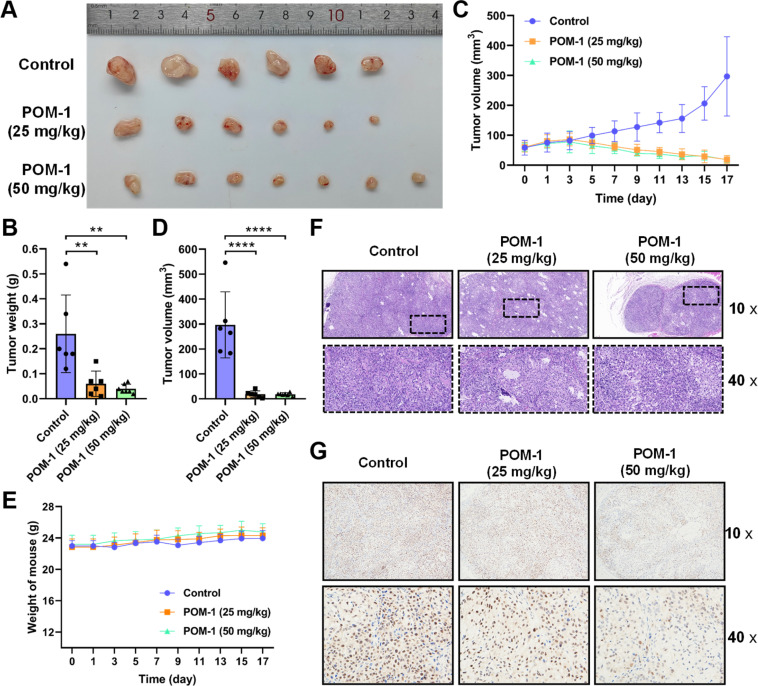
Polyoxometalates (POMs) are a class of anionic metal-oxygen clusters with versatile biological activities. Over the past decade, an increasing number of POMs, especially Sb-rich POMs, have been proven to exert antitumor activity. However, the antitumor effects and mechanisms of POMs in the treatment of non-small cell lung cancer (NSCLC) remain largely unexplored. This study employed a Sb-rich {SbTbW} POM (POM-1) for NSCLC therapy and investigated its mechanism of action. Our results demonstrated that POM-1 exhibited cytotoxicity against H1299 and A549 cells with IC values of 3.245 μM and 3.591 μM, respectively. The migration and invasion were also inhibited by 28.05% and 76.18% in H1299 cells, as well as 36.88% and 36.98% in A549 cells at a concentration of 5 μM. In a tumor xenograft mouse model, POM-1 suppressed tumor growth by 76.92% and 84.62% at doses of 25 and 50 mg kg, respectively. Transcriptomic analysis indicated the alteration of ferroptosis and apoptosis signaling pathways in POM-treated NSCLC cells. Subsequent experimentation confirmed the induction of ferroptosis, evidenced by 5.6-fold elevated lipid peroxide levels with treatment of 5 μM POM-1, alongside increased expression of ferroptosis-associated proteins. Additionally, the apoptosis induced by POM-1 was also validated by the 19.67% and 30.1% increase in apoptotic cells in H1299 and A549 cells treated with 5 μM POM-1, respectively, as well as the upregulated activation of caspase-3. In summary, this study reveals, for the first time, ferroptosis as the antitumor mechanism of Sb-rich POM, and that synergism with ferroptosis and apoptosis is a highly potent antitumor strategy for POM-based antitumor therapy.
多金属氧酸盐(POMs)是一类具有多种生物活性的阴离子金属氧簇。在过去十年中,越来越多的POMs,尤其是富含锑的POMs,已被证明具有抗肿瘤活性。然而,POMs在治疗非小细胞肺癌(NSCLC)中的抗肿瘤作用和机制在很大程度上仍未被探索。本研究采用一种富含锑的{SbTbW} POM(POM-1)进行NSCLC治疗,并研究其作用机制。我们的结果表明,POM-1对H1299和A549细胞具有细胞毒性,IC值分别为3.245 μM和3.591 μM。在浓度为5 μM时,H1299细胞的迁移和侵袭也分别被抑制了28.05%和76.18%,A549细胞的迁移和侵袭分别被抑制了36.88%和36.98%。在肿瘤异种移植小鼠模型中,POM-1在25和50 mg/kg剂量下分别抑制肿瘤生长76.92%和84.62%。转录组分析表明,POM处理的NSCLC细胞中,铁死亡和凋亡信号通路发生了改变。随后的实验证实了铁死亡的诱导,5 μM POM-1处理后脂质过氧化物水平升高了5.6倍,同时铁死亡相关蛋白的表达也增加,这证明了铁死亡的发生。此外,POM-1诱导的凋亡也得到了验证,5 μM POM-1处理的H1299和A549细胞中凋亡细胞分别增加了19.67%和30.1%,同时caspase-3的激活也上调。总之,本研究首次揭示了铁死亡是富含锑的POM的抗肿瘤机制,并且铁死亡与凋亡的协同作用是基于POM的抗肿瘤治疗的一种高效抗肿瘤策略。