Fu Li-Yuan, Yang Mi-Yang, Ye Pei-Yun, Wang Zhao-Chu, Chen Chu-Jie, Li Hui, Xu Shang-Wen
Department of Radiology, 900 Hospital of Joint Logistics Support Force, Fuzhou 350025, Fujian Province, China.
The First Clinical Medical College, Fuzong Teaching Hospital, Fujian University of Traditional Chinese Medicine, Fuzhou 350122, Fujian Province, China.
World J Clin Cases. 2024 Sep 6;12(25):5784-5790. doi: 10.12998/wjcc.v12.i25.5784.
Sinonasal teratocarcinosarcoma (SNTCS) is a rare and highly invasive neoplasm originating from the nasal cavity and sinuses. Typically, it exhibits an invasive behavior towards adjacent structures; however, in exceptional instances, it may infiltrate the intracranial compartment. Due to the tumor's rarity and lack of distinctive features on computed tomography (CT) and magnetic resonance imaging (MRI) images, SNTCS is often misdiagnosed.
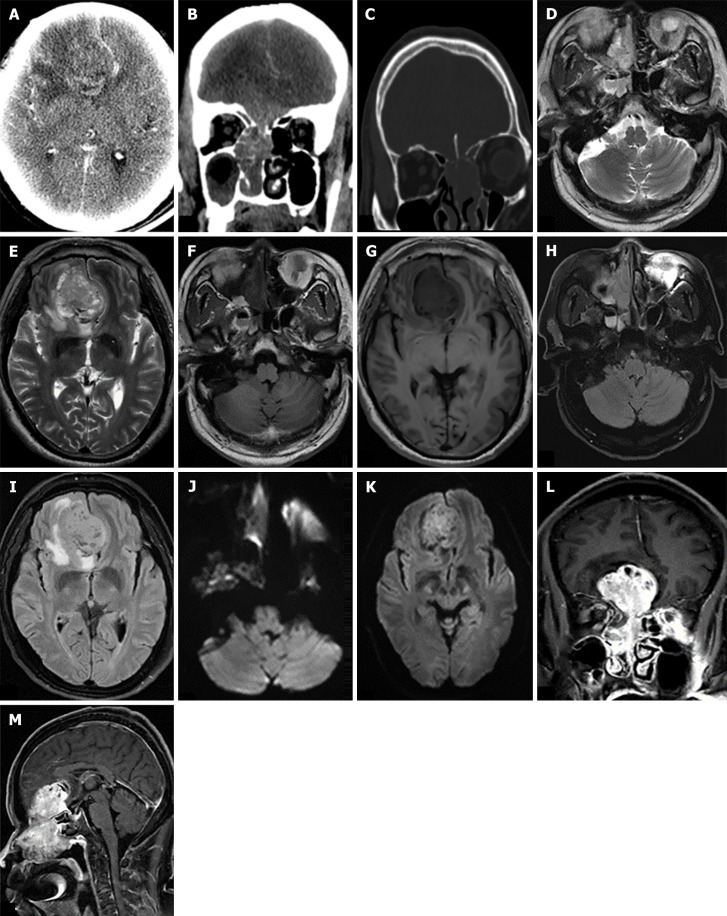
In this study, we present a case of SNTCS in a 56-year-old patient who exhibited unexplained cognitive impairment before admission. CT and MRI scans revealed the presence of a mass in the right nasal cavity, with lesions extending to the right ethmoid sinus and right frontal region. Subsequently, the patient underwent pathological examination for confirmation and received surgical intervention to excise the tumor. The future advancement in our understanding of this disease will significantly contribute to the precise diagnosis and treatment of SNTCS.
SNTCS is an exceptionally rare malignant tumor that originates from the nasal cavity and paranasal sinuses, presenting a diagnostic challenge due to its non-specific imaging findings. MRI accurately delineates the location, morphological characteristics, size, internal structure, extent of surrounding involvement, and metabolic information of the lesion. These aspects play a pivotal role in the precise localization and qualitative assessment of SNTCS. Nevertheless, a definitive diagnosis still requires a pathological biopsy.
鼻窦畸胎癌肉瘤(SNTCS)是一种罕见且具有高度侵袭性的肿瘤,起源于鼻腔和鼻窦。通常,它对相邻结构表现出侵袭性行为;然而,在特殊情况下,它可能会侵犯颅内腔隙。由于该肿瘤罕见且在计算机断层扫描(CT)和磁共振成像(MRI)图像上缺乏独特特征,SNTCS常常被误诊。
在本研究中,我们报告了一例56岁的SNTCS患者,该患者在入院前出现不明原因的认知障碍。CT和MRI扫描显示右侧鼻腔有一个肿块,病变延伸至右侧筛窦和右侧额叶区域。随后,患者接受了病理检查以确诊,并接受了手术干预以切除肿瘤。我们对这种疾病认识的未来进展将显著有助于SNTCS的精确诊断和治疗。
SNTCS是一种极其罕见的起源于鼻腔和鼻窦的恶性肿瘤,因其非特异性影像学表现而带来诊断挑战。MRI能准确描绘病变的位置、形态特征、大小、内部结构、周围受累范围及代谢信息。这些方面在SNTCS的精确定位和定性评估中起着关键作用。然而,明确诊断仍需病理活检。