Department of Internal Medicine III, Jena University Hospital - Friedrich Schiller University Jena, Jena, Germany.
Institute of Diagnostic and Interventional Radiology, Jena University Hospital - Friedrich Schiller University Jena, Jena, Germany.
Rheumatol Int. 2024 Nov;44(11):2483-2496. doi: 10.1007/s00296-024-05715-0. Epub 2024 Sep 9.
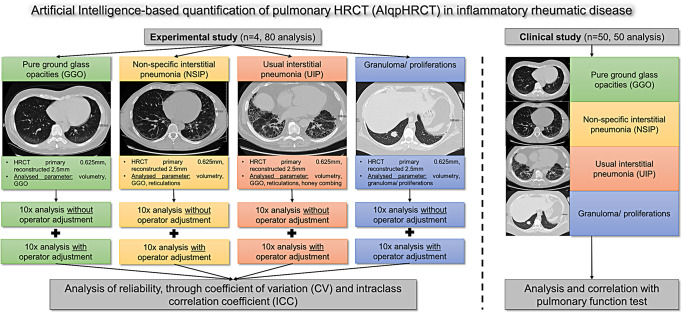
High-resolution computed tomography (HRCT) is important for diagnosing interstitial lung disease (ILD) in inflammatory rheumatic disease (IRD) patients. However, visual ILD assessment via HRCT often has high inter-reader variability. Artificial intelligence (AI)-based techniques for quantitative image analysis promise more accurate diagnostic and prognostic information. This study evaluated the reliability of artificial intelligence-based quantification of pulmonary HRCT (AIqpHRCT) in IRD-ILD patients and verified IRD-ILD quantification using AIqpHRCT in the clinical setting. Reproducibility of AIqpHRCT was verified for each typical HRCT pattern (ground-glass opacity [GGO], non-specific interstitial pneumonia [NSIP], usual interstitial pneumonia [UIP], granuloma). Additional, 50 HRCT datasets from 50 IRD-ILD patients using AIqpHRCT were analysed and correlated with clinical data and pulmonary lung function parameters. AIqpHRCT presented 100% agreement (coefficient of variation = 0.00%, intraclass correlation coefficient = 1.000) regarding the detection of the different HRCT pattern. Furthermore, AIqpHRCT data showed an increase of ILD from 10.7 ± 28.3% (median = 1.3%) in GGO to 18.9 ± 12.4% (median = 18.0%) in UIP pattern. The extent of fibrosis negatively correlated with FVC (ρ=-0.501), TLC (ρ=-0.622), and DLCO (ρ=-0.693) (p < 0.001). GGO measured by AIqpHRCT also significant negatively correlated with DLCO (ρ=-0.699), TLC (ρ=-0.580) and FVC (ρ=-0.423). For the first time, the study demonstrates that AIpqHRCT provides a highly reliable method for quantifying lung parenchymal changes in HRCT images of IRD-ILD patients. Further, the AIqpHRCT method revealed significant correlations between the extent of ILD and lung function parameters. This highlights the potential of AIpqHRCT in enhancing the accuracy of ILD diagnosis and prognosis in clinical settings, ultimately improving patient management and outcomes.
高分辨率计算机断层扫描(HRCT)对于诊断炎症性风湿病(IRD)患者的间质性肺病(ILD)非常重要。然而,通过 HRCT 进行的视觉ILD评估通常存在很高的读者间变异性。基于人工智能(AI)的定量图像分析技术有望提供更准确的诊断和预后信息。本研究评估了基于人工智能的肺部 HRCT 定量分析(AIqpHRCT)在 IRD-ILD 患者中的可靠性,并在临床环境中验证了使用 AIqpHRCT 对 IRD-ILD 的定量。对于每个典型的 HRCT 模式(磨玻璃影[GGO]、非特异性间质性肺炎[NSIP]、寻常型间质性肺炎[UIP]、肉芽肿),都验证了 AIqpHRCT 的可重复性。此外,使用 AIqpHRCT 对 50 名 IRD-ILD 患者的 50 个 HRCT 数据集进行了分析,并与临床数据和肺功能参数相关联。AIqpHRCT 在检测不同的 HRCT 模式方面表现出 100%的一致性(变异系数=0.00%,组内相关系数=1.000)。此外,AIqpHRCT 数据显示ILD 从 GGO 的 10.7±28.3%(中位数=1.3%)增加到 UIP 模式的 18.9±12.4%(中位数=18.0%)。纤维化程度与 FVC(ρ=-0.501)、TLC(ρ=-0.622)和 DLCO(ρ=-0.693)呈负相关(p<0.001)。AIqpHRCT 测量的 GGO 也与 DLCO(ρ=-0.699)、TLC(ρ=-0.580)和 FVC(ρ=-0.423)呈显著负相关。本研究首次证明,AIpqHRCT 为定量分析 IRD-ILD 患者 HRCT 图像中的肺实质变化提供了一种高度可靠的方法。此外,AIqpHRCT 方法揭示了ILD 程度与肺功能参数之间的显著相关性。这突出了 AIpqHRCT 在提高临床环境中ILD 诊断和预后准确性方面的潜力,最终改善患者管理和结局。