Weitberg A B, Weitzman S A, Clark E P, Stossel T P
J Clin Invest. 1985 Jun;75(6):1835-41. doi: 10.1172/JCI111897.
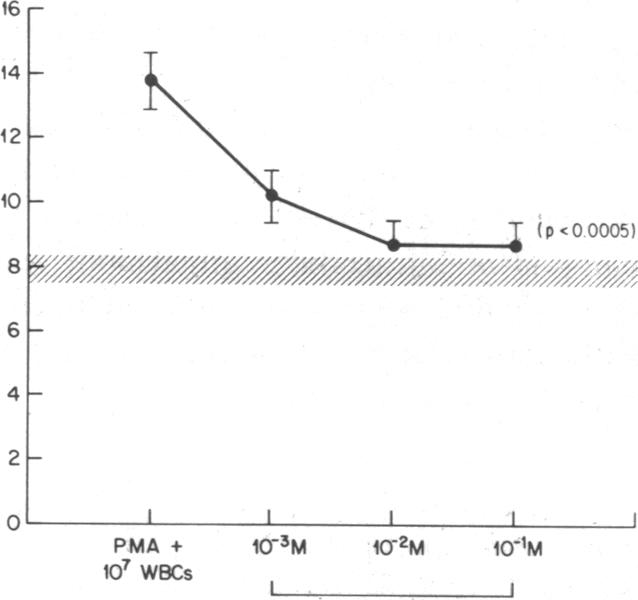
Stimulated human phagocytes produce sister chromatid exchanges in cultured mammalian cells by a mechanism involving oxygen metabolites. Experiments were designed to determine whether antioxidants inhibit this process. Superoxide dismutase, catalase, and hydroxyl radical scavengers (benzoate, mannitol) protected target Chinese hamster ovary cells from phagocyte-induced sister chromatid exchanges, implicating the involvement of hydroxyl radicals in this chromosomal damage. N-acetylcysteine and beta-carotene were also protective. alpha-Tocopherol (greater than 5 microM) protected target cells exposed to phagocytes but not to enzymatically generated oxidants when the vitamin was added just before the source of oxygen radicals, suggesting, as reported by others, that the principal action of tocopherol in this setting was to inhibit the release of oxidants from phagocytes. On the other hand, cultivation of target cells with supplemental tocopherol protected them from the toxic effects of the enzymatic oxidant-producing system, indicating a role for membrane-associated free radicals in the mechanism of sister chromatid exchange induction. Low concentrations of sodium selenite (0.1-1.0 microM) protected the target cells. However, higher concentrations (10 microM) of selenite had no effect on oxidant-induced sister chromatid exchange formation, and 0.1 mM selenite increased the number of exchanges. Sodium selenite concentrations of 0.1 mM also decreased the intracellular glutathione concentration of target cells during an oxidant stress, and reducing target cell glutathione concentrations with buthionine sulfoximine increased their sensitivity to oxygen-related chromosomal damage. Therefore, the potentiation of oxygen radical-induced chromosomal damage observed with high concentrations of selenite may result from a decrease in the thiol antioxidant defense systems within the cell. The findings suggest that the hydroxyl radical has an important role in the production of phagocyte-induced cytogenetic injury, membrane-derived intermediates may be involved, depletion of intracellular glutathione renders cells more susceptible to this injury, and supplementation of target cells with antioxidants can protect them from oxygen radical-generated chromosomal injury.
受刺激的人类吞噬细胞通过一种涉及氧代谢产物的机制在培养的哺乳动物细胞中产生姐妹染色单体交换。设计实验以确定抗氧化剂是否抑制这一过程。超氧化物歧化酶、过氧化氢酶和羟基自由基清除剂(苯甲酸盐、甘露醇)保护靶细胞中国仓鼠卵巢细胞免受吞噬细胞诱导的姐妹染色单体交换,这表明羟基自由基参与了这种染色体损伤。N-乙酰半胱氨酸和β-胡萝卜素也具有保护作用。当维生素α-生育酚在氧自由基来源之前加入时,大于5微摩尔的α-生育酚保护暴露于吞噬细胞的靶细胞,但不保护暴露于酶促产生的氧化剂的靶细胞,正如其他人所报道的,这表明在这种情况下生育酚的主要作用是抑制吞噬细胞释放氧化剂。另一方面,用补充的生育酚培养靶细胞可保护它们免受酶促产生氧化剂系统的毒性作用,这表明膜相关自由基在姐妹染色单体交换诱导机制中起作用。低浓度的亚硒酸钠(0.1 - 1.0微摩尔)保护靶细胞。然而,较高浓度(10微摩尔)的亚硒酸盐对氧化剂诱导的姐妹染色单体交换形成没有影响,而0.1毫摩尔的亚硒酸盐增加了交换的数量。0.1毫摩尔的亚硒酸钠浓度在氧化应激期间也降低了靶细胞的细胞内谷胱甘肽浓度,用丁硫氨酸亚砜胺降低靶细胞谷胱甘肽浓度增加了它们对与氧相关的染色体损伤的敏感性。因此,高浓度亚硒酸盐观察到的氧自由基诱导的染色体损伤增强可能是由于细胞内硫醇抗氧化防御系统的减少。这些发现表明羟基自由基在吞噬细胞诱导的细胞遗传损伤产生中起重要作用,膜衍生的中间体可能参与其中,细胞内谷胱甘肽的消耗使细胞更容易受到这种损伤,用抗氧化剂补充靶细胞可以保护它们免受氧自由基产生的染色体损伤。