Division of Endocrinology, Diabetes, and Metabolism, Rush University, Chicago, IL, United States.
Division of Endocrinology, Metabolism & Lipid Research, Washington University School of Medicine, St. Louis, MO, United States.
BMC Med Educ. 2024 Sep 9;24(1):977. doi: 10.1186/s12909-024-05969-z.
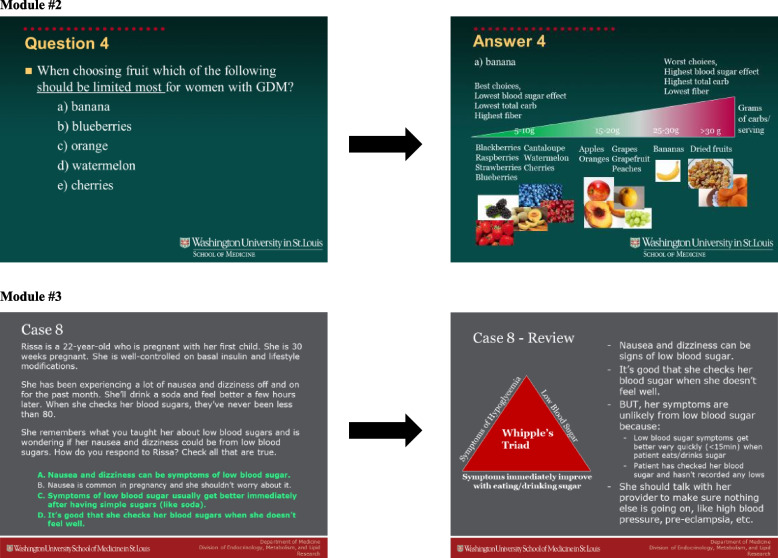
The risk of developing type 2 diabetes mellitus (T2DM) is up to 50% among women with gestational diabetes mellitus (GDM). However, diabetes education during and after pregnancy is limited. To bridge this gap, our team developed four training modules on GDM for nurses and community health workers. This pilot study assesses changes in knowledge, self-efficacy for providing diabetes education, attitudes, and intentions to recommend diabetes prevention before and after training completion.
Interactive online modules were disseminated to clinical staff providing care for women with GDM in the United States. Optional pre- and post-training surveys were conducted to gauge the effectiveness of the modules. GDM knowledge (scoring 0-100) was evaluated with a 23 question assessment with total score and individual module scores reported [(# correct/# total)*100]. Self-efficacy for providing diabetes education (scoring 1-10) was evaluated with a 15-question survey and intention to recommend diabetes prevention (scoring 1-5) was assessed with an 8-item survey. Attitudes were assessed with three subscales of the Diabetes Attitude Scale (scoring 1-5). Changes in scores on each scale before and after training are reported using non-parametric Wilcoxon matched-pair signed rank tests.
Eighty-two individuals completed baseline evaluation and 20 individuals accessed all modules and completed post-training assessments. Among those completing the training, improvement was noted in GDM knowledge [56.5 (16.0) v. 78.3 (22.0), p < 0.001], self-efficacy for providing diabetes education [6.60 (2.73) v. 9.33 (0.87), p < 0.001], attitudes toward the value of tight control [4.07 (0.79) v. 4.43 (0.86), p = 0.003], and intentions to recommend diabetes prevention measures [4.81 (0.63) v. 5.00 (0.00), p = 0.009)].
Completion of our interactive online modules improved knowledge, intention to recommend diabetes prevention, self-efficacy to provide diabetes education, and attitudes toward the value of tight control among individuals caring for women with GDM.
This study was registered at clinicaltrials.gov, identifier: NCT04474795.
患有妊娠糖尿病(GDM)的女性中,有高达 50%的人会发展为 2 型糖尿病(T2DM)。然而,在妊娠期间和妊娠后提供的糖尿病教育是有限的。为了弥补这一差距,我们的团队为护士和社区卫生工作者开发了四个关于 GDM 的培训模块。这项初步研究评估了在培训完成前后,知识、提供糖尿病教育的自我效能、态度以及推荐糖尿病预防的意愿的变化。
互动式在线模块分发给在美国为 GDM 女性提供护理的临床工作人员。进行了可选的培训前后调查,以评估模块的效果。通过 23 个问题评估 GDM 知识(0-100 分),总分数和各个模块分数报告为[(正确数/总数)*100]。通过 15 个问题的调查评估提供糖尿病教育的自我效能(1-10 分),通过 8 个项目的调查评估推荐糖尿病预防的意愿(1-5 分)。使用糖尿病态度量表(Diabetes Attitude Scale)的三个子量表评估态度(1-5 分)。报告培训前后每个量表分数的变化,使用非参数 Wilcoxon 匹配对符号秩检验。
82 人完成了基线评估,20 人访问了所有模块并完成了培训后评估。在完成培训的人员中,GDM 知识[56.5(16.0)v. 78.3(22.0),p<0.001]、提供糖尿病教育的自我效能[6.60(2.73)v. 9.33(0.87),p<0.001]、对严格控制价值的态度[4.07(0.79)v. 4.43(0.86),p=0.003]以及推荐糖尿病预防措施的意愿[4.81(0.63)v. 5.00(0.00),p=0.009]均有改善。
完成我们的互动式在线模块提高了照顾 GDM 女性的个人的知识、推荐糖尿病预防措施的意愿、提供糖尿病教育的自我效能、以及对严格控制价值的态度。
本研究在 clinicaltrials.gov 注册,标识符:NCT04474795。