Department of Nutrition, Dietetics and Food, Faculty of Medicine, Nursing and Health Sciences, Monash University, 264 Ferntree Gully Road, Notting Hill, 3168, Australia.
Victorian Heart Institute, Victoria Heart Hospital, 631 Blackburn Road, Clayton, VIC, 3168, Australia.
Cardiovasc Diabetol. 2024 Sep 9;23(1):332. doi: 10.1186/s12933-024-02428-3.
In populations with chronic disease, skin autofluorescence (SAF), a measure of long-term fluorescent advanced glycation end-products (AGEs) accumulation in body tissues, has been associated with vascular endothelial function, measured using flow-mediated dilation (FMD). The primary aim of this study was to quantify the relationship between endothelial function and tissue accumulation of AGEs in adults from the general population to determine whether SAF could be used as a marker to predict early impairment of the endothelium.
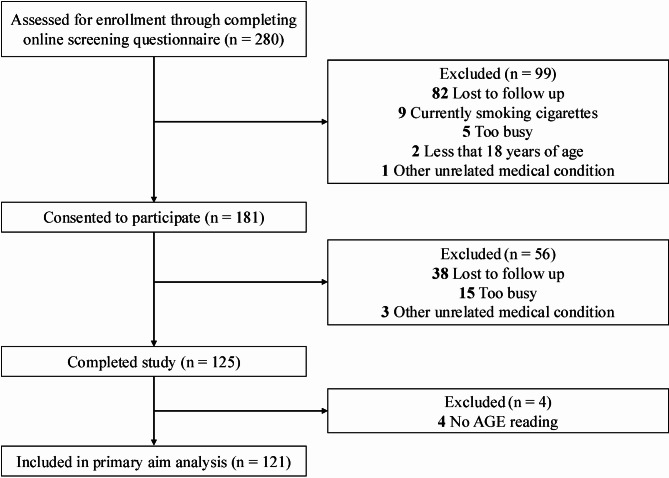
A cross-sectional study was conducted with 125 participants (median age: 28.5 y, IQR: 24.4-36.0; 54% women). Endothelial function was measured by fasting FMD. Skin AGEs were measured as SAF using an AGE Reader. Participant anthropometry, blood pressure, and blood biomarkers were also measured. Associations were evaluated using multivariable regression analysis and were adjusted for significant covariates.
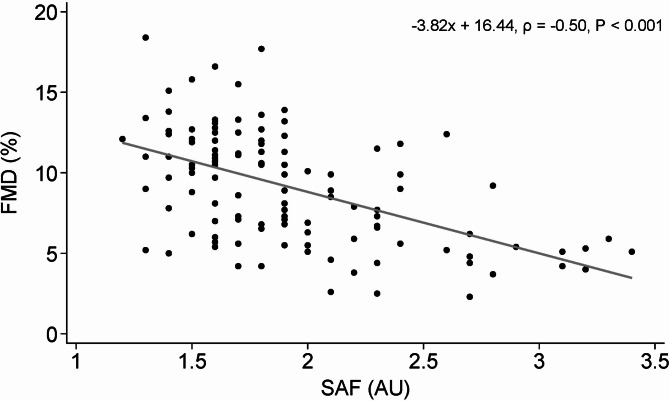
FMD was inversely correlated with SAF (ρ = -0.50, P < 0.001) and chronological age (ρ = -0.51, P < 0.001). In the multivariable analysis, SAF, chronological age, and male sex were independently associated with reduced FMD (B [95% CI]; -2.60 [-4.40, -0.80]; -0.10 [-0.16, -0.03]; 1.40 [0.14, 2.67], respectively), with the multivariable model adjusted R = 0.31, P < 0.001.
Higher skin AGE levels, as measured by SAF, were associated with lower FMD values, in a predominantly young, healthy population. Additionally, older age and male participants exhibited significantly lower FMD values, corresponding with compromised endothelial function. These results suggest that SAF, a simple and inexpensive marker, could be used to predict endothelial impairment before the emergence of any structural artery pathophysiology or classic cardiovascular disease risk markers.
The study was prospectively registered with the Australian New Zealand Clinical Trials Registry (ACTRN12621000821897) and concurrently entered into the WHO International Clinical Trials Registry Platform under the same ID number.
在患有慢性病的人群中,皮肤荧光(SAF)是衡量身体组织中长期荧光性糖基化终产物(AGEs)积累的指标,与使用血流介导扩张(FMD)测量的血管内皮功能有关。本研究的主要目的是量化一般人群中成年人内皮功能与组织 AGEs 积累之间的关系,以确定 SAF 是否可作为预测内皮早期受损的标志物。
对 125 名参与者(中位数年龄:28.5 岁,IQR:24.4-36.0;54%为女性)进行了横断面研究。内皮功能通过空腹 FMD 进行测量。皮肤 AGEs 使用 AGE 阅读器测量为 SAF。还测量了参与者的人体测量学、血压和血液生物标志物。使用多变量回归分析评估相关性,并对显著协变量进行调整。
FMD 与 SAF(ρ=-0.50,P<0.001)和年龄(ρ=-0.51,P<0.001)呈负相关。在多变量分析中,SAF、年龄和男性与 FMD 降低独立相关(B [95%CI];-2.60 [-4.40,-0.80];-0.10 [-0.16,-0.03];1.40 [0.14,2.67]),多变量模型调整 R2=0.31,P<0.001。
在以年轻人为主的健康人群中,SAF 测量的皮肤 AGE 水平越高,FMD 值越低。此外,年龄较大和男性参与者的 FMD 值明显较低,提示内皮功能受损。这些结果表明,SAF 作为一种简单且廉价的标志物,可用于预测内皮损伤,而无需出现任何结构性动脉病理生理学或经典心血管疾病风险标志物。
该研究前瞻性地在澳大利亚和新西兰临床试验注册中心(ACTRN12621000821897)注册,并在世界卫生组织国际临床试验注册平台下以相同的 ID 号同时注册。