Cruz Daniel Luís Viana, Pinto Ana Cristina da Silva, Matos Leonardo Brandão, Silva Junielson Soares da, Meireles Sabrina da Fonseca, Gomes Júnior Plínio Pereira, Chaves Francisco Celio Maia, Guilhon-Simplicio Fernanda, Rafael Míriam Silva
Programa de Genética, Conservação e Biologia Evolutiva/Instituto Nacional de Pesquisas da Amazônia - INPA, Manaus, AM, Brazil.
Faculdade de Ciências Farmacêuticas, Universidade Federal do Amazonas - UFAM, AM, Brazil.
Toxicol Rep. 2024 Aug 13;13:101712. doi: 10.1016/j.toxrep.2024.101712. eCollection 2024 Dec.
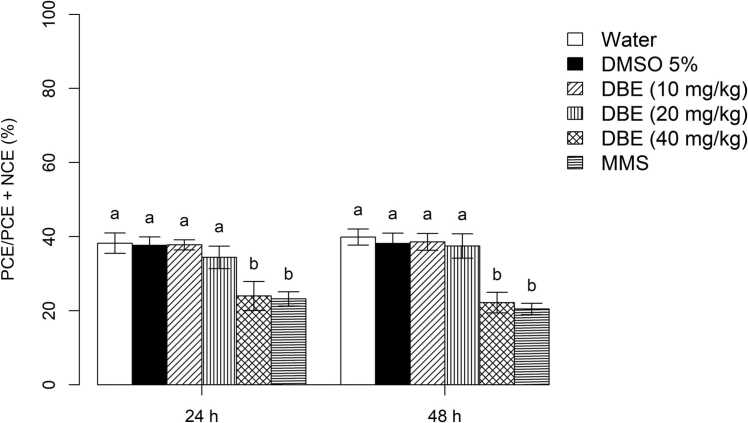
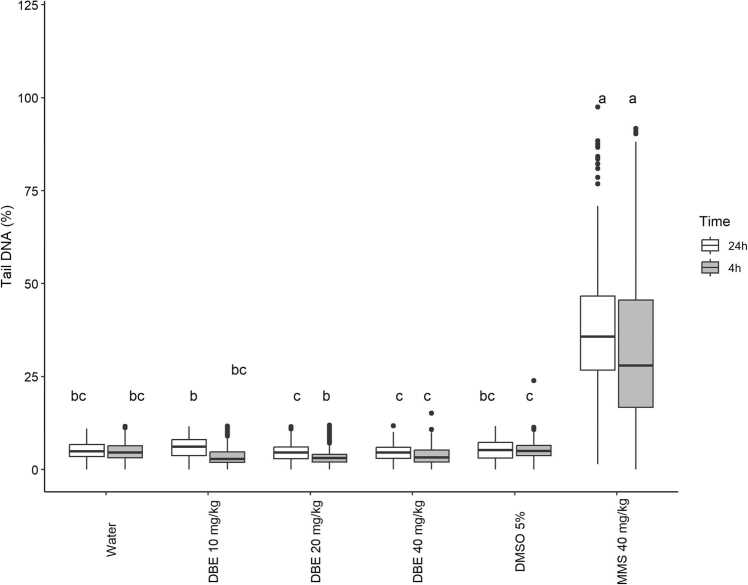
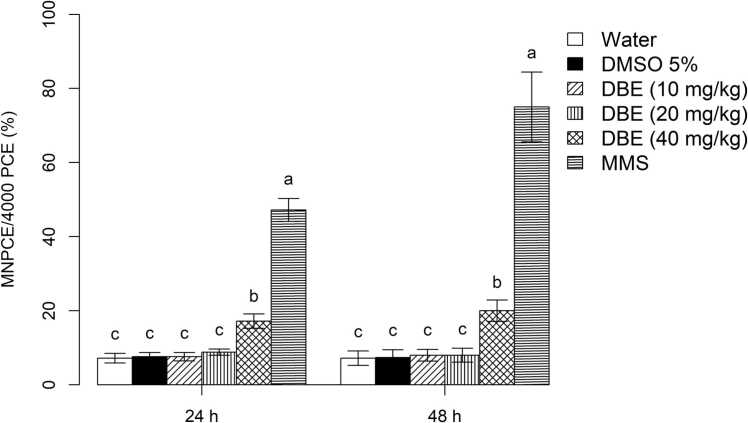
and are vectors of arboviruses and have different levels of resistance to synthetic insecticides, such as the organophosphate temephos, according to their area of occurrence. As an alternative, there are semisynthetic substances with potential insecticidal effect; however, they need to be fully tested by an effective method for the mosquito control. The semi-synthetic dillapiole butyl ether exhibits toxic ovicidal and larvicidal activity in both mosquito species. However, has no proven the mutagenicity and cytotoxicity risks of this larvicide in drinking water effect for consumption by non-target organisms, such as in humans neither in other vertebrates, which access pools of water contain this sprayed substance. In this sense, both of the biomarkers of the genotoxicity, the micronucleus (MN) and comet, using this substance were tested in Balb/C mice to assess the genetic damage and risks of its application as a mitigating measure against . Male specimens (n = 60) were exposed to dillapiole -butyl ether at concentrations of 10, 20 and 40 mg/kg via a comet assay in peripheral blood (n = 30) and a micronucleus test in bone marrow cells (n = 30). The induction of mutagenicity and cytotoxicity of dillapiole -butyl ether in these animals occurred only at a concentration of 40 mg/kg, in multiple treatments. However, dillapiole n-butyl ether at concentrations of 20 and 10 mg/kg has potential for use against in the form of a larvicide in water for consumption by humans and other vertebrates a new vector control measure.
[具体名称1]和[具体名称2]是虫媒病毒的传播媒介,根据它们的发生区域,对合成杀虫剂(如有机磷酸酯类的双硫磷)具有不同程度的抗性。作为替代方案,有一些具有潜在杀虫作用的半合成物质;然而,它们需要通过一种有效的蚊虫控制方法进行全面测试。半合成的莳萝脑丁醚在这两种蚊虫中均表现出有毒的杀卵和杀幼虫活性。然而,对于这种杀幼虫剂在饮用水中对非目标生物(如人类和其他脊椎动物)的致突变性和细胞毒性风险尚未得到证实,这些非目标生物会接触到含有这种喷洒物质的水池。从这个意义上说,使用该物质时,对两种遗传毒性生物标志物——微核(MN)和彗星试验,在Balb/C小鼠中进行了测试,以评估其作为针对[具体名称3]的缓解措施应用时的遗传损伤和风险。雄性样本(n = 60)通过外周血彗星试验(n = 30)和骨髓细胞微核试验(n = 30),以10、20和40mg/kg的浓度暴露于莳萝脑丁醚。莳萝脑丁醚在这些动物中仅在40mg/kg的浓度下经过多次处理才会诱导致突变性和细胞毒性。然而,20和10mg/kg浓度的莳萝脑正丁醚有潜力作为一种杀幼虫剂用于人类和其他脊椎动物饮用的水中,成为一种新的病媒控制措施。