• 文献检索
  • 文档翻译
  • 深度研究
  • 学术资讯
  • Suppr Zotero 插件Zotero 插件
  • 邀请有礼
  • 套餐&价格
  • 历史记录
应用&插件
Suppr Zotero 插件Zotero 插件浏览器插件Mac 客户端Windows 客户端微信小程序
定价
高级版会员购买积分包购买API积分包
服务
文献检索文档翻译深度研究API 文档MCP 服务
关于我们
关于 Suppr公司介绍联系我们用户协议隐私条款
关注我们

Suppr 超能文献

核心技术专利:CN118964589B侵权必究
粤ICP备2023148730 号-1Suppr @ 2026

文献检索

告别复杂PubMed语法,用中文像聊天一样搜索,搜遍4000万医学文献。AI智能推荐,让科研检索更轻松。

立即免费搜索

文件翻译

保留排版,准确专业,支持PDF/Word/PPT等文件格式,支持 12+语言互译。

免费翻译文档

深度研究

AI帮你快速写综述,25分钟生成高质量综述,智能提取关键信息,辅助科研写作。

立即免费体验

开发集成机器学习研究:来自多中心概念验证研究的见解。

Developing an ensemble machine learning study: Insights from a multi-center proof-of-concept study.

机构信息

Laboratorio Biostatistica e Bioinformatica, I.R.C.C.S. Istituto Tumori 'Giovanni Paolo II', Bari, Italy.

Servizio di Fisica Sanitaria, Azienda Ospedaliero-Universitaria di Parma, Parma, Italy.

出版信息

PLoS One. 2024 Sep 10;19(9):e0303217. doi: 10.1371/journal.pone.0303217. eCollection 2024.

DOI:10.1371/journal.pone.0303217
PMID:39255296
原文链接:https://pmc.ncbi.nlm.nih.gov/articles/PMC11386419/
Abstract

BACKGROUND

To address the numerous unmeet clinical needs, in recent years several Machine Learning models applied to medical images and clinical data have been introduced and developed. Even when they achieve encouraging results, they lack evolutionary progression, thus perpetuating their status as autonomous entities. We postulated that different algorithms which have been proposed in the literature to address the same diagnostic task, can be aggregated to enhance classification performance. We suggested a proof of concept to define an ensemble approach useful for integrating different algorithms proposed to solve the same clinical task.

METHODS

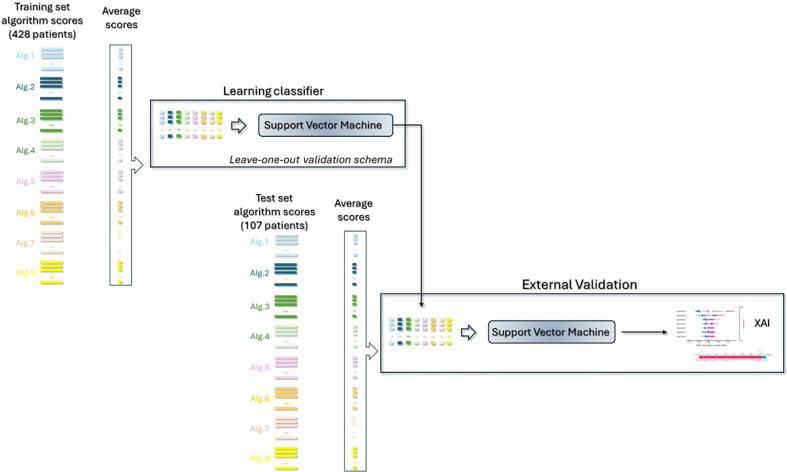
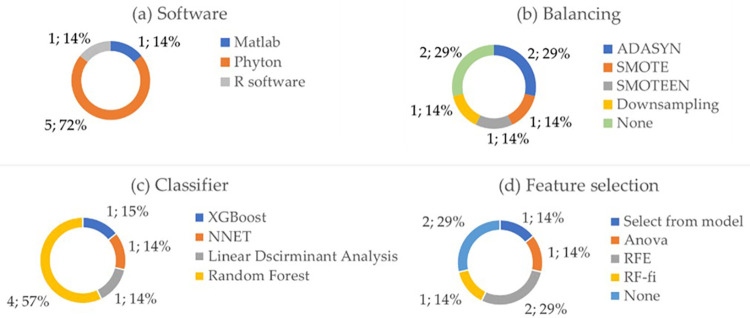
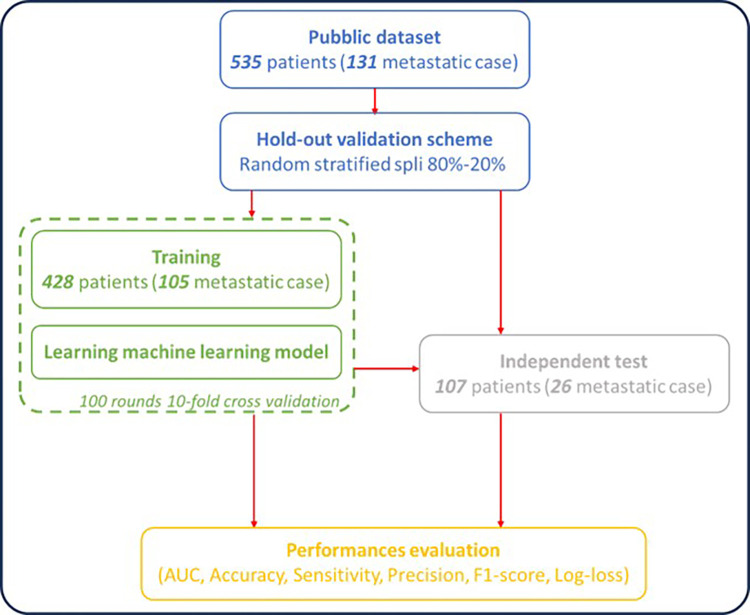
The proposed approach was developed starting from a public database consisting of radiomic features extracted from CT images relating to 535 patients suffering from lung cancer. Seven algorithms were trained independently by participants in the AI4MP working group on Artificial Intelligence of the Italian Association of Physics in Medicine to discriminate metastatic from non-metastatic patients. The classification scores generated by these algorithms are used to train SVM classifier. The Explainable Artificial Intelligence approach is applied to the final model. The ensemble model was validated following an 80-20 hold-out and leave-one-out scheme on the training set.

RESULTS

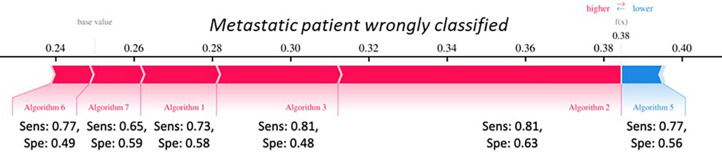
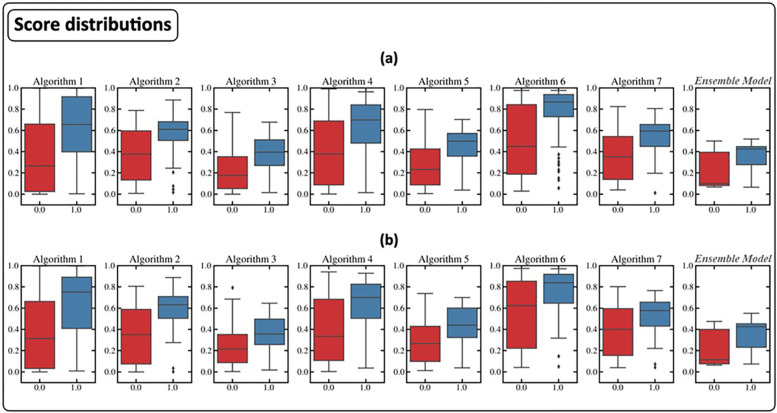
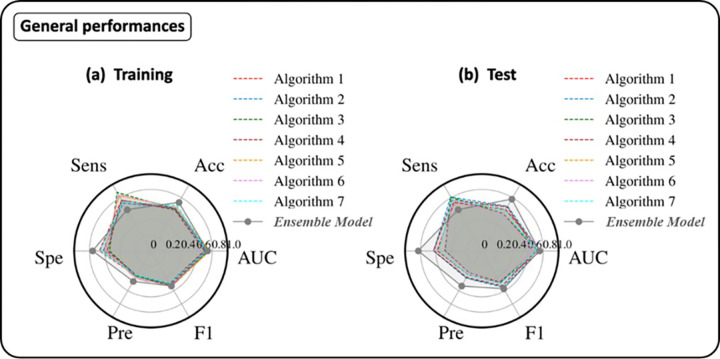
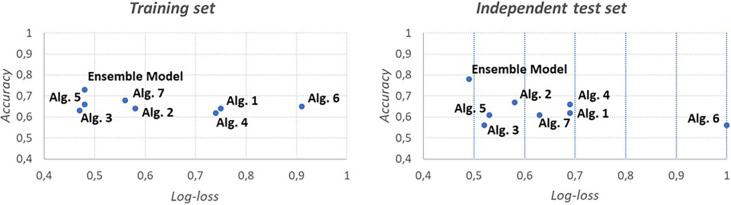
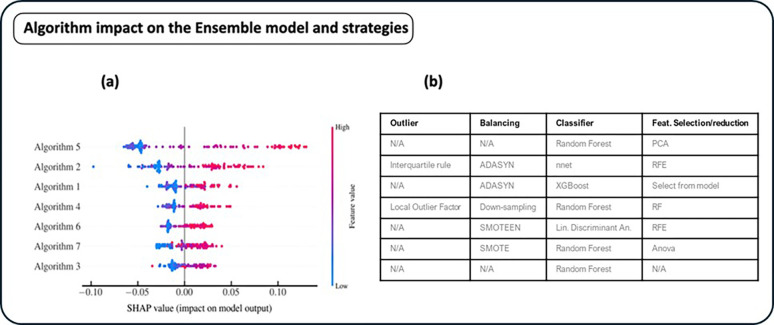
Compared to individual algorithms, a more accurate result was achieved. On the independent test the ensemble model achieved an accuracy of 0.78, a F1-score of 0.57 and a log-loss of 0.49. Shapley values representing the contribution of each algorithm to the final classification result of the ensemble model were calculated. This information represents an added value for the end user useful for evaluating the appropriateness of the classification result on a particular case. It also allows us to evaluate on a global level which methodological approaches of the individual algorithms are likely to have the most impact.

CONCLUSION

Our proposal represents an innovative approach useful for integrating different algorithms that populate the literature and which lays the foundations for future evaluations in broader application scenarios.

摘要

背景

为了满足众多未满足的临床需求,近年来,已经引入和开发了一些应用于医学图像和临床数据的机器学习模型。即使它们取得了令人鼓舞的结果,它们也缺乏进化的进展,因此仍然是自主的实体。我们假设,已经在文献中提出的用于解决相同诊断任务的不同算法,可以被聚合以增强分类性能。我们提出了一个概念验证来定义一种有用的集成方法,用于集成为解决相同临床任务而提出的不同算法。

方法

该方法是从一个公共数据库开始开发的,该数据库由与 535 名肺癌患者相关的 CT 图像提取的放射组学特征组成。七个算法由 AI4MP 工作组的参与者独立训练,以区分转移性和非转移性患者。这些算法生成的分类分数用于训练 SVM 分类器。应用可解释人工智能方法对最终模型进行解释。在训练集上,采用 80-20 分割和留一法对集成模型进行验证。

结果

与单个算法相比,该方法取得了更准确的结果。在独立测试中,集成模型的准确率为 0.78,F1 得分为 0.57,对数损失为 0.49。计算了每个算法对集成模型最终分类结果的贡献的 Shapley 值。这些信息为最终用户提供了一个附加价值,有助于评估特定病例的分类结果的适当性。它还允许我们从全局水平评估个体算法的方法学方法最有可能产生影响的程度。

结论

我们的建议代表了一种有用的创新方法,用于集成文献中存在的不同算法,并为未来在更广泛的应用场景中的评估奠定了基础。
https://cdn.ncbi.nlm.nih.gov/pmc/blobs/90a4/11386419/836a5044c48d/pone.0303217.g010.jpg
https://cdn.ncbi.nlm.nih.gov/pmc/blobs/90a4/11386419/14ec2ab4fb93/pone.0303217.g001.jpg
https://cdn.ncbi.nlm.nih.gov/pmc/blobs/90a4/11386419/15ab0df9022c/pone.0303217.g002.jpg
https://cdn.ncbi.nlm.nih.gov/pmc/blobs/90a4/11386419/a0d6cb6b049b/pone.0303217.g003.jpg
https://cdn.ncbi.nlm.nih.gov/pmc/blobs/90a4/11386419/633086bd0ba5/pone.0303217.g004.jpg
https://cdn.ncbi.nlm.nih.gov/pmc/blobs/90a4/11386419/e131571644e3/pone.0303217.g005.jpg
https://cdn.ncbi.nlm.nih.gov/pmc/blobs/90a4/11386419/586831f115f6/pone.0303217.g006.jpg
https://cdn.ncbi.nlm.nih.gov/pmc/blobs/90a4/11386419/8f37cd0b3058/pone.0303217.g007.jpg
https://cdn.ncbi.nlm.nih.gov/pmc/blobs/90a4/11386419/1ce924a60960/pone.0303217.g008.jpg
https://cdn.ncbi.nlm.nih.gov/pmc/blobs/90a4/11386419/816154552045/pone.0303217.g009.jpg
https://cdn.ncbi.nlm.nih.gov/pmc/blobs/90a4/11386419/836a5044c48d/pone.0303217.g010.jpg
https://cdn.ncbi.nlm.nih.gov/pmc/blobs/90a4/11386419/14ec2ab4fb93/pone.0303217.g001.jpg
https://cdn.ncbi.nlm.nih.gov/pmc/blobs/90a4/11386419/15ab0df9022c/pone.0303217.g002.jpg
https://cdn.ncbi.nlm.nih.gov/pmc/blobs/90a4/11386419/a0d6cb6b049b/pone.0303217.g003.jpg
https://cdn.ncbi.nlm.nih.gov/pmc/blobs/90a4/11386419/633086bd0ba5/pone.0303217.g004.jpg
https://cdn.ncbi.nlm.nih.gov/pmc/blobs/90a4/11386419/e131571644e3/pone.0303217.g005.jpg
https://cdn.ncbi.nlm.nih.gov/pmc/blobs/90a4/11386419/586831f115f6/pone.0303217.g006.jpg
https://cdn.ncbi.nlm.nih.gov/pmc/blobs/90a4/11386419/8f37cd0b3058/pone.0303217.g007.jpg
https://cdn.ncbi.nlm.nih.gov/pmc/blobs/90a4/11386419/1ce924a60960/pone.0303217.g008.jpg
https://cdn.ncbi.nlm.nih.gov/pmc/blobs/90a4/11386419/816154552045/pone.0303217.g009.jpg
https://cdn.ncbi.nlm.nih.gov/pmc/blobs/90a4/11386419/836a5044c48d/pone.0303217.g010.jpg

相似文献

1
Developing an ensemble machine learning study: Insights from a multi-center proof-of-concept study.开发集成机器学习研究:来自多中心概念验证研究的见解。
PLoS One. 2024 Sep 10;19(9):e0303217. doi: 10.1371/journal.pone.0303217. eCollection 2024.
2
Integration of intratumoral and peritumoral CT radiomic features with machine learning algorithms for predicting induction therapy response in locally advanced non-small cell lung cancer.整合瘤内和瘤周CT影像组学特征与机器学习算法以预测局部晚期非小细胞肺癌诱导治疗反应
BMC Cancer. 2025 Mar 13;25(1):461. doi: 10.1186/s12885-025-13804-x.
3
Comparison of an Ensemble of Machine Learning Models and the BERT Language Model for Analysis of Text Descriptions of Brain CT Reports to Determine the Presence of Intracranial Hemorrhage.基于机器学习模型集成与 BERT 语言模型的脑 CT 报告文本描述分析用于判断颅内出血的比较研究
Sovrem Tekhnologii Med. 2024;16(1):27-34. doi: 10.17691/stm2024.16.1.03. Epub 2024 Feb 28.
4
Computer-aided diagnosis of pulmonary nodules using a two-step approach for feature selection and classifier ensemble construction.使用两步特征选择和分类器集成构建方法进行肺结节计算机辅助诊断。
Artif Intell Med. 2010 Sep;50(1):43-53. doi: 10.1016/j.artmed.2010.04.011. Epub 2010 May 31.
5
A hybrid explainable ensemble transformer encoder for pneumonia identification from chest X-ray images.一种用于从胸部 X 光图像中识别肺炎的混合可解释集成式变压器编码器。
J Adv Res. 2023 Jun;48:191-211. doi: 10.1016/j.jare.2022.08.021. Epub 2022 Sep 7.
6
Reproducible Machine Learning Methods for Lung Cancer Detection Using Computed Tomography Images: Algorithm Development and Validation.使用计算机断层扫描图像检测肺癌的可重现机器学习方法:算法开发与验证。
J Med Internet Res. 2020 Aug 5;22(8):e16709. doi: 10.2196/16709.
7
An explainable machine learning model to solid adnexal masses diagnosis based on clinical data and qualitative ultrasound indicators.基于临床数据和定性超声指标的可解释性机器学习模型对附件实性肿块的诊断。
Cancer Med. 2024 Jun;13(12):e7425. doi: 10.1002/cam4.7425.
8
Radiomics feature analysis and model research for predicting histopathological subtypes of non-small cell lung cancer on CT images: A multi-dataset study.基于 CT 图像的非小细胞肺癌组织病理亚型预测的影像组学特征分析及模型研究:多数据集研究
Med Phys. 2023 Jul;50(7):4351-4365. doi: 10.1002/mp.16233. Epub 2023 Feb 1.
9
Establishment and validation of an interactive artificial intelligence platform to predict postoperative ambulatory status for patients with metastatic spinal disease: a multicenter analysis.建立和验证交互式人工智能平台,以预测转移性脊柱疾病患者的术后活动状态:一项多中心分析。
Int J Surg. 2024 May 1;110(5):2738-2756. doi: 10.1097/JS9.0000000000001169.
10
Using machine learning to develop a stacking ensemble learning model for the CT radiomics classification of brain metastases.利用机器学习开发用于脑转移瘤 CT 放射组学分类的堆叠集成学习模型。
Sci Rep. 2024 Nov 19;14(1):28575. doi: 10.1038/s41598-024-80210-x.

引用本文的文献

1
Gender Medicine in Computed Tomography Radiomics Analysis to Predict Disease Progression in Liver Respectable Colorectal Cancer Patients.计算机断层扫描影像组学分析中的性别医学用于预测可切除性肝癌患者的疾病进展
Cancer Med. 2025 Sep;14(17):e70991. doi: 10.1002/cam4.70991.

本文引用的文献

1
An Explainable Artificial Intelligence Model Proposed for the Prediction of Myalgic Encephalomyelitis/Chronic Fatigue Syndrome and the Identification of Distinctive Metabolites.一种用于预测肌痛性脑脊髓炎/慢性疲劳综合征及识别特征性代谢物的可解释人工智能模型
Diagnostics (Basel). 2023 Nov 21;13(23):3495. doi: 10.3390/diagnostics13233495.
2
Explainable artificial intelligence (XAI) in radiology and nuclear medicine: a literature review.放射学和核医学中的可解释人工智能(XAI):文献综述
Front Med (Lausanne). 2023 May 12;10:1180773. doi: 10.3389/fmed.2023.1180773. eCollection 2023.
3
A Hybrid Algorithm of ML and XAI to Prevent Breast Cancer: A Strategy to Support Decision Making.
一种用于预防乳腺癌的机器学习与可解释人工智能混合算法:一种支持决策的策略
Cancers (Basel). 2023 Apr 25;15(9):2443. doi: 10.3390/cancers15092443.
4
Analyzing breast cancer invasive disease event classification through explainable artificial intelligence.通过可解释人工智能分析乳腺癌浸润性疾病事件分类
Front Med (Lausanne). 2023 Feb 2;10:1116354. doi: 10.3389/fmed.2023.1116354. eCollection 2023.
5
Artificial intelligence in cancer research and precision medicine: Applications, limitations and priorities to drive transformation in the delivery of equitable and unbiased care.癌症研究与精准医学中的人工智能:推动公平且无偏见医疗服务变革的应用、局限性与优先事项。
Cancer Treat Rev. 2023 Jan;112:102498. doi: 10.1016/j.ctrv.2022.102498. Epub 2022 Dec 11.
6
A machine learning ensemble approach for 5- and 10-year breast cancer invasive disease event classification.机器学习集成方法用于 5 年和 10 年乳腺癌浸润性疾病事件分类。
PLoS One. 2022 Sep 19;17(9):e0274691. doi: 10.1371/journal.pone.0274691. eCollection 2022.
7
Breast Tumor Classification Using an Ensemble Machine Learning Method.基于集成机器学习方法的乳腺肿瘤分类
J Imaging. 2020 May 29;6(6):39. doi: 10.3390/jimaging6060039.
8
Artificial intelligence applications in medical imaging: A review of the medical physics research in Italy.人工智能在医学影像中的应用:意大利医学物理学研究综述。
Phys Med. 2021 Mar;83:221-241. doi: 10.1016/j.ejmp.2021.04.010. Epub 2021 May 2.
9
A Clinical Decision Support System for Predicting Invasive Breast Cancer Recurrence: Preliminary Results.一种用于预测浸润性乳腺癌复发的临床决策支持系统:初步结果。
Front Oncol. 2021 Mar 11;11:576007. doi: 10.3389/fonc.2021.576007. eCollection 2021.
10
XAI-Explainable artificial intelligence.可解释人工智能
Sci Robot. 2019 Dec 18;4(37). doi: 10.1126/scirobotics.aay7120.