Yagin Fatma Hilal, Alkhateeb Abedalrhman, Raza Ali, Samee Nagwan Abdel, Mahmoud Noha F, Colak Cemil, Yagin Burak
Department of Biostatistics and Medical Informatics, Faculty of Medicine, Inonu University, Malatya 44280, Türkiye.
Computer Science Department, Lakehead University, Thunder Bay, ON P7B 5E1, Canada.
Diagnostics (Basel). 2023 Nov 21;13(23):3495. doi: 10.3390/diagnostics13233495.
Myalgic encephalomyelitis/chronic fatigue syndrome (ME/CFS) is a complex and debilitating illness with a significant global prevalence, affecting over 65 million individuals. It affects various systems, including the immune, neurological, gastrointestinal, and circulatory systems. Studies have shown abnormalities in immune cell types, increased inflammatory cytokines, and brain abnormalities. Further research is needed to identify consistent biomarkers and develop targeted therapies. This study uses explainable artificial intelligence and machine learning techniques to identify discriminative metabolites for ME/CFS.
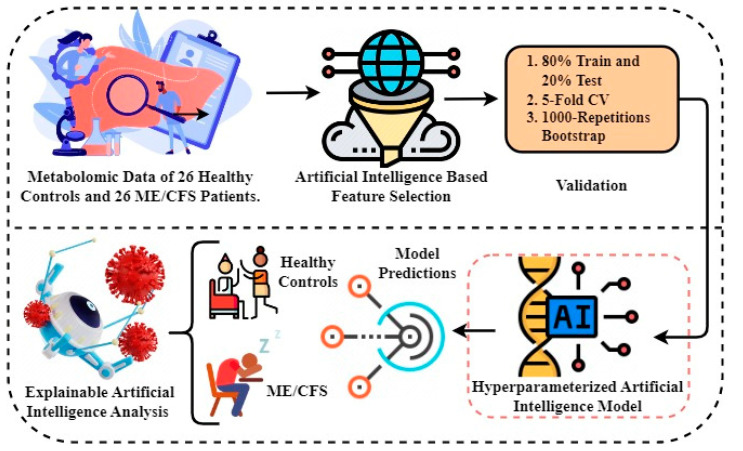
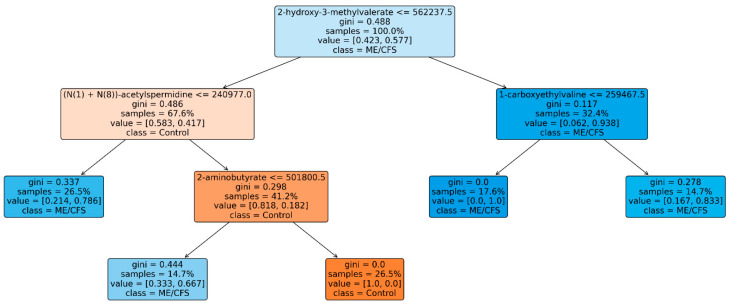
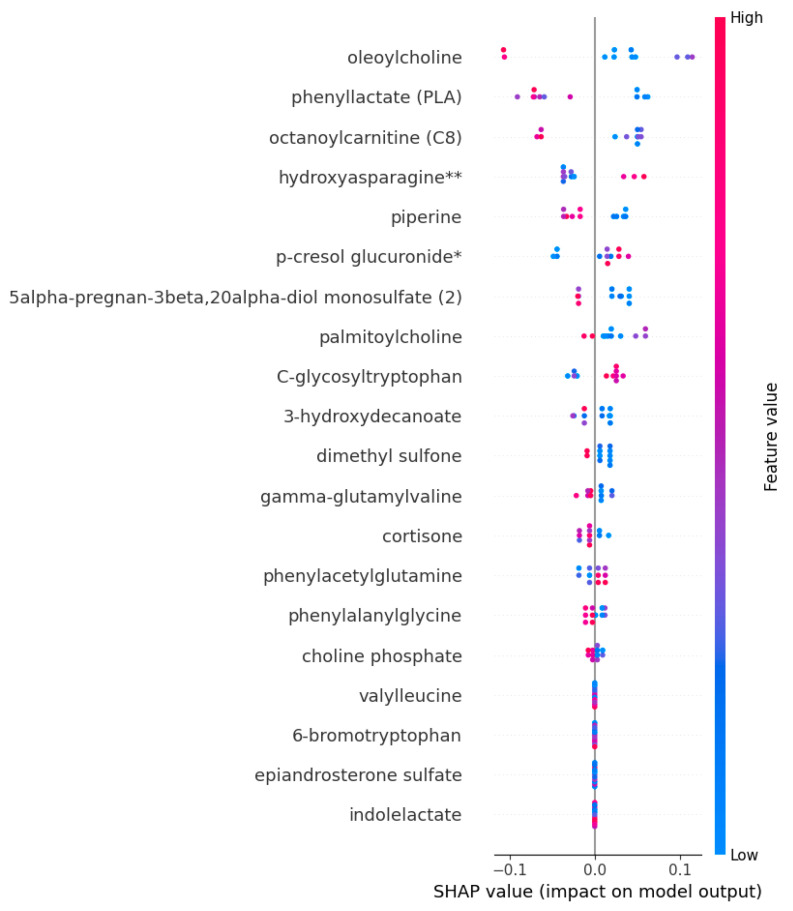
The model investigates a metabolomics dataset of CFS patients and healthy controls, including 26 healthy controls and 26 ME/CFS patients aged 22-72. The dataset encapsulated 768 metabolites into nine metabolic super-pathways: amino acids, carbohydrates, cofactors, vitamins, energy, lipids, nucleotides, peptides, and xenobiotics. Random forest methods together with other classifiers were applied to the data to classify individuals as ME/CFS patients and healthy individuals. The classification learning algorithms' performance in the validation step was evaluated using a variety of methods, including the traditional hold-out validation method, as well as the more modern cross-validation and bootstrap methods. Explainable artificial intelligence approaches were applied to clinically explain the optimum model's prediction decisions.
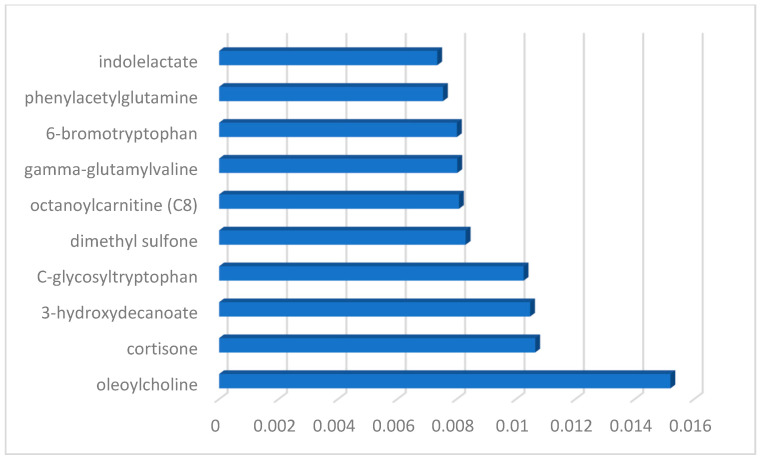
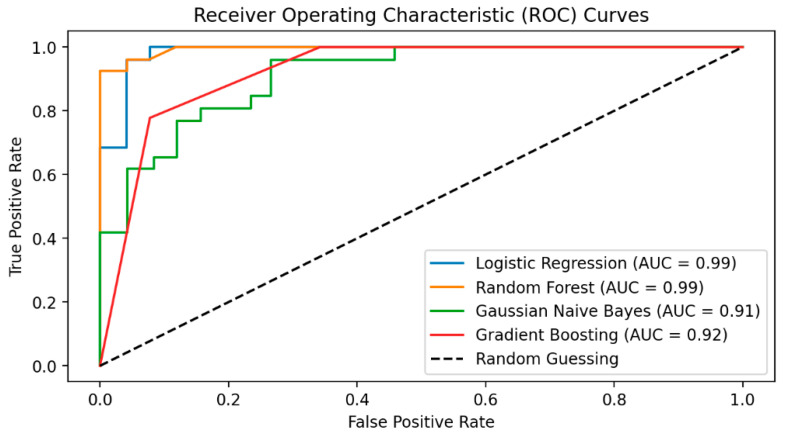
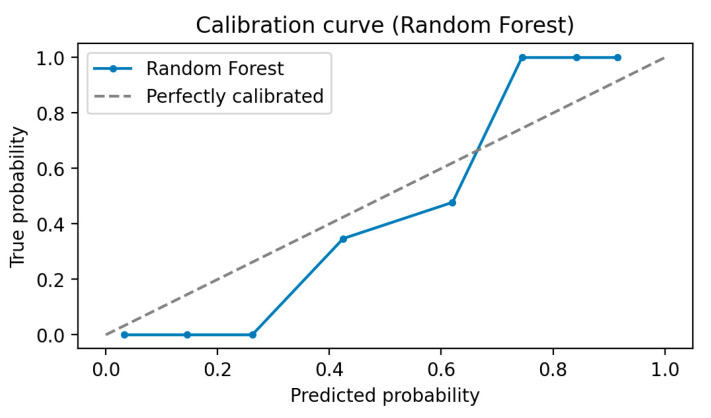
The metabolomics of C-glycosyltryptophan, oleoylcholine, cortisone, and 3-hydroxydecanoate were determined to be crucial for ME/CFS diagnosis. The random forest model outperformed the other classifiers in ME/CFS prediction using the 1000-iteration bootstrapping method, achieving 98% accuracy, precision, recall, F1 score, 0.01 Brier score, and 99% AUC. According to the obtained results, the bootstrap validation approach demonstrated the highest classification outcomes.
The proposed model accurately classifies ME/CFS patients based on the selected biomarker candidate metabolites. It offers a clear interpretation of risk estimation for ME/CFS, aiding physicians in comprehending the significance of key metabolomic features within the model.
肌痛性脑脊髓炎/慢性疲劳综合征(ME/CFS)是一种复杂且使人衰弱的疾病,在全球具有显著的患病率,影响超过6500万人。它会影响包括免疫、神经、胃肠和循环系统在内的多个系统。研究表明免疫细胞类型存在异常、炎性细胞因子增加以及脑部异常。需要进一步研究以确定一致的生物标志物并开发靶向治疗方法。本研究使用可解释人工智能和机器学习技术来识别ME/CFS的判别性代谢物。
该模型研究了CFS患者和健康对照的代谢组学数据集,包括26名健康对照和26名年龄在22至72岁之间的ME/CFS患者。该数据集将768种代谢物封装到九个代谢超级途径中:氨基酸、碳水化合物、辅因子、维生素、能量、脂质、核苷酸、肽和外源性物质。将随机森林方法与其他分类器应用于数据,以将个体分类为ME/CFS患者和健康个体。在验证步骤中,使用多种方法评估分类学习算法的性能,包括传统的留出验证方法以及更现代的交叉验证和自助法。应用可解释人工智能方法从临床上解释最佳模型的预测决策。
确定C-糖基色氨酸、油酰胆碱、可的松和3-羟基癸酸的代谢组学对ME/CFS诊断至关重要。使用1000次迭代自助法,随机森林模型在ME/CFS预测方面优于其他分类器,准确率、精确率、召回率、F1分数达到98%,布里尔分数为0.01,曲线下面积为99%。根据所得结果,自助验证方法显示出最高的分类结果。
所提出的模型基于选定的生物标志物候选代谢物准确地对ME/CFS患者进行分类。它为ME/CFS的风险估计提供了清晰的解释,有助于医生理解模型中关键代谢组学特征的重要性。