Energy Materials Program, Institute of Basic and Applied Sciences, Egypt-Japan University of Science and Technology, New Borg El-Arab City, Alexandria, 21934, Egypt.
PharmD Program, Egypt-Japan University of Science and Technology, New Borg El-Arab 21934, Alexandria, Egypt.
Sci Rep. 2024 Sep 10;14(1):21144. doi: 10.1038/s41598-024-70844-2.
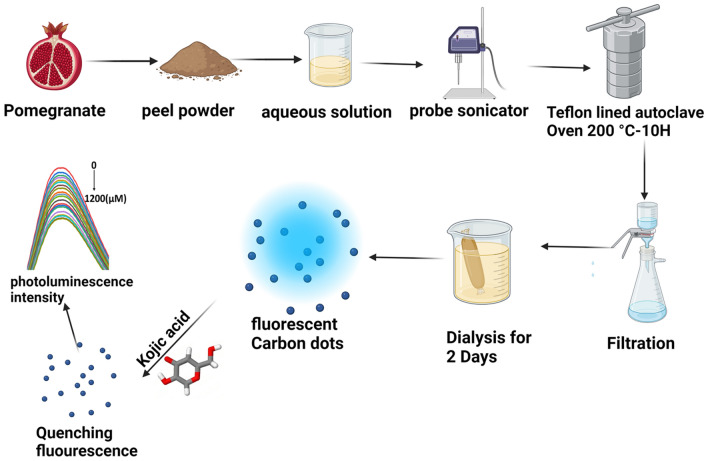
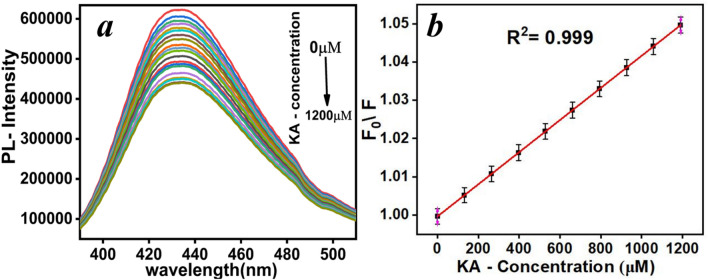
Kojic acid (KA) has gained significant attention due to its widespread use in the food and cosmetics industries. However, concerns about its potential carcinogenic effects have heightened the need for sensitive detection methods. This study introduces a fluorescence-based optical sensor for the quantification of KA in food samples, utilizing fluorescent carbon dots (CDs) synthesized from pomegranate peel via a hydrothermal method. The Stern-Volmer plot demonstrated a linear response for KA in the range of 120 to 1200 µM, with a Pearson correlation coefficient (r) of 0.9999 and. The sensor exhibited a detection limit of 30 ± 0.04 µM and a limit of quantification (LOQ) of 90 ± 0.14 µM. Application of the developed method to soy sauce and vinegar samples yielded accurate KA determinations, with recoveries of 103.11 ± 0.96% and 104.45 ± 2.15%, respectively. These findings highlight the potential of the proposed sensor for practical applications in food quality and safety assessment, offering valuable insights into the presence of KA in food products.
由于其在食品和化妆品行业的广泛应用,曲酸(KA)受到了极大的关注。然而,由于其潜在的致癌作用,人们对其产生了担忧,这就需要更灵敏的检测方法。本研究介绍了一种基于荧光的光学传感器,用于检测食品样品中的 KA,该传感器利用石榴皮通过水热法合成的荧光碳点(CDs)。Stern-Volmer 图显示,KA 在 120 到 1200 μM 的范围内呈现出线性响应,皮尔逊相关系数(r)为 0.9999。该传感器的检测限为 30±0.04 μM,定量限(LOQ)为 90±0.14 μM。将所开发的方法应用于酱油和醋样品中,得到了准确的 KA 测定结果,回收率分别为 103.11±0.96%和 104.45±2.15%。这些发现突出了所提出的传感器在食品质量和安全评估中的实际应用潜力,为食品中 KA 的存在提供了有价值的见解。