
臭氧自体血疗法治疗创伤性脑损伤后心肌损伤的疗效。
Efficacy of ozonated autohemotherapy for improvement of myocardial injury following traumatic brain injury.
机构信息
Department of Anesthesiology, Central Hospital of Wuhan, Huazhong University of Science and Technology, Wuhan, 430000, Hubei Province, China.
Department of Anesthesiology, Changzhou No.2 People's Hospital, Nanjing Medical University, Changzhou, 213000, Jiangsu Province, China.
出版信息
BMC Anesthesiol. 2024 Sep 11;24(1):324. doi: 10.1186/s12871-024-02684-6.
BACKGROUND
Traumatic brain injury is a kind of injury caused by external violence on the head. Its danger is not limited to life rescue in the early stage of the disease. Moreover, the subsequent inflammatory reaction and the change in its oxidative stress level will cause secondary myocardial injury. The purpose of this study is to explore the myocardial protective effect of ozone autohemotherapy (OA) in the progression of acute traumatic brain injury (TBI).
METHODS
Forty patients with acute TBI were recruited and divided into The treatment group (Group OA, n = 18) and the Control group (Group C, n = 19). Patients in Group OA received OA before surgery and on the 1st and 2nd postoperative days, while patients in Group C underwent autologous blood transfusion. Venous blood was collected from all patients before (T0) and after 7 days (T1) days of surgery for measurement of cardiac troponin T (cTnT) and amino-terminal pro-B-type natriuretic peptide (NT-proBNP). At T0 and T1, transthoracic cardiac ultrasound was performed to measure left ventricular ejection fraction (LVEF), tricuspid annular plane systolic excursion (TAPSE), and venous blood was sampled to determine the contents of superoxide dismutase (SOD) and malondialdehyde (MDA). NIH Stroke Scale (NIHSS) and Glasgow Coma Scale (GCS) scores were calculated, and other clinical indexes were recorded.
RESULTS
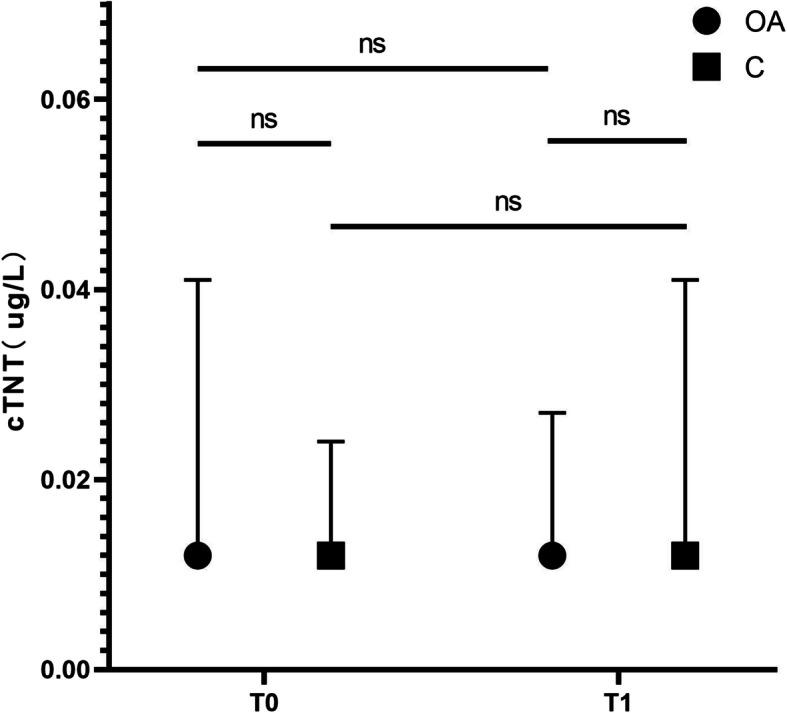
(1) The levels of cTnT at T1 were significantly higher as compared with that at T0 in both groups (p < 0.01). Compared with Group C, a remarkable decline in the content of NT-proBNP was found in Group OA at T1 (p = 0.021). (2) The LVEF (p = 0.002) and serum SOD (p = 0.015) at T1 were significantly increased in Group OA as compared with those in Group C. (3) The length of Intensive Care Unit and hospitalization time for patients in Group OA was distinctly shorter than that for patients in Group C (p = 0.021, p = 0.015, respectively).
CONCLUSION
Perioperative OA treatment can alleviate the secondary myocardial injury during the disease course of TBI, which might be associated with its myocardial protective effect against oxidative stress.
TRIAL REGISTRATION
This study was approved by the Ethical Committee of Changzhou NO.2 People's Hospital. The protocol was registered prospectively with the Chinese Clinical Trial Registry (ChiCTR2000029612) on February 02, 2020.
背景
创伤性脑损伤是一种由头部外力引起的损伤。其危险不仅限于疾病早期的生命抢救,而且随后的炎症反应和氧化应激水平的变化会导致继发性心肌损伤。本研究旨在探讨臭氧自体血疗法(OA)在急性创伤性脑损伤(TBI)进展中的心肌保护作用。
方法
招募 40 名急性 TBI 患者,分为治疗组(OA 组,n=18)和对照组(C 组,n=19)。OA 组患者在术前及术后第 1、2 天接受 OA 治疗,C 组患者接受自体血输血。所有患者分别于术前(T0)和术后 7 天(T1)采集静脉血,检测肌钙蛋白 T(cTnT)和氨基末端 B 型利钠肽前体(NT-proBNP)。于 T0 和 T1 时行经胸超声心动图测量左心室射血分数(LVEF)、三尖瓣环平面收缩期位移(TAPSE),并采集静脉血检测超氧化物歧化酶(SOD)和丙二醛(MDA)含量。计算 NIH 卒中量表(NIHSS)和格拉斯哥昏迷量表(GCS)评分,并记录其他临床指标。
结果
(1)两组 T1 时 cTnT 水平均明显高于 T0(p<0.01)。与 C 组相比,OA 组 T1 时 NT-proBNP 含量明显下降(p=0.021)。(2)与 C 组相比,OA 组 T1 时 LVEF(p=0.002)和血清 SOD(p=0.015)明显升高。(3)OA 组患者的 ICU 时间和住院时间明显短于 C 组(p=0.021,p=0.015)。
结论
围手术期 OA 治疗可减轻 TBI 病程中的继发性心肌损伤,这可能与其对氧化应激的心肌保护作用有关。
试验注册
本研究经常州市第二人民医院伦理委员会批准。该方案于 2020 年 2 月 2 日在中国临床试验注册中心(ChiCTR2000029612)进行了前瞻性注册。




 Zotero 插件