Jeong Gangwon, Li Fu, Mitcham Trevor M, Villa Umberto, Duric Nebojsa, Anastasio Mark A
IEEE Trans Ultrason Ferroelectr Freq Control. 2024 Nov;71(11):1358-1376. doi: 10.1109/TUFFC.2024.3459391. Epub 2024 Nov 27.
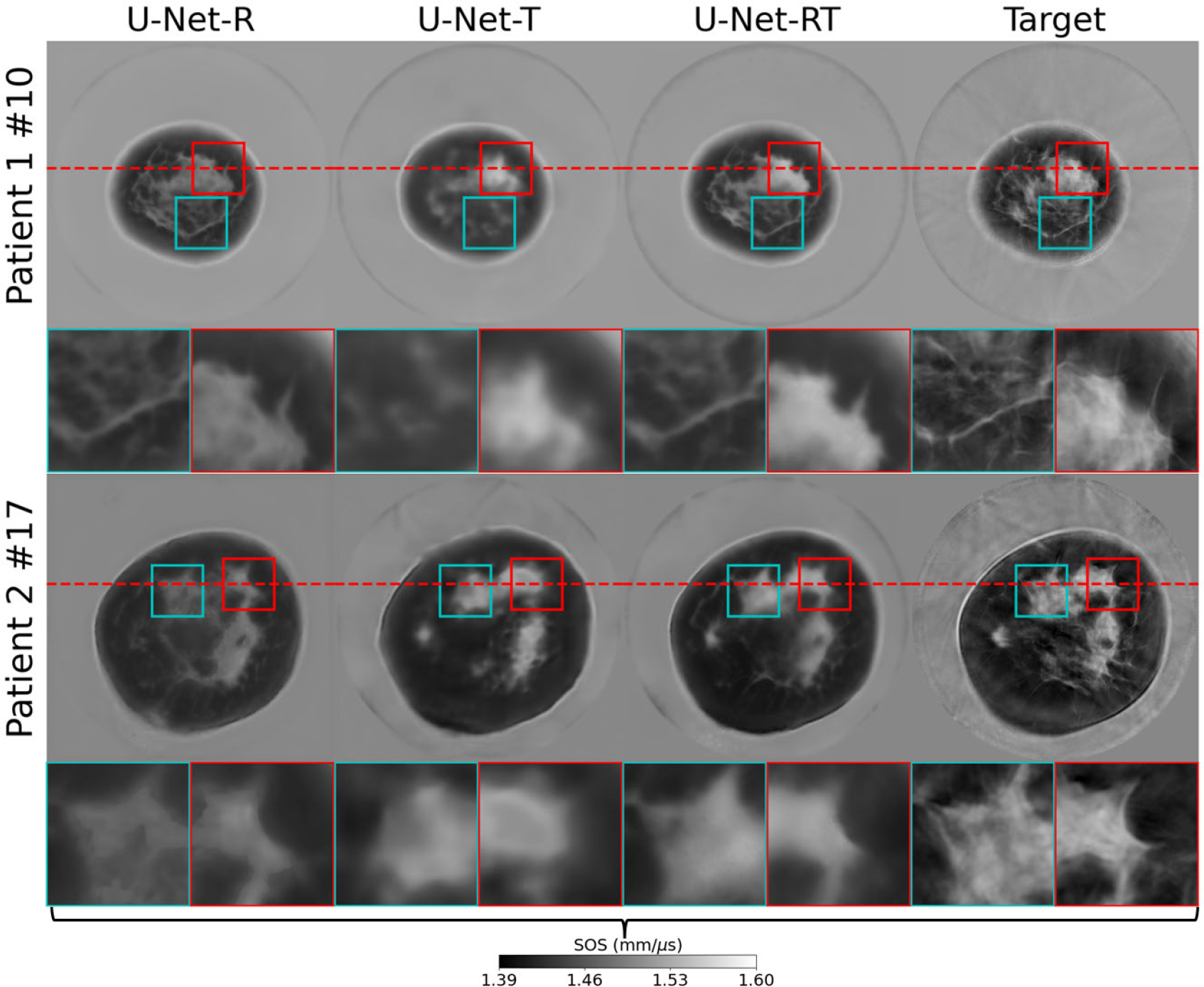
Ultrasound computed tomography (USCT) quantifies acoustic tissue properties such as the speed-of-sound (SOS). Although full-waveform inversion (FWI) is an effective method for accurate SOS reconstruction, it can be computationally challenging for large-scale problems. Deep learning-based image-to-image learned reconstruction (IILR) methods can offer computationally efficient alternatives. This study investigates the impact of the chosen input modalities on IILR methods for high-resolution SOS reconstruction in USCT. The selected modalities are traveltime tomography (TT) and reflection tomography (RT), which produce a low-resolution SOS map and a reflectivity map, respectively. These modalities have been chosen for their lower computational cost relative to FWI and their capacity to provide complementary information: TT offers a direct SOS measure, while RT reveals tissue boundary information. Systematic analyses were facilitated by employing a virtual USCT imaging system with anatomically realistic numerical breast phantoms (NBPs). Within this testbed, a supervised convolutional neural network (CNN) was trained to map dual-channel (TT and RT images) to a high-resolution SOS map. Single-input CNNs were trained separately using inputs from each modality alone (TT or RT) for comparison. The accuracy of the methods was systematically assessed using normalized root-mean-squared error (NRMSE), structural similarity index measure (SSIM), and peak signal-to-noise ratio (PSNR). For tumor detection performance, receiver operating characteristic (ROC) analysis was employed. The dual-channel IILR method was also tested on clinical human breast data. Ensemble average of the NRMSE, SSIM, and PSNR evaluated on this clinical dataset was 0.2355, 0.8845, and 28.33 dB, respectively.
超声计算机断层扫描(USCT)可对声速(SOS)等声学组织特性进行量化。尽管全波形反演(FWI)是一种精确重建SOS的有效方法,但对于大规模问题,其计算量可能很大。基于深度学习的图像到图像学习重建(IILR)方法可提供计算效率更高的替代方案。本研究调查了所选输入模态对USCT中高分辨率SOS重建的IILR方法的影响。所选模态为走时层析成像(TT)和反射层析成像(RT),它们分别生成低分辨率SOS图和反射率图。选择这些模态是因为它们相对于FWI计算成本较低,且能够提供互补信息:TT提供直接的SOS测量值,而RT揭示组织边界信息。通过使用具有解剖学逼真数值乳腺模型(NBP)的虚拟USCT成像系统,便于进行系统分析。在这个测试平台内,训练了一个监督卷积神经网络(CNN),以将双通道(TT和RT图像)映射到高分辨率SOS图。单独使用每个模态(TT或RT)的输入分别训练单输入CNN进行比较。使用归一化均方根误差(NRMSE)、结构相似性指数测量(SSIM)和峰值信噪比(PSNR)系统地评估这些方法的准确性。对于肿瘤检测性能,采用了接收者操作特征(ROC)分析。双通道IILR方法也在临床人体乳腺数据上进行了测试。在此临床数据集上评估的NRMSE、SSIM和PSNR的总体平均值分别为0.2355、0.8845和28.33 dB。