Department of Gastroenterology and Hepatology, Kindai University Faculty of Medicine, Osaka-Sayama, Osaka, Japan.
Laboratory for Immunological Memory, RIKEN IMS Center for Integrative Medical Science, Yokohama, Japan.
JCI Insight. 2024 Sep 12;9(20):e167910. doi: 10.1172/jci.insight.167910.
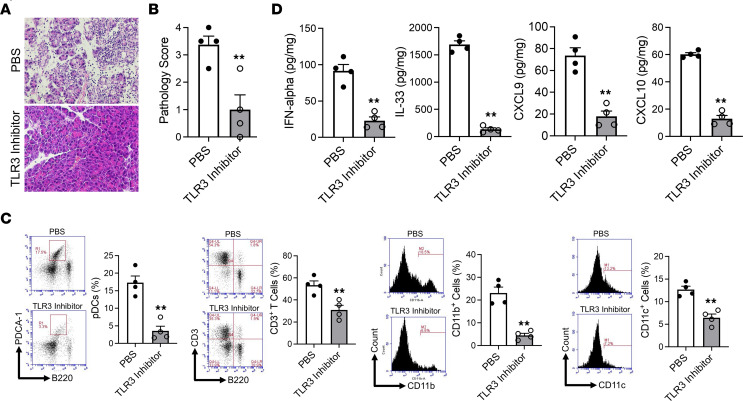
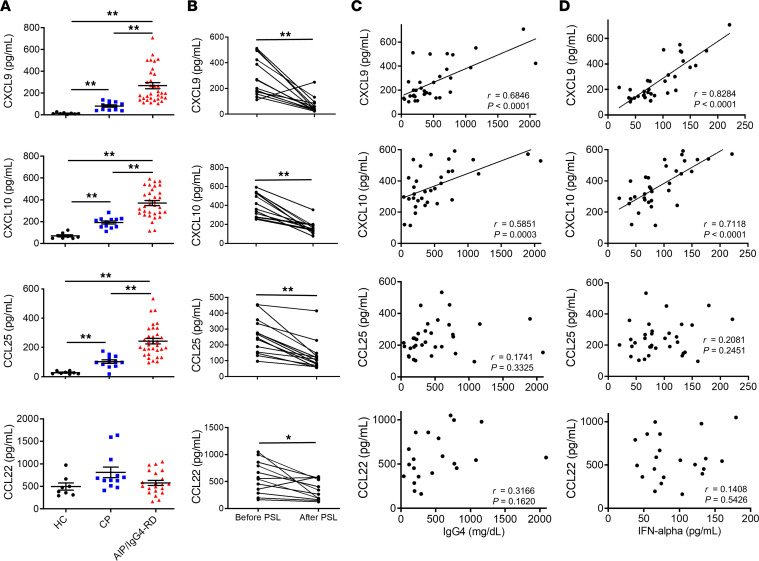
The pathogenesis of the murine model of autoimmune pancreatitis associated with IgG4-related disease (AIP/IgG4-RD) induced by administration of polyinosinic-polycytidylic acid (poly[I:C]) is incompletely understood. While it is known that murine and human AIP/IgG4-RD is driven by plasmacytoid dendritic cells (pDCs) producing IFN-α, the origin of these cells and their relation to effector T cells is not known. Here, we show that murine AIP was initiated by TLR3-bearing conventional DCs in the uninflamed pancreas whose activation by the TLR3 ligand poly(I:C) caused IFN-α, CXCL9, and CXCL10 secretion. This, in turn, induced pancreatic recruitment of CXCR3+ T cells and these T cells, via their secretion of CCL25, facilitated migration of pDCs bearing CCR9 into the pancreas. This established a feedback loop anchored by the now dominant pDC production of IFN-α and the continued CXCR3+ T cell facilitation of pDC migration. Remarkably, the interaction between CXCR3+ T cells and pDCs also existed at the functional level since this interaction enhanced the production of CCL25 and IFN-α by CXCR3+ T cells and pDCs, respectively. Evidence presented here that a similar disease mechanism was present in human AIP/IgG4-RD creates new avenues of disease treatment.
自身免疫性胰腺炎伴 IgG4 相关疾病(AIP/IgG4-RD)的鼠模型的发病机制,是由多聚肌苷酸多聚胞苷酸(poly[I:C])给药诱导的,目前尚未完全了解。虽然已知鼠类和人类的 AIP/IgG4-RD 是由产生 IFN-α 的浆细胞样树突状细胞(pDCs)驱动的,但这些细胞的起源及其与效应 T 细胞的关系尚不清楚。在这里,我们显示鼠类 AIP 是由未发炎胰腺中的 TLR3 携带的常规 DC 启动的,其 TLR3 配体 poly(I:C)的激活导致 IFN-α、CXCL9 和 CXCL10 的分泌。反过来,这诱导了 CXCR3+T 细胞向胰腺募集,这些 T 细胞通过分泌 CCL25,促进了携带 CCR9 的 pDC 向胰腺的迁移。这建立了一个由现在占主导地位的 pDC 产生 IFN-α和持续的 CXCR3+T 细胞促进 pDC 迁移所锚定的反馈回路。值得注意的是,CXCR3+T 细胞和 pDCs 之间的相互作用也存在于功能水平上,因为这种相互作用分别增强了 CXCR3+T 细胞和 pDCs 产生 CCL25 和 IFN-α的能力。本文提供的证据表明,在人类 AIP/IgG4-RD 中存在类似的疾病机制,为疾病治疗开辟了新的途径。