Baur David, Bieck Richard, Berger Johann, Schöfer Patrick, Stelzner Tim, Neumann Juliane, Neumuth Thomas, Heyde Christoph-E, Voelker Anna
Department for Orthopedics, Trauma and Plastic Surgery, University Hospital Leipzig, Liebigstraße 20, 04103, Leipzig, Germany.
Innovation Center Computer Assisted Surgery (ICCAS), Universität Leipzig, Leipzig, Germany.
J Imaging Inform Med. 2025 Apr;38(2):979-987. doi: 10.1007/s10278-024-01251-2. Epub 2024 Sep 12.
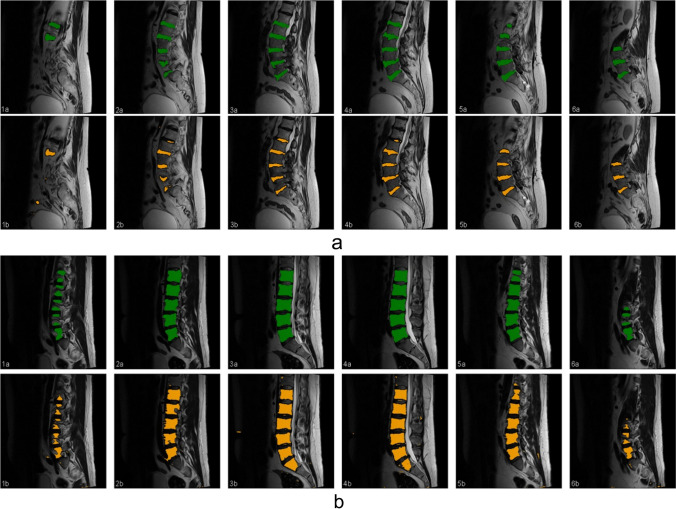
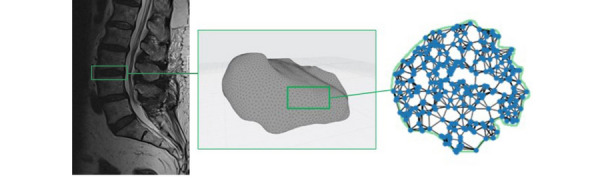
This study aimed to develop a graph neural network (GNN) for automated three-dimensional (3D) magnetic resonance imaging (MRI) visualization and Pfirrmann grading of intervertebral discs (IVDs), and benchmark it against manual classifications. Lumbar IVD MRI data from 300 patients were retrospectively analyzed. Two clinicians assessed the manual segmentation and grading for inter-rater reliability using Cohen's kappa. The IVDs were then processed and classified using an automated convolutional neural network (CNN)-GNN pipeline, and their performance was evaluated using F1 scores. Manual Pfirrmann grading exhibited moderate agreement (κ = 0.455-0.565) among the clinicians, with higher exact match frequencies at lower lumbar levels. Single-grade discrepancies were prevalent except at L5/S1. Automated segmentation of IVDs using a pretrained U-Net model achieved an F1 score of 0.85, with a precision and recall of 0.83 and 0.88, respectively. Following 3D reconstruction of the automatically segmented IVD into a 3D point-cloud representation of the target intervertebral disc, the GNN model demonstrated moderate performance in Pfirrmann classification. The highest precision (0.81) and F1 score (0.71) were observed at L2/3, whereas the overall metrics indicated moderate performance (precision: 0.46, recall: 0.47, and F1 score: 0.46), with variability across spinal levels. The integration of CNN and GNN offers a new perspective for automating IVD analysis in MRI. Although the current performance highlights the need for further refinement, the moderate accuracy of the model, combined with its 3D visualization capabilities, establishes a promising foundation for more advanced grading systems.
本研究旨在开发一种用于椎间盘(IVD)自动三维(3D)磁共振成像(MRI)可视化和Pfirrmann分级的图神经网络(GNN),并将其与手动分类进行对比。对300例患者的腰椎IVD MRI数据进行回顾性分析。两名临床医生使用Cohen's kappa评估手动分割和分级的评分者间信度。然后使用自动卷积神经网络(CNN)-GNN管道对IVD进行处理和分类,并使用F1分数评估其性能。临床医生之间的手动Pfirrmann分级表现出中等一致性(κ = 0.455 - 0.565),在腰椎较低节段的精确匹配频率更高。除了L5/S1节段外,单级差异普遍存在。使用预训练的U-Net模型对IVD进行自动分割,F1分数达到0.85,精确率和召回率分别为0.83和0.88。将自动分割的IVD三维重建为目标椎间盘的三维点云表示后,GNN模型在Pfirrmann分类中表现出中等性能。在L2/3节段观察到最高精确率(0.81)和F1分数(0.71),而总体指标显示性能中等(精确率:0.46,召回率:0.47,F1分数:0.46),各脊柱节段存在差异。CNN和GNN的整合为MRI中IVD分析的自动化提供了新视角。尽管目前的性能表明需要进一步优化,但模型的中等准确性及其三维可视化能力为更先进的分级系统奠定了有前景的基础。