Gou Jiayan, Zhang Xin, He Yichen, He Kexin, Xu Jiajia
School of Nursing, BSN, Chinese Academy of Medical Sciences & Peking Union Medical College, Beijing, RN, China.
School of Nursing, Chinese Academy of Medical Sciences & Peking Union Medical College, Beijing, China.
BMC Nurs. 2024 Sep 12;23(1):648. doi: 10.1186/s12912-024-02313-0.
A positive work environment can enhance nursing safety and patient satisfaction while alleviating nurse stress. Conversely, a poor work environment can harm nurses' physical and mental health and compromise the quality of care, particularly in the high-intensity and shift-based setting of the ICU.
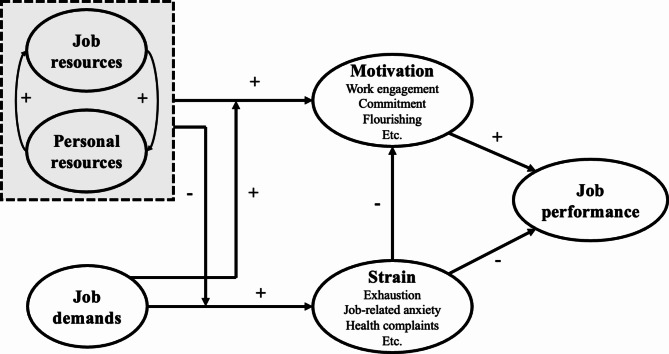
Based on the Job demands-resources (JD-R) model, this study examined the effects of job demands and job resources in the work environment, as well as personal resources, on the night-shift alertness of ICU shift nurses.
This cross-sectional correlational exploratory study, conducted from July to September 2022, recruited 291 ICU shift nurses from a hospital in Beijing, China. The Copenhagen Psychosocial Questionnaire (COPSOQ), the Self-resilience scale, the General Self-Efficacy Scale (GSES), and the Psychomotor Vigilance Task (PVT) were used to subjectively and objectively measure the job demands, job resources, personal resources, and night-shift alertness. SPSS 26.0 and Mplus 8.3 were used to analyze the data and construct the structural equation model.
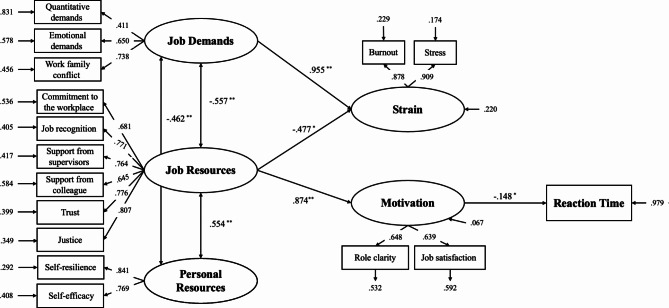
The night-shift reaction time was 251.0 ms (Median), indicating a relatively high level of alertness. Job demands were negatively correlated with both job resources (r=-0.570, P < 0.001) and personal resources (r=-0.462, P < 0.001), while a positive correlation existed between job resources and personal resources (r = 0.554, P < 0.001). The results show that increased job demands can lead to higher levels of nurse strain (β = 0.955, P < 0.001), whereas job resources were found that it can decrease strain (β=-0.477, P = 0.047). Adequate job resources can enhance motivation directly (β = 0.874, P < 0.001), subsequently reducing reaction time (β=-0.148, P = 0.044) and improving night-shift alertness among ICU shift nurses.
Enhancing ICU shift nurses' work motivation through bolstering job resources can boost night-shift alertness. However, it is noteworthy that, in this study, neither strain nor individual resources significantly influenced nurses' night-shift alertness. This may be attributed to the complexity of the ICU environment and individual differences. Future research should explore the relationship between these factors and nurses' work alertness.
积极的工作环境可以提高护理安全性和患者满意度,同时减轻护士的压力。相反,恶劣的工作环境会损害护士的身心健康,并影响护理质量,尤其是在重症监护病房(ICU)高强度且轮班制的工作环境中。
基于工作需求-资源(JD-R)模型,本研究探讨了工作环境中的工作需求、工作资源以及个人资源对ICU轮班护士夜班警觉性的影响。
本横断面相关性探索性研究于2022年7月至9月进行,从中国北京的一家医院招募了291名ICU轮班护士。使用哥本哈根心理社会问卷(COPSOQ)、自我复原力量表、一般自我效能感量表(GSES)和心理运动警觉任务(PVT),主观和客观地测量工作需求、工作资源、个人资源和夜班警觉性。使用SPSS 26.0和Mplus 8.3分析数据并构建结构方程模型。
夜班反应时间为251.0毫秒(中位数),表明警觉性水平相对较高。工作需求与工作资源(r=-0.570,P<0.001)和个人资源(r=-0.