ISGlobal, Barcelona, Spain.
Universitat Pompeu Fabra (UPF), Barcelona, Spain.
Int J Behav Nutr Phys Act. 2024 Sep 12;21(1):102. doi: 10.1186/s12966-024-01639-x.
Altered meal timing patterns can disrupt the circadian system and affect metabolism. Our aim was to describe sex-specific chrono-nutritional patterns, assess their association with body mass index (BMI) and investigate the role of sleep in this relationship.
We used the 2018 questionnaire data from the population-based Genomes for Life (GCAT) (n = 7074) cohort of adults aged 40-65 in Catalonia, Spain, for cross-sectional analysis and its follow-up questionnaire data in 2023 (n = 3128) for longitudinal analysis. We conducted multivariate linear regressions to explore the association between mutually adjusted meal-timing variables (time of first meal, number of eating occasions, nighttime fasting duration) and BMI, accounting for sleep duration and quality, and additional relevant confounders including adherence to a Mediterranean diet. Finally, cluster analysis was performed to identify chrono-nutritional patterns, separately for men and women, and sociodemographic and lifestyle characteristics were compared across clusters and analyzed for associations with BMI.
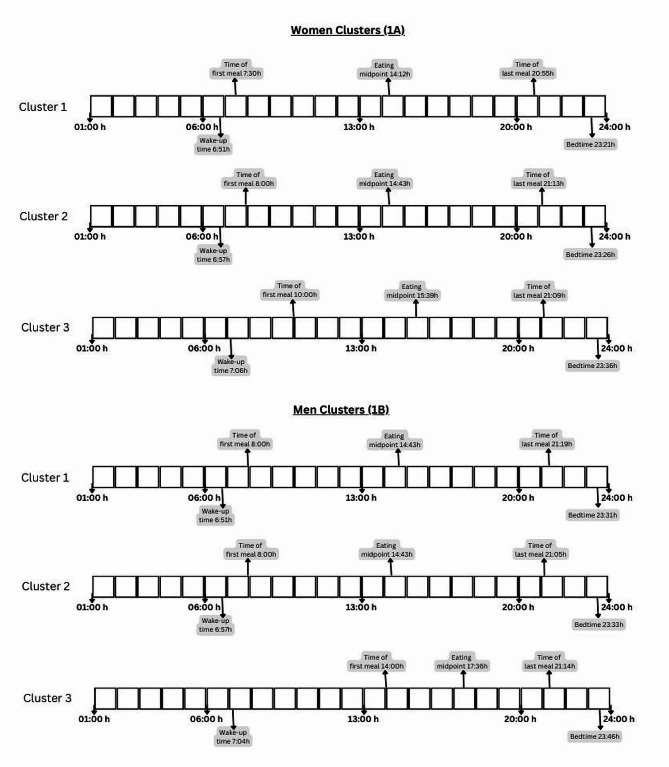
In the cross-sectional analysis, a later time of first meal (β 1 h increase = 0.32, 95% CI 0.18, 0.47) and more eating occasions (only in women, β 1 more eating occasion = 0.25, 95% CI 0.00, 0.51) were associated with a higher BMI, while longer nighttime fasting duration with a lower BMI (β 1 h increase=-0.27, 95% CI -0.41, -0.13). These associations were particularly evident in premenopausal women. Longitudinal analyses corroborated the associations with time of first meal and nighttime fasting duration, particularly in men. Finally, we obtained 3 sex-specific clusters, that mostly differed in number of eating occasions and time of first meal. Clusters defined by a late first meal displayed lower education and higher unemployment in men, as well as higher BMI for both sexes. A clear "breakfast skipping" pattern was identified only in the smallest cluster in men.
In a population-based cohort of adults in Catalonia, we found that a later time of first meal was associated with higher BMI, while longer nighttime fasting duration associated with a lower BMI, both in cross-sectional and longitudinal analyses.
改变进餐时间模式会扰乱生物钟系统并影响新陈代谢。我们的目的是描述性别特异性的时间营养模式,评估其与体重指数(BMI)的关联,并研究睡眠在这种关系中的作用。
我们使用了西班牙加泰罗尼亚地区基于人群的基因组生活(GCAT)(n=7074)队列的 2018 年问卷调查数据进行横断面分析,并使用其 2023 年的随访问卷调查数据(n=3128)进行纵向分析。我们进行了多变量线性回归分析,以探索相互调整的进餐时间变量(第一餐时间、进餐次数、夜间禁食时间)与 BMI 之间的关联,同时考虑了睡眠时间和质量以及包括地中海饮食依从性在内的其他相关混杂因素。最后,我们进行了聚类分析,分别为男性和女性确定时间营养模式,并比较了不同聚类的社会人口学和生活方式特征,并分析了与 BMI 的关联。
在横断面分析中,第一餐时间较晚(每增加 1 小时,β 1=0.32,95%CI 0.18,0.47)和进餐次数较多(仅在女性中,β 1 次进餐机会增加=0.25,95%CI 0.00,0.51)与 BMI 较高相关,而夜间禁食时间较长与 BMI 较低相关(β 1 小时增加=-0.27,95%CI -0.41,-0.13)。这些关联在绝经前妇女中尤为明显。纵向分析证实了与第一餐时间和夜间禁食时间的关联,尤其是在男性中。最后,我们获得了 3 个性别特异性聚类,这些聚类主要在进餐次数和第一餐时间上有所不同。以第一餐时间较晚定义的聚类在男性中表现出较低的教育程度和较高的失业率,以及男女两性的 BMI 较高。仅在男性中最小的聚类中确定了明显的“不吃早餐”模式。
在加泰罗尼亚地区的一项基于人群的成年人队列中,我们发现第一餐时间较晚与 BMI 较高相关,而夜间禁食时间较长与 BMI 较低相关,这在横断面和纵向分析中均成立。