Yan Li-Ming, Li Hai-Jun, Fan Qi, Xue Yi-Dong, Wang Tao
Department of Gynecology, The Affiliated Hospital of Yan'an University, Yan'an, Shaanxi, China.
Department of Neurology, The Affiliated Hospital of Yan'an University, Yan'an, Shaanxi, China.
PLoS One. 2024 Aug 1;19(8):e0308172. doi: 10.1371/journal.pone.0308172. eCollection 2024.
Meal timing has been associated with metabolism and cardiovascular diseases; however, the relationship between meal timing and sleep quality remains inconclusive.
This study aims to investigate the relationship between meal timing and sleep quality from a chronobiological perspective.
This study utilized data from the NHANES for the years 2005-2008, including a cohort of 7,023 participants after applying exclusion criteria. Sleep quality was assessed using the Pittsburgh Sleep Quality Index (PSQI). Meal timing was analyzed based on two 24-hour dietary recalls from each individual, considering the timing of the initial and final meals, meal duration, and frequency of meal occasions. Multiple linear regression models and hierarchical analyses were employed to examine the relationship between meal timing and PSQI scores, adjusting for various demographic and habitat covariates.
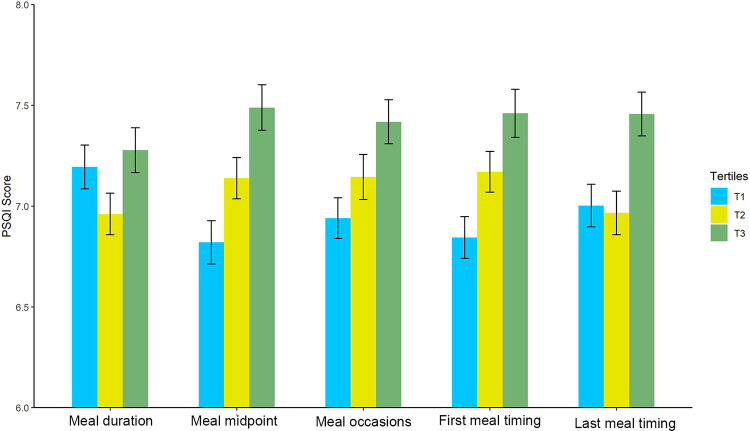
Statistical analysis revealed a positive correlation between delayed meal timings, increased meal occasions, and elevated PSQI scores, indicating that later meal timing are intricately linked with diminished sleep quality. Both later meal timings and more frequent meal occasions were significantly associated with poorer sleep quality. Compared to the first tertile, the β (95%CI) values of the third tertile were 0.545 (0.226, 0.864) for first meal timing, 0.586 (0.277, 0.896) for midpoint meal timing, 0.385 (0.090, 0.680) for last meal timing, and 0.332 (0.021, 0.642) for meal occasions in the adjusted models.
These findings suggest that late initial, midpoint, and final meal timing, as well as more frequent meal occasions, are chrono-nutrition patterns associated with poor sleep quality.
用餐时间与新陈代谢及心血管疾病有关;然而,用餐时间与睡眠质量之间的关系尚无定论。
本研究旨在从生物钟学角度调查用餐时间与睡眠质量之间的关系。
本研究使用了2005 - 2008年美国国家健康与营养检查调查(NHANES)的数据,在应用排除标准后,该队列有7023名参与者。使用匹兹堡睡眠质量指数(PSQI)评估睡眠质量。根据每个人的两次24小时饮食回忆记录来分析用餐时间,考虑第一餐和最后一餐的时间、用餐时长以及用餐次数。采用多元线性回归模型和分层分析来检验用餐时间与PSQI得分之间的关系,并对各种人口统计学和居住环境协变量进行了调整。
统计分析显示,用餐时间延迟、用餐次数增加与PSQI得分升高之间存在正相关,表明用餐时间越晚与睡眠质量下降密切相关。用餐时间晚和用餐次数频繁均与较差的睡眠质量显著相关。在调整模型中,与第一三分位数相比,第三三分位数的第一餐时间β(95%置信区间)值为0.545(0.226,0.864),中点餐时间为0.586(0.277,0.896),最后一餐时间为0.385(0.090,0.680),用餐次数为0.332(0.021,0.642)。
这些研究结果表明,较晚的第一餐、中点餐和最后一餐时间,以及更频繁的用餐次数,是与睡眠质量差相关的时间营养学模式。