Palomar-Cros Anna, Harding Barbara N, Espinosa Ana, Papantoniou Kyriaki, Pérez-Gómez Beatriz, Straif Kurt, Ardanaz Eva, Fernández Villa Tania, Amiano Pilar, Gómez-Acebo Inés, Moreno Victor, Alguacil Juan, Fernández-Tardón Guillermo, Molina-Barceló Ana, Marcos-Gragera Rafael, Aragonés Nuria, Castaño-Vinyals Gemma, Guevara Marcela, Marcos Delgado Alba, Pollán Marina, Romaguera Dora, Kogevinas Manolis
Barcelona Institute for Global Health (ISGlobal), Barcelona, Spain.
Department of Medicine and Life Sciences, Universitat Pompeu Fabra (UPF), Barcelona, Spain.
Front Nutr. 2022 Aug 11;9:941477. doi: 10.3389/fnut.2022.941477. eCollection 2022.
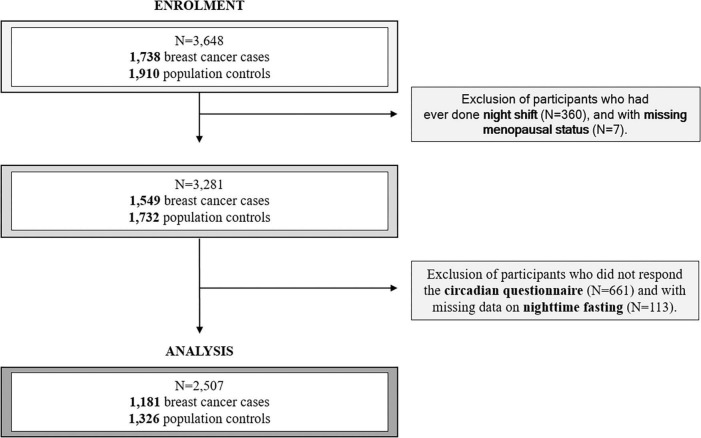
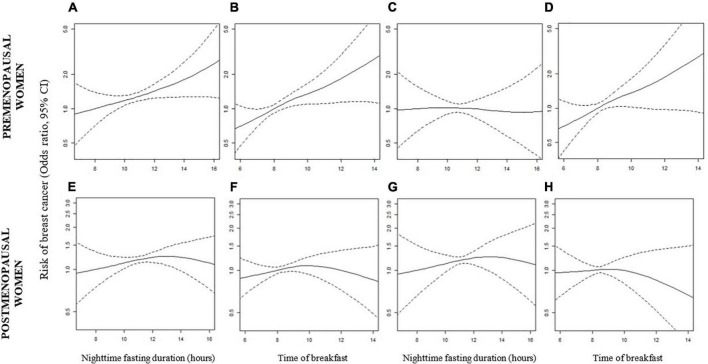
Circadian nutritional behaviors, defined by the daily eating/fasting cycle, have been linked with breast cancer. This study aimed to further disentangle the association of nighttime fasting duration and time of breakfast with breast cancer risk. We analyzed data from 1,181 breast cancer cases and 1,326 population controls from the Spanish multicase-control study (MCC-Spain), 2008-2013. We collected circadian nutritional behaviors at mid-age a telephonic interview. We applied logistic regression to estimate odds ratios (OR) and 95% confidence intervals (CIs) for the association of nighttime fasting duration and time of breakfast with breast cancer risk in all women and stratified by menopausal status. Models were adjusted for age, center, education, family history of breast cancer, age at menarche, number of children, breastfeeding, age at first child, body mass index (BMI), contraceptive use, and hormonal replacement therapy (HRT). A later time of breakfast was associated with a non-significant increased risk of breast cancer (OR = 1.05, 95% CI: 0.95-1.16, per hour increase). This association was stronger among premenopausal women, among whom each hour later, the time of breakfast was associated with an 18% increase in breast cancer risk (OR = 1.18, 95% CI: 1.01-1.40). The association was not observed in postmenopausal women. We did not observe an association between nighttime fasting duration and breast cancer risk after adjusting for the time of breakfast. In this study, late breakfast was associated with increased breast cancer risk, especially among premenopausal women, compared with early breakfast. Aside from nutritional quality, circadian nutritional behaviors should be further studied in relation to cancer.
由每日进食/禁食周期所定义的昼夜节律营养行为与乳腺癌有关。本研究旨在进一步厘清夜间禁食时长和早餐时间与乳腺癌风险之间的关联。我们分析了来自西班牙多病例对照研究(MCC - 西班牙,2008 - 2013年)的1181例乳腺癌病例和1326例人群对照的数据。我们通过电话访谈收集了中年时期的昼夜节律营养行为。我们应用逻辑回归来估计夜间禁食时长和早餐时间与所有女性乳腺癌风险之间关联的比值比(OR)和95%置信区间(CI),并按绝经状态进行分层。模型对年龄、中心、教育程度、乳腺癌家族史、初潮年龄、子女数量、母乳喂养情况、头胎年龄、体重指数(BMI)、避孕措施使用情况以及激素替代疗法(HRT)进行了校正。早餐时间较晚与乳腺癌风险非显著性增加相关(每小时增加,OR = 1.05,95% CI:0.95 - 1.16)。这种关联在绝经前女性中更强,其中早餐时间每推迟一小时,乳腺癌风险增加18%(OR = 1.18,95% CI:1.01 - 1.40)。在绝经后女性中未观察到这种关联。在对早餐时间进行校正后,我们未观察到夜间禁食时长与乳腺癌风险之间的关联。在本研究中,与早餐较早相比,早餐较晚与乳腺癌风险增加相关,尤其是在绝经前女性中。除了营养质量外,昼夜节律营养行为与癌症的关系应进一步研究。