Souza Jorge Fernando Tavares, Monico-Neto Marcos, Tufik Sergio, Antunes Hanna Karen Moreira
Departamento de Psicobiologia, Escola Paulista de Medicina (EPM), Universidade Federal de São Paulo (Unifesp), São Paulo, SP, Brazil.
Department of Biosciences, Instituto de Saúde e Sociedade (ISS), Universidade Federal de São Paulo (Unifesp), Santos, SP, Brazil.
Sleep Sci. 2024 May 21;17(3):e272-e280. doi: 10.1055/s-0044-1782173. eCollection 2024 Sep.
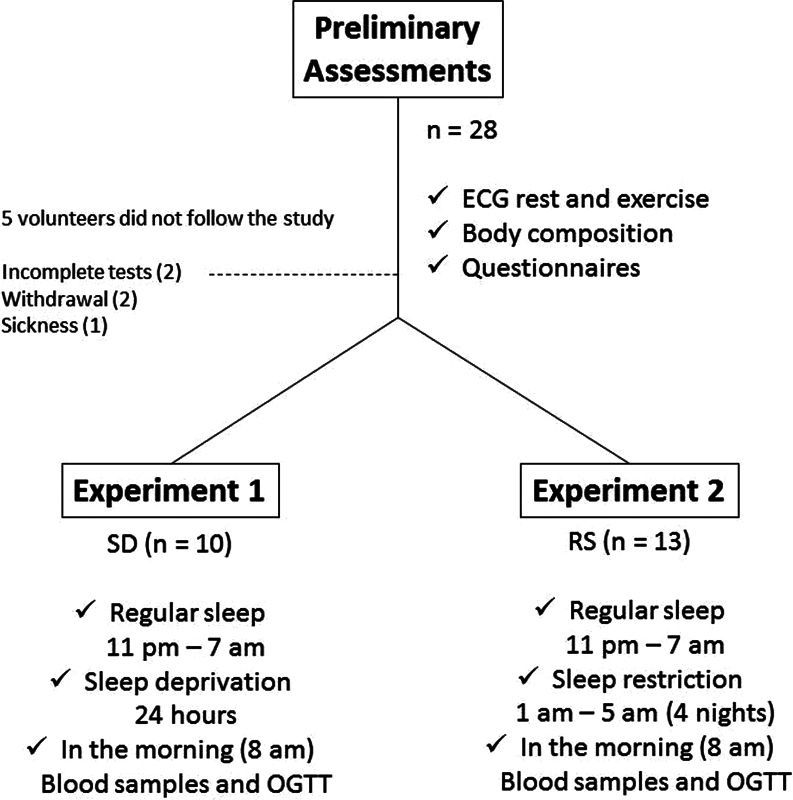
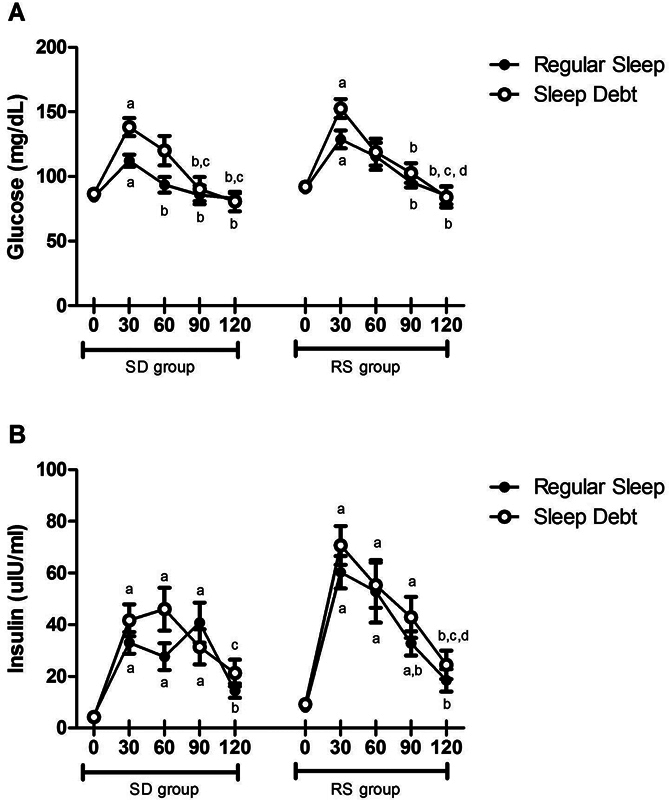
To evaluate which condition of sleep debt has a greater negative impact on insulin resistance: sleep deprivation for 24 hours or 4 hours of sleep restriction for 4 nights. In total, 28 healthy male subjects aged 18 to 40 years were recruited and randomly allocated to two groups: sleep deprivation (SD) and sleep restriction (SR). Each group underwent two conditions: regular sleep (11 pm to 7 am ) and total sleep deprivation for 24 hours (SD); regular sleep (11 pm to 7 am ) and 4 nights of sleep restriction (SR) (1 am to 5 am ). The oral glucose tolerance test (OGTT) was performed, and baseline glucose, insulin, free fatty acids (FFAs), and cortisol were measured. In addition, the area under the curve (AUC) for glucose and insulin, the homeostasis model assessment of insulin resistance (HOMA-IR), and the Matsuda Index (Insulin Sensitivity Index, ISI) were calculated. Glucose and insulin had a similar pattern between groups, except at the baseline, when insulin was higher in the sleep debt condition of the SR when compared with the SD ( < 0.01). In the comparison between regular sleep and sleep debt, the SD had a higher insulin AUC ( < 0.01) and FFAs ( = 0.03) after sleep deprivation, and insulin and the insulin AUC increased ( < 0.01 for both), while the ISI decreased ( = 0.02) after sleep restriction in the SR. In baseline parameters covariate by the condition of regular sleep, insulin ( = 0.02) and the HOMA-IR ( < 0.01) were higher, and cortisol ( = 0.04) was lower after sleep restriction when compared with sleep deprivation. Sleep restriction for 4 consecutive nights is more detrimental to energy metabolism because of the higher insulin values and insulin resistance compared with an acute period of sleep deprivation of 24 hours.
24小时睡眠剥夺还是连续4晚每晚限制睡眠4小时。
总共招募了28名年龄在18至40岁的健康男性受试者,并将他们随机分为两组:睡眠剥夺(SD)组和睡眠限制(SR)组。每组都经历两种状况:规律睡眠(晚上11点至早上7点)和24小时完全睡眠剥夺(SD);规律睡眠(晚上11点至早上7点)和连续4晚睡眠限制(SR)(凌晨1点至5点)。进行了口服葡萄糖耐量试验(OGTT),并测量了基线血糖、胰岛素、游离脂肪酸(FFA)和皮质醇。此外,还计算了血糖和胰岛素的曲线下面积(AUC)、胰岛素抵抗的稳态模型评估(HOMA-IR)和松田指数(胰岛素敏感性指数,ISI)。
除了在基线时,与SD组相比,SR组睡眠债状况下胰岛素水平更高(P<0.01)外,两组之间血糖和胰岛素的变化模式相似。在规律睡眠与睡眠债的比较中,睡眠剥夺后SD组的胰岛素AUC更高(P<0.01),FFA也更高(P = 0.03),而在SR组中,睡眠限制后胰岛素和胰岛素AUC增加(两者均P<0.01),而ISI降低(P = 0.02)。在以规律睡眠状况作为协变量的基线参数中,与睡眠剥夺相比,睡眠限制后胰岛素(P = 0.02)和HOMA-IR更高(P<0.01),而皮质醇更低(P = 0.04)。
与24小时急性睡眠剥夺相比,连续4晚睡眠限制因胰岛素值和胰岛素抵抗更高,对能量代谢的损害更大。