CLIP, Department of Pediatric Hematology and Oncology, Second Faculty of Medicine, Charles University and University Hospital Motol, Prague, Czech Republic.
Section on Intracellular Protein Trafficking, Neurosciences and Cellular and Structural Biology Division, Eunice Kennedy Shriver National Institute of Child Health and Human Development, National Institutes of Health, Bethesda, MD, USA.
J Mol Med (Berl). 2024 Nov;102(11):1343-1353. doi: 10.1007/s00109-024-02482-0. Epub 2024 Sep 13.
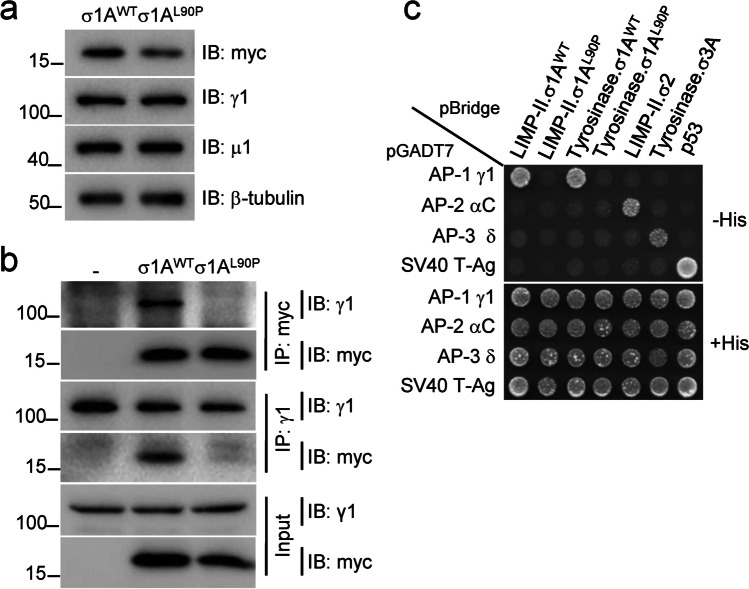
MEDNIK syndrome is a rare autosomal recessive disease characterized by mental retardation, enteropathy, deafness, peripheral neuropathy, ichthyosis, and keratoderma, and caused by variants in the adaptor-related protein complex 1 subunit sigma 1 (AP1S1) gene. This gene encodes the σ1A protein, which is a subunit of the adaptor protein complex 1 (AP-1), a key component of the intracellular protein trafficking machinery. Previous work identified three AP1S1 nonsense, frameshift and splice-site variants in MEDNIK patients predicted to encode truncated σ1A proteins, with consequent AP-1 dysfunction. However, two AP1S1 missense variants (c.269 T > C and c.346G > A) were recently reported in patients who presented with severe enteropathy but no additional symptoms of MEDNIK. This condition was described as a novel non-syndromic form of congenital diarrhea caused specifically by the AP1S1 missense variants. In this study, we report two patients with the same c.269 T > C variant, who, contrary to the previous cases, presented as complete MEDNIK syndrome. These data substantially revise the presentation of disorders associated with AP1S1 gene variants and indicate that all the identified pathogenic AP1S1 variants result in MEDNIK syndrome. We also provide a series of functional analyses that elucidate the impact of the c.269 T > C variant on σ1A function, contributing to a better understanding of the molecular pathogenesis of MEDNIK syndrome. KEY MESSAGES: A missense AP1S1 c.269 T > C (σ1A L90P) variant causes full MEDNIK syndrome. The σ1A L90P variant is largely unable to assemble into the AP-1 complex. The σ1A L90P variant fails to bind [DE]XXXL[LI] sorting motifs. The σ1A L90P variant results in loss-of-function of the protein.
MEDNIK 综合征是一种罕见的常染色体隐性疾病,其特征为智力障碍、肠病、耳聋、周围神经病、鱼鳞病和角化过度,由衔接蛋白相关复合物 1 亚基 sigma 1(AP1S1)基因突变引起。该基因编码 σ1A 蛋白,它是衔接蛋白复合物 1(AP-1)的一个亚基,AP-1 是细胞内蛋白运输机制的关键组成部分。先前的工作鉴定了 3 种 MEDNIK 患者中的 AP1S1 无义、移码和剪接位点变异,这些变异预计会导致截断的 σ1A 蛋白的产生,从而导致 AP-1 功能障碍。然而,最近在表现出严重肠病但没有 MEDNIK 其他症状的患者中报道了 2 种 AP1S1 错义变异(c.269T>C 和 c.346G>A)。这种情况被描述为一种由 AP1S1 错义变异引起的特定非综合征型先天性腹泻的新形式。在这项研究中,我们报告了 2 名具有相同 c.269T>C 变异的患者,与之前的病例不同,他们表现为完全的 MEDNIK 综合征。这些数据大大修改了与 AP1S1 基因突变相关疾病的表现,并表明所有鉴定的致病性 AP1S1 变异均导致 MEDNIK 综合征。我们还提供了一系列功能分析,阐明了 c.269T>C 变异对 σ1A 功能的影响,有助于更好地理解 MEDNIK 综合征的分子发病机制。 关键信息:AP1S1 c.269T>C(σ1A L90P)错义变异导致完全的 MEDNIK 综合征。σ1A L90P 变异体在很大程度上不能组装成 AP-1 复合物。σ1A L90P 变异体不能结合 [DE]XXXL[LI]分拣基序。σ1A L90P 变异体导致蛋白功能丧失。