• 文献检索
  • 文档翻译
  • 深度研究
  • 学术资讯
  • Suppr Zotero 插件Zotero 插件
  • 邀请有礼
  • 套餐&价格
  • 历史记录
应用&插件
Suppr Zotero 插件Zotero 插件浏览器插件Mac 客户端Windows 客户端微信小程序
定价
高级版会员购买积分包购买API积分包
服务
文献检索文档翻译深度研究API 文档MCP 服务
关于我们
关于 Suppr公司介绍联系我们用户协议隐私条款
关注我们

Suppr 超能文献

核心技术专利:CN118964589B侵权必究
粤ICP备2023148730 号-1Suppr @ 2026

文献检索

告别复杂PubMed语法,用中文像聊天一样搜索,搜遍4000万医学文献。AI智能推荐,让科研检索更轻松。

立即免费搜索

文件翻译

保留排版,准确专业,支持PDF/Word/PPT等文件格式,支持 12+语言互译。

免费翻译文档

深度研究

AI帮你快速写综述,25分钟生成高质量综述,智能提取关键信息,辅助科研写作。

立即免费体验

探索5G上行链路通信的潜力:联合功率控制、用户分组和多学习灰狼优化器的协同集成

Exploring the potential of 5G uplink communication: Synergistic integration of joint power control, user grouping, and multi-learning Grey Wolf Optimizer.

作者信息

Sikkanan Sobana, Kumar Chandrasekaran, Manoharan Premkumar, Ravichandran Sowmya

机构信息

Department of Electronics and Communication Engineering, Karpagam College of Engineering, Coimbatore, Tamil Nadu, 641032, India.

Department of Electrical and Electronics Engineering, Karpagam College of Engineering, Coimbatore, Tamil Nadu, 641032, India.

出版信息

Sci Rep. 2024 Sep 13;14(1):21406. doi: 10.1038/s41598-024-71751-2.

DOI:10.1038/s41598-024-71751-2
PMID:39271735
原文链接:https://pmc.ncbi.nlm.nih.gov/articles/PMC11399275/
Abstract

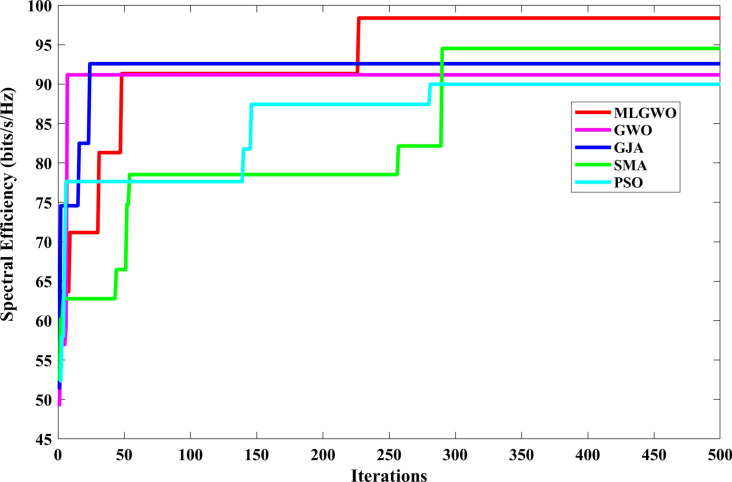
Non-orthogonal Multiple Access (NOMA) techniques offer potential enhancements in spectral efficiency for 5G and 6G wireless networks, facilitating broader network access. Central to realizing optimal system performance are factors like joint power control, user grouping, and decoding order. This study investigates power control and user grouping to optimize spectral efficiency in NOMA uplink systems, aiming to reduce computational difficulty. While previous research on this integrated optimization has identified several near-optimal solutions, they often come with considerable system and computational overheads. To address this, this study employed an improved Grey Wolf Optimizer (GWO), a nature-inspired metaheuristic optimization method. Although GWO is effective, it can sometimes converge prematurely and might lack diversity. To enhance its performance, this study introduces a new version of GWO, integrating Competitive Learning, Q-learning, and Greedy Selection. Competitive learning adopts agent competition, balancing exploration and exploitation and preserving diversity. Q-learning guides the search based on past experiences, enhancing adaptability and preventing redundant exploration of sub-optimal regions. Greedy selection ensures the retention of the best solutions after each iteration. The synergistic integration of these three components substantially enhances the performance of the standard GWO. This algorithm was used to manage power and user-grouping in NOMA systems, aiming to strengthen system performance while restricting computational demands. The effectiveness of the proposed algorithm was validated through numerical evaluations. Simulated outcomes revealed that when applied to the joint challenge in NOMA uplink systems, it surpasses the spectral efficiency of conventional orthogonal multiple access. Moreover, the proposed approach demonstrated superior performance compared to the standard GWO and other state-of-the-art algorithms, achieving reduced system complexity under identical constraints.

摘要

非正交多址接入(NOMA)技术为5G和6G无线网络的频谱效率提供了潜在的提升,有助于实现更广泛的网络接入。实现最优系统性能的核心因素包括联合功率控制、用户分组和解码顺序。本研究调查了功率控制和用户分组,以优化NOMA上行链路系统中的频谱效率,旨在降低计算难度。虽然此前关于这种综合优化的研究已经确定了几种近似最优解,但它们往往伴随着相当大的系统和计算开销。为了解决这个问题,本研究采用了一种改进的灰狼优化器(GWO),这是一种受自然启发的元启发式优化方法。尽管GWO很有效,但它有时会过早收敛,可能缺乏多样性。为了提高其性能,本研究引入了一种新版本的GWO,集成了竞争学习、Q学习和贪婪选择。竞争学习采用智能体竞争,平衡探索和利用并保持多样性。Q学习根据过去的经验指导搜索,增强适应性并防止对次优区域的冗余探索。贪婪选择确保每次迭代后保留最佳解。这三个组件的协同集成大大提高了标准GWO的性能。该算法用于管理NOMA系统中的功率和用户分组,旨在在限制计算需求的同时增强系统性能。通过数值评估验证了所提算法的有效性。仿真结果表明,当应用于NOMA上行链路系统的联合挑战时,它超过了传统正交多址接入的频谱效率。此外,与标准GWO和其他现有算法相比,所提方法表现出卓越的性能,在相同约束下实现了更低的系统复杂度。

https://cdn.ncbi.nlm.nih.gov/pmc/blobs/2604/11399275/e40005c2078b/41598_2024_71751_Fig12_HTML.jpg
https://cdn.ncbi.nlm.nih.gov/pmc/blobs/2604/11399275/53e93480c2b1/41598_2024_71751_Fig1_HTML.jpg
https://cdn.ncbi.nlm.nih.gov/pmc/blobs/2604/11399275/0ccf5889af44/41598_2024_71751_Fig2_HTML.jpg
https://cdn.ncbi.nlm.nih.gov/pmc/blobs/2604/11399275/17a8c73ca18d/41598_2024_71751_Figa_HTML.jpg
https://cdn.ncbi.nlm.nih.gov/pmc/blobs/2604/11399275/e60dedb53f75/41598_2024_71751_Figb_HTML.jpg
https://cdn.ncbi.nlm.nih.gov/pmc/blobs/2604/11399275/05392e501e3b/41598_2024_71751_Figc_HTML.jpg
https://cdn.ncbi.nlm.nih.gov/pmc/blobs/2604/11399275/240b288056ba/41598_2024_71751_Fig3_HTML.jpg
https://cdn.ncbi.nlm.nih.gov/pmc/blobs/2604/11399275/7bb1de0f0958/41598_2024_71751_Fig4_HTML.jpg
https://cdn.ncbi.nlm.nih.gov/pmc/blobs/2604/11399275/1056448555c0/41598_2024_71751_Fig5_HTML.jpg
https://cdn.ncbi.nlm.nih.gov/pmc/blobs/2604/11399275/5bb12aeba839/41598_2024_71751_Fig6_HTML.jpg
https://cdn.ncbi.nlm.nih.gov/pmc/blobs/2604/11399275/49126983d0e2/41598_2024_71751_Fig7_HTML.jpg
https://cdn.ncbi.nlm.nih.gov/pmc/blobs/2604/11399275/a1fe8230f1fb/41598_2024_71751_Fig8_HTML.jpg
https://cdn.ncbi.nlm.nih.gov/pmc/blobs/2604/11399275/8ab664265423/41598_2024_71751_Fig9_HTML.jpg
https://cdn.ncbi.nlm.nih.gov/pmc/blobs/2604/11399275/b8be752ef3ee/41598_2024_71751_Fig10_HTML.jpg
https://cdn.ncbi.nlm.nih.gov/pmc/blobs/2604/11399275/ceaf41170ca6/41598_2024_71751_Fig11_HTML.jpg
https://cdn.ncbi.nlm.nih.gov/pmc/blobs/2604/11399275/e40005c2078b/41598_2024_71751_Fig12_HTML.jpg
https://cdn.ncbi.nlm.nih.gov/pmc/blobs/2604/11399275/53e93480c2b1/41598_2024_71751_Fig1_HTML.jpg
https://cdn.ncbi.nlm.nih.gov/pmc/blobs/2604/11399275/0ccf5889af44/41598_2024_71751_Fig2_HTML.jpg
https://cdn.ncbi.nlm.nih.gov/pmc/blobs/2604/11399275/17a8c73ca18d/41598_2024_71751_Figa_HTML.jpg
https://cdn.ncbi.nlm.nih.gov/pmc/blobs/2604/11399275/e60dedb53f75/41598_2024_71751_Figb_HTML.jpg
https://cdn.ncbi.nlm.nih.gov/pmc/blobs/2604/11399275/05392e501e3b/41598_2024_71751_Figc_HTML.jpg
https://cdn.ncbi.nlm.nih.gov/pmc/blobs/2604/11399275/240b288056ba/41598_2024_71751_Fig3_HTML.jpg
https://cdn.ncbi.nlm.nih.gov/pmc/blobs/2604/11399275/7bb1de0f0958/41598_2024_71751_Fig4_HTML.jpg
https://cdn.ncbi.nlm.nih.gov/pmc/blobs/2604/11399275/1056448555c0/41598_2024_71751_Fig5_HTML.jpg
https://cdn.ncbi.nlm.nih.gov/pmc/blobs/2604/11399275/5bb12aeba839/41598_2024_71751_Fig6_HTML.jpg
https://cdn.ncbi.nlm.nih.gov/pmc/blobs/2604/11399275/49126983d0e2/41598_2024_71751_Fig7_HTML.jpg
https://cdn.ncbi.nlm.nih.gov/pmc/blobs/2604/11399275/a1fe8230f1fb/41598_2024_71751_Fig8_HTML.jpg
https://cdn.ncbi.nlm.nih.gov/pmc/blobs/2604/11399275/8ab664265423/41598_2024_71751_Fig9_HTML.jpg
https://cdn.ncbi.nlm.nih.gov/pmc/blobs/2604/11399275/b8be752ef3ee/41598_2024_71751_Fig10_HTML.jpg
https://cdn.ncbi.nlm.nih.gov/pmc/blobs/2604/11399275/ceaf41170ca6/41598_2024_71751_Fig11_HTML.jpg
https://cdn.ncbi.nlm.nih.gov/pmc/blobs/2604/11399275/e40005c2078b/41598_2024_71751_Fig12_HTML.jpg

相似文献

1
Exploring the potential of 5G uplink communication: Synergistic integration of joint power control, user grouping, and multi-learning Grey Wolf Optimizer.探索5G上行链路通信的潜力:联合功率控制、用户分组和多学习灰狼优化器的协同集成
Sci Rep. 2024 Sep 13;14(1):21406. doi: 10.1038/s41598-024-71751-2.
2
A competitive learning-based Grey wolf Optimizer for engineering problems and its application to multi-layer perceptron training.一种基于竞争学习的灰狼优化算法在工程问题中的应用及其在多层感知器训练中的应用。
Multimed Tools Appl. 2023 Mar 22:1-59. doi: 10.1007/s11042-023-15146-x.
3
A Novel Hybrid Algorithm Based on Grey Wolf Optimizer and Fireworks Algorithm.基于灰狼优化算法和烟花算法的新型混合算法。
Sensors (Basel). 2020 Apr 10;20(7):2147. doi: 10.3390/s20072147.
4
Reinforcement Learning-Based Joint User Pairing and Power Allocation in MIMO-NOMA Systems.基于强化学习的MIMO-NOMA系统联合用户配对与功率分配
Sensors (Basel). 2020 Dec 11;20(24):7094. doi: 10.3390/s20247094.
5
Augmented weighted K-means grey wolf optimizer: An enhanced metaheuristic algorithm for data clustering problems.增强加权K均值灰狼优化算法:一种用于数据聚类问题的增强型元启发式算法。
Sci Rep. 2024 Mar 5;14(1):5434. doi: 10.1038/s41598-024-55619-z.
6
Spectral Efficiency Optimization of Uplink Millimeter Wave MIMO-NOMA Systems.上行链路毫米波MIMO-NOMA系统的频谱效率优化
Sensors (Basel). 2022 Aug 27;22(17):6466. doi: 10.3390/s22176466.
7
Dimensional Learning Strategy-Based Grey Wolf Optimizer for Solving the Global Optimization Problem.基于维度学习策略的灰狼优化算法求解全局优化问题。
Comput Intell Neurosci. 2022 Jan 30;2022:3603607. doi: 10.1155/2022/3603607. eCollection 2022.
8
Fuzzy Strategy Grey Wolf Optimizer for Complex Multimodal Optimization Problems.模糊策略灰狼优化器在复杂多模态优化问题中的应用。
Sensors (Basel). 2022 Aug 25;22(17):6420. doi: 10.3390/s22176420.
9
An Intelligent Grey Wolf Optimizer Algorithm for Distributed Compressed Sensing.一种用于分布式压缩感知的智能灰狼优化算法。
Comput Intell Neurosci. 2018 Jan 31;2018:1723191. doi: 10.1155/2018/1723191. eCollection 2018.
10
Adaptive dynamic self-learning grey wolf optimization algorithm for solving global optimization problems and engineering problems.用于求解全局优化问题和工程问题的自适应动态自学习灰狼优化算法。
Math Biosci Eng. 2024 Feb 21;21(3):3910-3943. doi: 10.3934/mbe.2024174.

引用本文的文献

1
Electrical Equivalent Circuit Parameter Estimation of Commercial Induction Machines Using an Enhanced Grey Wolf Optimization Algorithm.基于增强灰狼优化算法的商用感应电机电气等效电路参数估计
Biomimetics (Basel). 2025 Apr 6;10(4):228. doi: 10.3390/biomimetics10040228.

本文引用的文献

1
Joint Power and Channel Allocation for Non-Orthogonal Multiple Access in 5G Networks and Beyond.5G及未来网络中非正交多址接入的联合功率与信道分配
Sensors (Basel). 2023 Sep 23;23(19):8040. doi: 10.3390/s23198040.
2
A competitive learning-based Grey wolf Optimizer for engineering problems and its application to multi-layer perceptron training.一种基于竞争学习的灰狼优化算法在工程问题中的应用及其在多层感知器训练中的应用。
Multimed Tools Appl. 2023 Mar 22:1-59. doi: 10.1007/s11042-023-15146-x.
3
Variants of Chaotic Grey Wolf Heuristic for Robust Identification of Control Autoregressive Model.
用于稳健识别自回归控制模型的混沌灰狼启发式算法变体
Biomimetics (Basel). 2023 Mar 30;8(2):141. doi: 10.3390/biomimetics8020141.
4
Localization of sensor nodes in wireless sensor networks using bat optimization algorithm with enhanced exploration and exploitation characteristics.基于具有增强探索与利用特性的蝙蝠优化算法的无线传感器网络中传感器节点的定位
J Supercomput. 2022;78(9):11975-12023. doi: 10.1007/s11227-022-04320-x. Epub 2022 Feb 22.
5
Efficient Allocation for Downlink Multi-Channel NOMA Systems Considering Complex Constraints.考虑复杂约束的下行多信道非正交多址接入系统的高效分配
Sensors (Basel). 2021 Mar 6;21(5):1833. doi: 10.3390/s21051833.
6
An Effective Cuckoo Search Algorithm for Node Localization in Wireless Sensor Network.一种用于无线传感器网络节点定位的有效布谷鸟搜索算法。
Sensors (Basel). 2016 Aug 31;16(9):1390. doi: 10.3390/s16091390.