Anmella Gerard, De Prisco Michele, Joyce Jeremiah B, Valenzuela-Pascual Claudia, Mas-Musons Ariadna, Oliva Vincenzo, Fico Giovanna, Chatzisofroniou George, Mishra Sanjeev, Al-Soleiti Majd, Corponi Filippo, Giménez-Palomo Anna, Montejo Laura, González-Campos Meritxell, Popovic Dina, Pacchiarotti Isabella, Valentí Marc, Cavero Myriam, Colomer Lluc, Grande Iria, Benabarre Antoni, Llach Cristian-Daniel, Raduà Joaquim, McInnis Melvin, Hidalgo-Mazzei Diego, Frye Mark A, Murru Andrea, Vieta Eduard
Department of Psychiatry and Psychology, Institute of Neuroscience, Hospital Clinic of Barcelona, 08036 Barcelona, Catalonia, Spain.
Bipolar and Depressive Disorders Unit, Digital Innovation Group, Institut d'Investigacions Biomèdiques August Pi i Sunyer (IDIBAPS), 08036 Barcelona, Catalonia, Spain.
J Clin Med. 2024 Aug 23;13(17):4997. doi: 10.3390/jcm13174997.
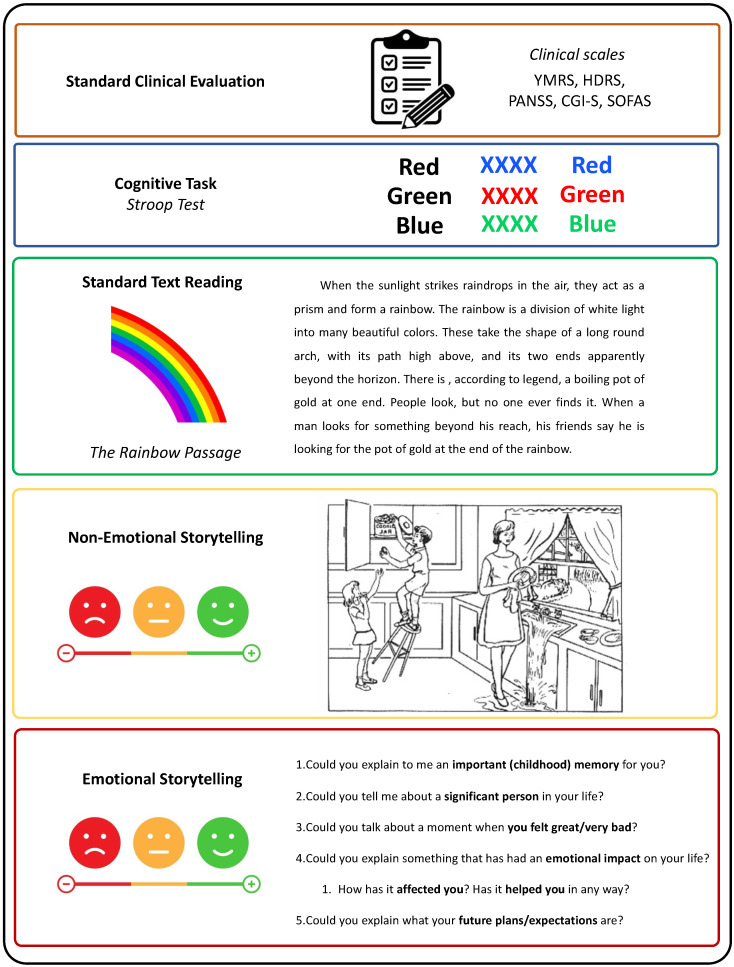
: Bipolar disorder (BD) involves significant mood and energy shifts reflected in speech patterns. Detecting these patterns is crucial for diagnosis and monitoring, currently assessed subjectively. Advances in natural language processing offer opportunities to objectively analyze them. : To (i) correlate speech features with manic-depressive symptom severity in BD, (ii) develop predictive models for diagnostic and treatment outcomes, and (iii) determine the most relevant speech features and tasks for these analyses. : This naturalistic, observational study involved longitudinal audio recordings of BD patients at euthymia, during acute manic/depressive phases, and after-response. Patients participated in clinical evaluations, cognitive tasks, standard text readings, and storytelling. After automatic diarization and transcription, speech features, including acoustics, content, formal aspects, and emotionality, will be extracted. Statistical analyses will (i) correlate speech features with clinical scales, (ii) use lasso logistic regression to develop predictive models, and (iii) identify relevant speech features. : Audio recordings from 76 patients (24 manic, 21 depressed, 31 euthymic) were collected. The mean age was 46.0 ± 14.4 years, with 63.2% female. The mean YMRS score for manic patients was 22.9 ± 7.1, reducing to 5.3 ± 5.3 post-response. Depressed patients had a mean HDRS-17 score of 17.1 ± 4.4, decreasing to 3.3 ± 2.8 post-response. Euthymic patients had mean YMRS and HDRS-17 scores of 0.97 ± 1.4 and 3.9 ± 2.9, respectively. Following data pre-processing, including noise reduction and feature extraction, comprehensive statistical analyses will be conducted to explore correlations and develop predictive models. : Automated speech analysis in BD could provide objective markers for psychopathological alterations, improving diagnosis, monitoring, and response prediction. This technology could identify subtle alterations, signaling early signs of relapse. Establishing standardized protocols is crucial for creating a global speech cohort, fostering collaboration, and advancing BD understanding.
双相情感障碍(BD)涉及显著的情绪和精力变化,这些变化反映在言语模式中。检测这些模式对于诊断和监测至关重要,目前主要通过主观评估。自然语言处理的进展为客观分析这些模式提供了机会。
(i)将言语特征与双相情感障碍的躁狂抑郁症状严重程度相关联;(ii)开发用于诊断和治疗结果的预测模型;(iii)确定这些分析中最相关的言语特征和任务。
这项自然主义的观察性研究涉及双相情感障碍患者在心境正常期、急性躁狂/抑郁期及缓解后的纵向音频记录。患者参与临床评估、认知任务、标准文本朗读和讲故事。在自动分帧和转录后,将提取包括声学、内容、形式方面和情感等言语特征。统计分析将:(i)将言语特征与临床量表相关联;(ii)使用套索逻辑回归开发预测模型;(iii)识别相关的言语特征。
收集了76名患者(24名躁狂患者、21名抑郁患者、31名心境正常患者)的音频记录。平均年龄为46.0±14.4岁,女性占63.2%。躁狂患者的平均杨氏躁狂量表(YMRS)评分为22.9±7.1,缓解后降至5.3±5.3。抑郁患者的平均17项汉密尔顿抑郁量表(HDRS-17)评分为17.1±4.4,缓解后降至3.3±2.8。心境正常患者的平均YMRS和HDRS-17评分分别为0.97±1.4和3.9±2.9。在进行包括降噪和特征提取的数据预处理后,将进行全面的统计分析以探索相关性并开发预测模型。
双相情感障碍中的自动言语分析可为精神病理改变提供客观指标,改善诊断、监测和反应预测。该技术可识别细微改变,提示复发的早期迹象。建立标准化方案对于创建全球言语队列、促进合作以及增进对双相情感障碍的理解至关重要。