Doroshenko Olga V, Kuchumov Alex G, Golub Mikhail V, Rakisheva Irina O, Skripka Nikita A, Pavlov Sergey P, Strazhec Yulija A, Lazarkov Petr V, Saychenko Nikita D, Shekhmametyev Roman M
Institute for Mathematics, Mechanics and Informatics, Kuban State University, Krasnodar 350040, Russia.
Biofluids Laboratory, Perm National Research Polytechnic University, Perm 614990, Russia.
J Clin Med. 2024 Aug 29;13(17):5141. doi: 10.3390/jcm13175141.
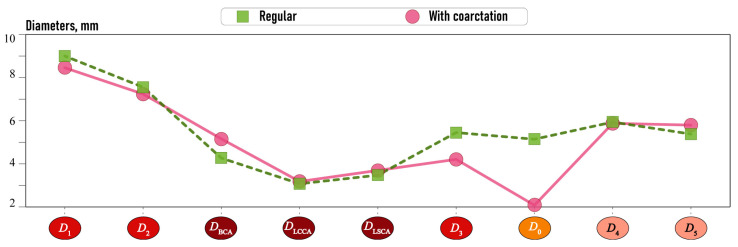
: The utilization of hemodynamic parameters, whose estimation is often cumbersome, can fasten diagnostics and decision-making related to congenital heart diseases. The main goal of this study is to investigate the relationship between hemodynamic and morphometric features of the thoracic aorta and to construct corresponding predictive models. : Multi-slice spiral computed tomography images of the aortas of patients with coarctation diagnoses and patients without cardiac or vascular diseases were evaluated to obtain numerical models of the aorta and branches of the aortic arch. Hemodynamic characteristics were estimated in key subdomains of the aorta and three branches using computational fluid dynamics methods. The key morphometric features (diameters) were calculated at locations in proximity to the domains, where hemodynamic characteristics are evaluated. : The functional dependencies for velocities and pressure on the corresponding diameters have been fitted, and a metamodel has been constructed employing the predicted values from these models. : The metamodel demonstrated high accuracy in classifying aortas into their respective types, thereby confirming the adequacy of the predicted hemodynamic characteristics by morphometric characteristics. The proposed methodology is applicable to other heart diseases without fundamental changes.
血流动力学参数的运用往往繁琐,但其可加快先天性心脏病的诊断和决策。本研究的主要目的是探究胸主动脉血流动力学与形态学特征之间的关系,并构建相应的预测模型。
对患有缩窄诊断的患者以及无心脏或血管疾病的患者的主动脉进行多层螺旋计算机断层扫描图像评估,以获得主动脉及主动脉弓分支的数值模型。使用计算流体动力学方法估计主动脉和三个分支的关键子域中的血流动力学特征。在评估血流动力学特征的区域附近位置计算关键形态学特征(直径)。
拟合了速度和压力对相应直径的函数依赖关系,并利用这些模型的预测值构建了一个元模型。
该元模型在将主动脉分类为各自类型方面表现出高精度,从而证实了形态学特征对预测血流动力学特征的充分性。所提出的方法无需进行根本性改变即可应用于其他心脏病。