D'Onghia Martina, Malvaso Dalma, Galluccio Giulia, Antonelli Flaminia, Coscarella Giulia, Rubegni Pietro, Peris Ketty, Calabrese Laura
Dermatology Unit, Department of Medical, Surgical and Neurological Sciences, University of Siena, 53100 Siena, Italy.
UOC di Dermatologia, Dipartimento di Scienze Mediche e Chirurgiche, Fondazione Policlinico Universitario A. Gemelli - IRCCS, 00168 Rome, Italy.
J Clin Med. 2024 Sep 2;13(17):5211. doi: 10.3390/jcm13175211.
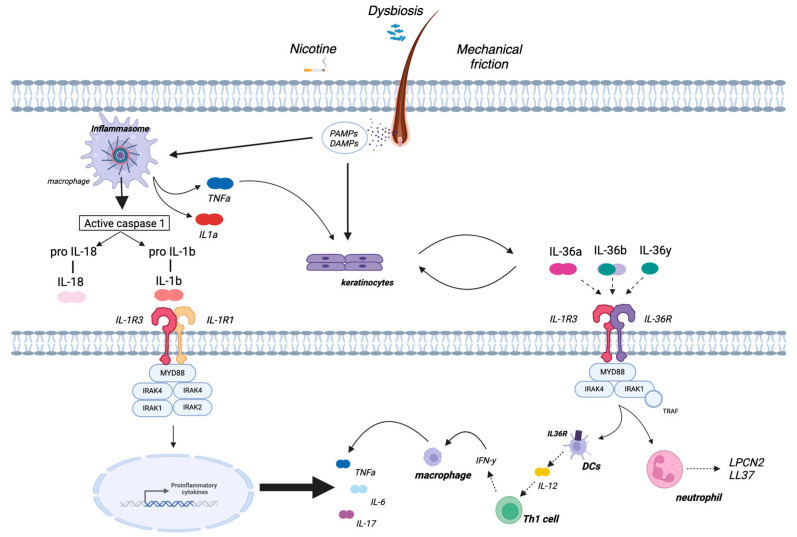
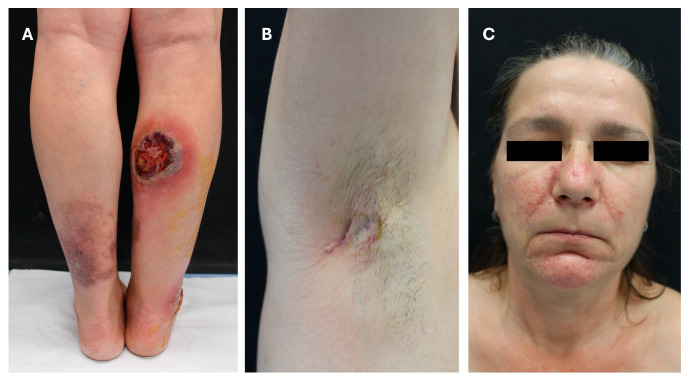
Hidradenitis suppurativa (HS) is a chronic and debilitating inflammatory skin disease that often exhibits heterogeneity in its clinical presentation, especially in the context of its rare syndromic forms. The pathogenesis of HS results from a complex interplay of genetic predisposition, innate and adaptive immunity dysregulation, smoking, obesity and environmental factors. In the early phase of the disease, the innate immune system is hyperactivated, contributing to tissue damage and triggering the activation and amplification of the adaptive immune response, which plays a pivotal role in the chronic stages of the disease. Recent studies focused on elucidating the importance of innate immunity impairment and autoinflammation in HS and increasing evidence has emerged on the occurrence of the disease in the context of well-known monogenic and polygenic autoinflammatory syndromes (AIDs). This review provides a comprehensive examination of the current scientific background supporting the contribution of autoinflammation to HS etiology, including genetic data, molecular studies and clinical evidence, as well as the association between HS and AIDs. However, further research is needed to shed light on the pathogenic mechanism of this challenging condition and to identify potential perspectives for future therapeutic approaches.
化脓性汗腺炎(HS)是一种慢性且使人衰弱的炎症性皮肤病,其临床表现往往具有异质性,尤其是在罕见的综合征形式中。HS的发病机制源于遗传易感性、先天性和适应性免疫失调、吸烟、肥胖及环境因素的复杂相互作用。在疾病早期,先天性免疫系统过度激活,导致组织损伤并触发适应性免疫反应的激活和放大,而适应性免疫反应在疾病的慢性阶段起关键作用。最近的研究聚焦于阐明先天性免疫损伤和自身炎症在HS中的重要性,并且在著名的单基因和多基因自身炎症综合征(AIDs)背景下该疾病的发生有了越来越多的证据。本综述全面审视了支持自身炎症对HS病因学贡献的当前科学背景,包括遗传数据、分子研究和临床证据,以及HS与AIDs之间的关联。然而,需要进一步研究以阐明这种具有挑战性病症的致病机制,并确定未来治疗方法的潜在前景。