Kusy Krzysztof, Matysiak Jan, Zarębska Ewa Anna, Klupczyńska-Gabryszak Agnieszka, Ciekot-Sołtysiak Monika, Plewa Szymon, Kokot Zenon J, Dereziński Paweł, Zieliński Jacek
Department of Athletics, Strength and Conditioning, Poznan University of Physical Education, Królowej Jadwigi Street 27/39, 61-871 Poznań, Poland.
Department of Inorganic and Analytical Chemistry, Poznan University of Medical Sciences, ul. Rokietnicka, 60-806 Poznań, Poland.
J Clin Med. 2024 Sep 6;13(17):5300. doi: 10.3390/jcm13175300.
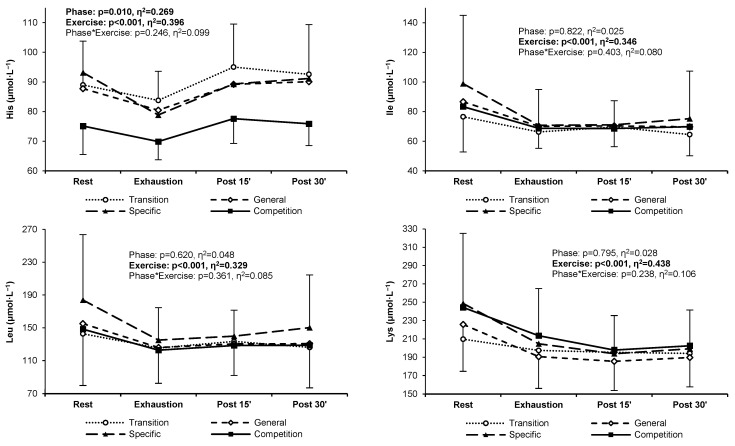
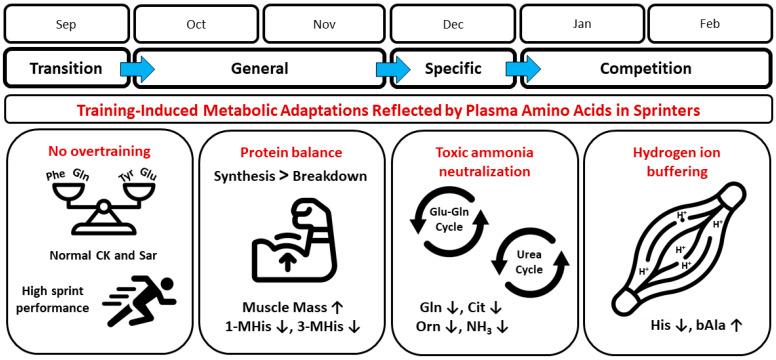
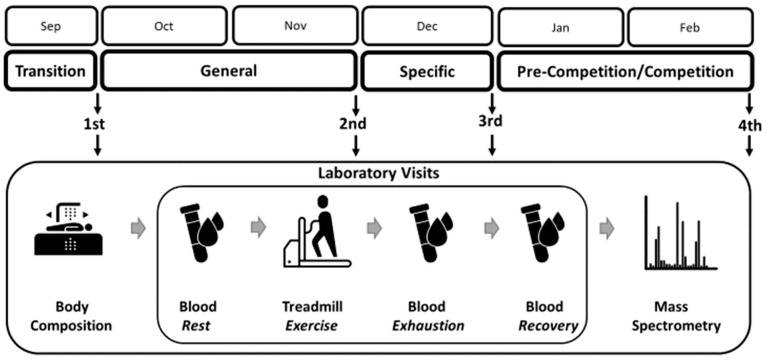
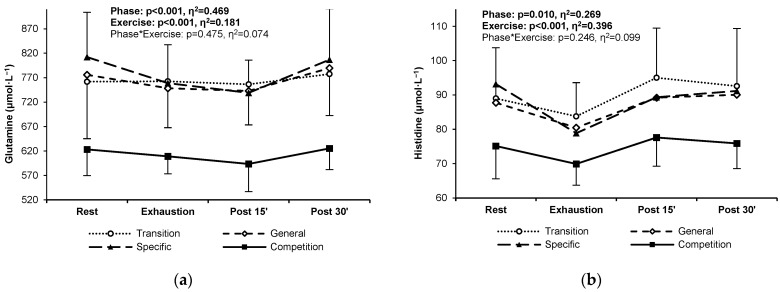
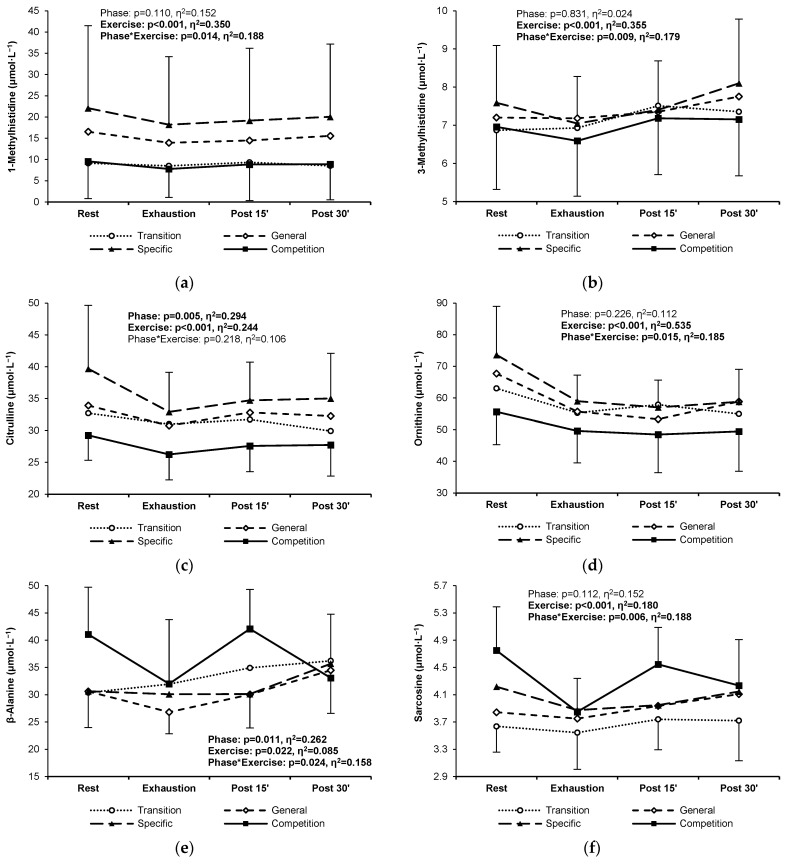
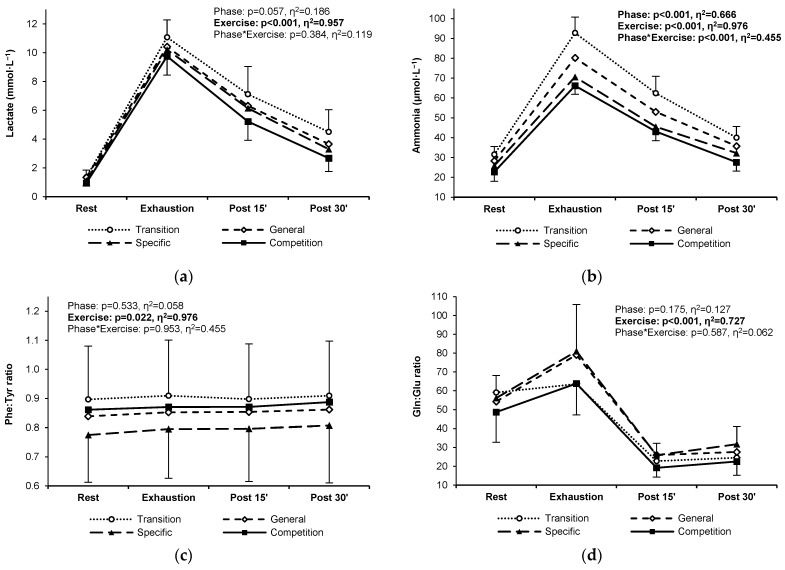
Free amino acids substantially contribute to energy metabolism. Also, their profile may identify (over)training status and effectiveness. The long-term effects of speed-power training on plasma free amino acid (PFAA) profiles are not known. We aimed to observe variations in PFAA levels in high-performance sprinters in a six-month training cycle. Ten male athletes (24.6 ± 3.3 years) were examined during four training phases: transition (1 month), general preparation (2 months), specific preparation (1 month), and pre-competition/competition (2 months). Venous blood was collected at rest, after exhaustive exercise, and recovery. Forty-two PFAAs were analyzed by the LC-ESI-MS/MS method. Significant decreases in resting concentrations were observed between the transition and competition phases for glutamine (762 ± 117 vs. 623 ± 53 μmol∙L; < 0.001, η = 0.47) and histidine (89 ± 15 vs. 75 ± 10 μmol∙L; = 0.010, η = 0.27), whereas β-alanine (30 ± 7 vs. 41 ± 9 μmol∙L; = 0.024, η = 016) and sarcosine (3.6 ± 0.4 vs. 4.8 ± 0.6 μmol∙L; = 0.006, η = 0.188) levels increased. Between the specific and competition phases, significant decreases in the resting levels of 1-methylhistidine (22.1 ± 19.4 vs. 9.6 ± 8.8 μmol∙L; = 0.14, η = 0.19), 3-methylhistidine (7.1 ± 1.5 vs. 6.5 ± 1.6 μmol∙L; = 0.009, η = 0.18), citrulline (40 ± 10 vs. 29 ± 4 μmol∙L; = 0.05, η = 0.29), and ornithine (74 ± 15 vs. 56 ± 10 μmol∙L; = 0.015, η = 185) were noticed. Also, for β-alanine and sarcosine, the pattern of response to exercise strongly changed between the training phases. Blood ammonia levels at exhaustion decreased between the transition and competition phases (32 ± 4 vs. 23 ± 5 μmol∙L; < 0.001, η = 0.67), while lactate, the phenylalanine-tyrosine ratio, the glutamine-glutamate ratio, hematological parameters, and cardiorespiratory indices remained at similar levels. Speed-power training seems to affect PFAAs involved in skeletal muscle metabolic pathways responsible for neutralizing toxic ammonia (glutamine, arginine, citrulline, ornithine), attenuating the deleterious effects of H ions (histidine, β-alanine), and reducing exercise-induced protein breakdown (1- and 3-methylhistidine). Our findings suggest that sprint-oriented training supports metabolic pathways that are responsible for the removal of harmful metabolites produced during exercise.
游离氨基酸对能量代谢有重要贡献。此外,它们的组成特征可能有助于识别(过度)训练状态及训练效果。速度 - 力量训练对血浆游离氨基酸(PFAA)组成特征的长期影响尚不清楚。我们旨在观察高水平短跑运动员在为期六个月的训练周期中PFAA水平的变化。对10名男性运动员(24.6±3.3岁)在四个训练阶段进行了检测:过渡阶段(1个月)、一般准备阶段(2个月)、专项准备阶段(1个月)和赛前/比赛阶段(2个月)。在静息状态、力竭运动后及恢复阶段采集静脉血。采用液相色谱 - 电喷雾串联质谱法(LC - ESI - MS/MS)分析了42种PFAA。在过渡阶段和比赛阶段之间,观察到谷氨酰胺(762±117 vs. 623±53μmol∙L;<0.001,η = 0.47)和组氨酸(89±15 vs. 75±10μmol∙L;= 0.010,η = 0.27)的静息浓度显著降低,而β - 丙氨酸(30±7 vs. 41±9μmol∙L;= 0.024,η = 0.16)和肌氨酸(3.6±0.4 vs. 4.8±0.6μmol∙L;= 0.006,η = 0.188)水平升高。在专项准备阶段和比赛阶段之间,观察到1 - 甲基组氨酸(22.1±19.4 vs. 9.6±8.8μmol∙L;= 0.14,η = 0.19)、3 - 甲基组氨酸(7.1±1.5 vs. 6.5±1.6μmol∙L;= 0.009,η = 0.18)、瓜氨酸(40±10 vs. 29±4μmol∙L;= 0.05,η = 0.29)和鸟氨酸(74±15 vs. 56±10μmol∙L;= 0.015,η = 0.185)的静息水平显著降低。此外,对于β - 丙氨酸和肌氨酸,运动反应模式在训练阶段之间发生了显著变化。力竭时的血氨水平在过渡阶段和比赛阶段之间有所下降(32±4 vs. 23±5μmol∙L;<0.001,η = 0.67),而乳酸、苯丙氨酸 - 酪氨酸比值、谷氨酰胺 - 谷氨酸比值、血液学参数和心肺指标保持在相似水平。速度 - 力量训练似乎会影响参与骨骼肌代谢途径的PFAA,这些途径负责中和有毒氨(谷氨酰胺、精氨酸、瓜氨酸、鸟氨酸)、减轻H离子的有害影响(组氨酸、β - 丙氨酸)以及减少运动诱导的蛋白质分解(1 - 和3 - 甲基组氨酸)。我们的研究结果表明,以短跑为导向的训练支持负责清除运动过程中产生的有害代谢产物的代谢途径。