
羧甲基纤维素和聚乙烯醇对由再生碳纤维组成的无纺布的分散性和化学官能团的影响
Effect of Carboxymethyl Cellulose and Polyvinyl Alcohol on the Dispersibility and Chemical Functional Group of Nonwoven Fabrics Composed of Recycled Carbon Fibers.
作者信息
Kim Kyungeun, Kim Gyungha, Kim Daeup
机构信息
Carbon & Light Materials Group, Korea Institute of Industrial Technology, Jeonju-si 54853, Republic of Korea.
出版信息
Materials (Basel). 2024 Aug 26;17(17):4209. doi: 10.3390/ma17174209.
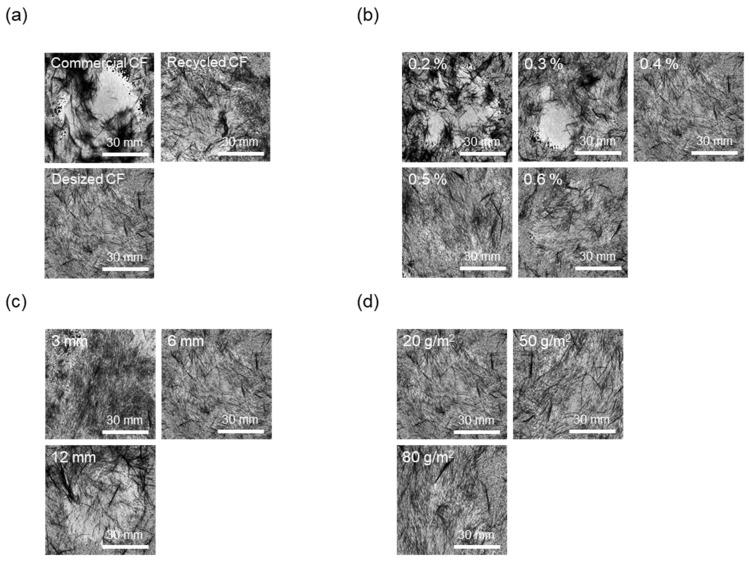
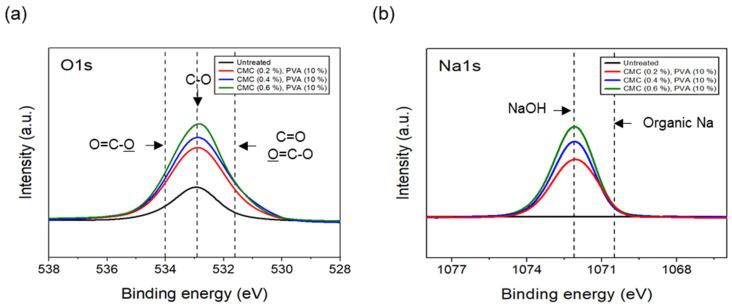
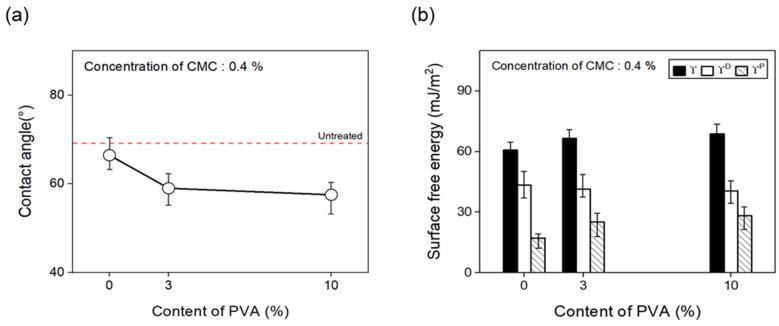
In this study, recycled carbon fibers (rCFs) recovered from waste carbon composites were used to manufacture wet-laid nonwoven fabrics. The aim was to improve dispersibility by investigating the changes in the dispersibility of carbon fibers (CFs) based on the content of the dispersant carboxymethyl cellulose (CMC) and the binder polyvinyl alcohol (PVA), and the length and basis weight of the CFs. In addition, the chemical property changes and oxygen functional group mechanisms based on the content of the CMC dispersant and PVA binder were investigated. The nonwoven fabrics made with desized CFs exhibited significantly improved dispersibility. For nonwoven fabrics produced with a fixed binder PVA content of 10%, optimal dispersibility was achieved at a dispersant CMC concentration of 0.4%. When the dispersant CMC concentration was fixed at 0.4% and the binder PVA content at 10%, the best dispersibility was observed at a CF length of 3 mm, while the maximum tensile strength was achieved at a fiber length of 6 mm. Dispersibility remained almost consistent across different basis weights. As the dispersant CMC concentration increased from 0.2% to 0.6%, the oxygen functional groups, such as carbonyl group (C=O), lactone group (O=C-O), and natrium hydroxide (NaOH), also increased. However, hydroxyl group (C-O) decreased. Moreover, the contact angle decreased, while the surface free energy increased. On the other hand, when the dispersant CMC concentration was fixed at 0.4%, the optimal binder PVA content was found to be 3%. As the binder PVA content increased from 0% to 10%, the formation of hydrogen bonds between the CMC dispersant and the PVA binder led to an increase in C=O and O=C-O bonds, while C-O and NaOH decreased. As the amount of oxygen increased, the contact angle decreased and the surface free energy increased.
在本研究中,从废弃碳复合材料中回收的再生碳纤维(rCFs)被用于制造湿法非织造布。目的是通过研究基于分散剂羧甲基纤维素(CMC)和粘合剂聚乙烯醇(PVA)的含量、碳纤维(CFs)的长度和定量,来考察碳纤维分散性的变化,从而提高分散性。此外,还研究了基于CMC分散剂和PVA粘合剂含量的化学性质变化和氧官能团机理。用退浆后的碳纤维制成的非织造布表现出显著改善的分散性。对于固定粘合剂PVA含量为10%生产的非织造布,在分散剂CMC浓度为0.4%时实现了最佳分散性。当分散剂CMC浓度固定在0.4%且粘合剂PVA含量为10%时,在CF长度为3mm时观察到最佳分散性,而在纤维长度为6mm时达到最大拉伸强度。不同定量下的分散性几乎保持一致。随着分散剂CMC浓度从0.2%增加到0.6%,羰基(C=O)、内酯基(O=C-O)和氢氧化钠(NaOH)等氧官能团也增加。然而,羟基(C-O)减少。此外,接触角减小,而表面自由能增加。另一方面,当分散剂CMC浓度固定在0.4%时,发现最佳粘合剂PVA含量为3%。随着粘合剂PVA含量从0%增加到10%,CMC分散剂与PVA粘合剂之间氢键的形成导致C=O和O=C-O键增加,而C-O和NaOH减少。随着氧量增加,接触角减小,表面自由能增加。





 Zotero 插件