Hugh Sinclair Unit of Human Nutrition, Department of Food and Nutritional Sciences, Institute for Cardiovascular and Metabolic Research (ICMR), University of Reading, Reading RG6 6DZ, UK.
Department of Nutrition, Faculty of Health Sciences, Alma Ata University, Bantul, Yogyakarta 55183, Indonesia.
Nutrients. 2024 Sep 6;16(17):3022. doi: 10.3390/nu16173022.
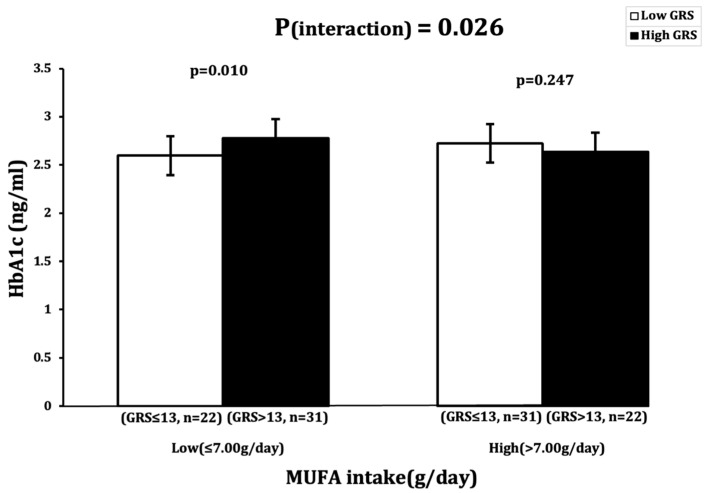
Metabolic diseases result from interactions between genetic and lifestyle factors. Understanding the combined influences of single-nucleotide polymorphisms (SNPs) and lifestyle is crucial. This study employs genetic risk scores (GRS) to assess SNPs, providing insight beyond single gene/SNP studies by revealing synergistic effects. Here, we aim to investigate the association of a 23-SNP GRS with metabolic disease-related traits (obesity and type 2 diabetes) to understand if these associations are altered by lifestyle/dietary factors. For this study, 106 Minangkabau women were included and underwent physical, anthropometric, biochemical, dietary and genetic evaluations. The interaction of GRS with lifestyle factors was analyzed using linear regression models, adjusting for potential confounders. No statistically significant associations were observed between GRS and metabolic traits; however, this study demonstrates a novel interaction observed between 13-SNP GRS and monounsaturated fatty acid (MUFA) intake, and that it had an effect on HbA1c levels ( = 0.026). Minangkabau women with low MUFA intake (≤7.0 g/day) and >13 risk alleles had significantly higher HbA1c levels ( = 0.010). This finding has implications for public health, suggesting the need for large-scale studies to confirm our results before implementing dietary interventions in the Indonesian population. Identifying genetic influences on dietary response can inform personalized nutrition strategies to reduce the risk of metabolic disease.
代谢疾病是由遗传和生活方式因素相互作用引起的。了解单核苷酸多态性 (SNP) 和生活方式的综合影响至关重要。本研究采用遗传风险评分 (GRS) 来评估 SNP,通过揭示协同效应,提供超越单个基因/SNP 研究的见解。在这里,我们旨在研究 23-SNP GRS 与代谢疾病相关特征(肥胖和 2 型糖尿病)之间的关联,以了解这些关联是否受到生活方式/饮食因素的改变。为此,我们纳入了 106 名米南卡保女性,并对其进行了身体、人体测量、生化、饮食和遗传评估。使用线性回归模型分析 GRS 与生活方式因素的相互作用,调整了潜在的混杂因素。GRS 与代谢特征之间没有观察到统计学上的显著关联;然而,本研究表明,在单不饱和脂肪酸 (MUFA) 摄入和 13-SNP GRS 之间观察到一种新的相互作用,并且它对 HbA1c 水平有影响( = 0.026)。MUFA 摄入量低(≤7.0g/天)和风险等位基因数>13 的米南卡保女性 HbA1c 水平显著更高( = 0.010)。这一发现对公共卫生具有重要意义,表明需要进行大规模研究来确认我们的结果,然后才能在印度尼西亚人群中实施饮食干预。确定遗传对饮食反应的影响可以为个性化营养策略提供信息,以降低代谢疾病的风险。