Eftekhari Zohre, Zohrabi Horieh, Oghalaie Akbar, Ebrahimi Tahereh, Shariati Fatemeh Sadat, Behdani Mahdi, Kazemi-Lomedasht Fatemeh
Venom and Biotherapeutics Molecules Laboratory, Biotechnology Department, Biotechnology Research Center, Pasteur Institute of Iran, Tehran 1316943551, Iran.
Department of Nanobiotechnology, New Technologies Research Group, Pasteur Institute of Iran, Tehran 1316943551, Iran.
Mol Ther Nucleic Acids. 2024 Aug 19;35(3):102313. doi: 10.1016/j.omtn.2024.102313. eCollection 2024 Sep 10.
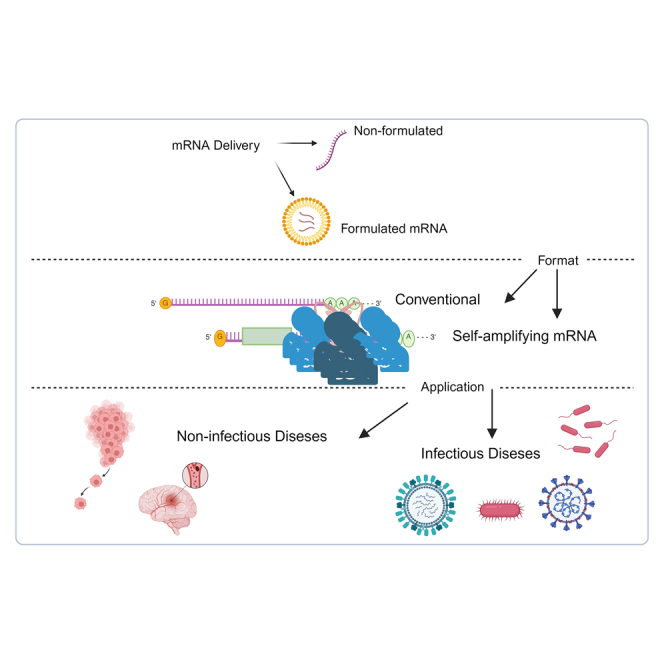
The use of mRNA and ribonucleoproteins (RNPs) as therapeutic agents is a promising strategy for treating diseases such as cancer and infectious diseases. This review provides recent advancements and challenges in mRNA- and RNP-based therapies, focusing on delivery systems such as lipid nanoparticles (LNPs), which ensure efficient delivery to target cells. Strategies such as microfluidic devices are employed to prepare LNPs loaded with mRNA and RNPs, demonstrating effective genome editing and protein expression and . These applications extend to cancer treatment and infectious disease management, with promising results in genome editing for cancer therapy using LNPs encapsulating Cas9 mRNA and single-guide RNA. In addition, tissue-specific targeting strategies offer potential for improved therapeutic outcomes and reduced off-target effects. Despite progress, challenges such as optimizing delivery efficiency and targeting remain. Future research should enhance delivery efficiency, explore tissue-specific targeting, investigate combination therapies, and advance clinical translation. In conclusion, mRNA- and RNP-based therapies offer a promising avenue for treating various diseases and have the potential to revolutionize medicine, providing new hope for patients worldwide.
将信使核糖核酸(mRNA)和核糖核蛋白(RNP)用作治疗剂是治疗癌症和传染病等疾病的一种很有前景的策略。本综述介绍了基于mRNA和RNP的疗法的最新进展与挑战,重点关注脂质纳米颗粒(LNP)等递送系统,这些系统可确保有效递送至靶细胞。诸如微流控装置等策略被用于制备负载mRNA和RNP的LNP,显示出有效的基因组编辑和蛋白质表达。这些应用扩展到癌症治疗和传染病管理,在使用包裹Cas9 mRNA和单向导RNA的LNP进行癌症治疗的基因组编辑方面取得了有前景的结果。此外,组织特异性靶向策略为改善治疗效果和减少脱靶效应提供了潜力。尽管取得了进展,但仍存在诸如优化递送效率和靶向等挑战。未来的研究应提高递送效率、探索组织特异性靶向、研究联合疗法并推进临床转化。总之,基于mRNA和RNP的疗法为治疗各种疾病提供了一条很有前景的途径,并有潜力彻底改变医学,为全球患者带来新的希望。