Katrinli Seyma, Rothbaum Alex O, DeMoss Raneeka, Turner William C, Hunter Ben, Powers Abigail, Michopoulos Vasiliki, Smith Alicia K
Department of Gynecology and Obstetrics, Emory University, Atlanta, GA.
Skyland Trail, Atlanta, GA.
medRxiv. 2024 Sep 4:2024.09.04.24313069. doi: 10.1101/2024.09.04.24313069.
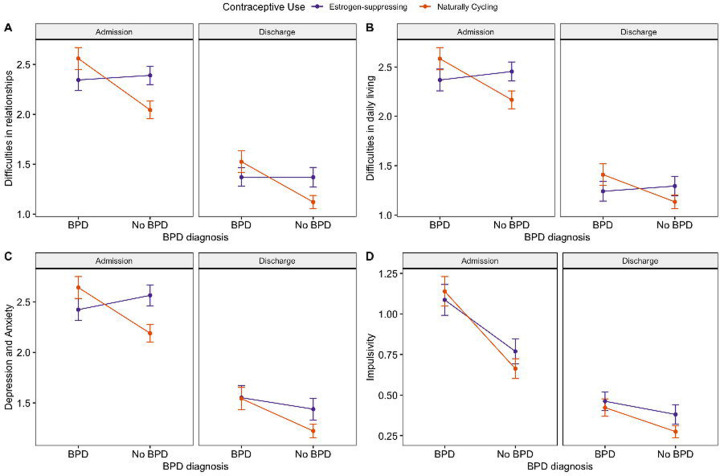
Borderline Personality Disorder (BPD) is characterized by rapidly shifting emotional, interpersonal, and behavioral symptoms, and is often co-morbid with mood and anxiety disorders. Females are more likely to be diagnosed with BPD than males and exhibit greater functional impairment. Hormonal fluctuations, particularly in estrogen levels, may influence the manifestation of BPD symptoms. Here we investigated the influence of estrogen-suppressing contraceptives on behavioral and functional difficulties in BPD. The analytical sample included 348 females ages 18-50 undergoing residential treatment for psychiatric disorders, with 131 having a BPD diagnosis. Patients were categorized based on their contraceptive method: 1) Estrogen-suppressing contraceptives (N=145) and 2) Naturally cycling (N=203). Interaction models tested the impact of estrogen-suppressing contraceptives on the relationship between BPD diagnosis and behavioral and functional difficulties at admission and discharge, assessed by the four Behavior and Symptom Identification Scale (BASIS-32) domains: difficulties in relationships, daily living, depression/anxiety, and impulsivity. Females with a BPD diagnosis were more likely to use estrogen-suppressing contraceptives compared to those without BPD (p=0.04). However, estrogen-suppressing contraceptive use was not associated with behavioral and functional difficulties at admission, discharge, or over time. Estrogen-suppressing contraceptives moderated the association between BPD diagnosis and difficulties in relationships (p=0.004), difficulties in daily living (p=0.01), and depression/anxiety symptoms (p=0.004). Patients with BPD expressed increased behavioral and functional difficulties at admission, discharge, and over time only if naturally cycling (p<0.003). Our findings suggest that estrogen-suppressing contraceptives may help to regulate the rapidly shifting emotional, interpersonal, and behavioral symptoms in females with BPD by stabilizing estrogen levels.
边缘性人格障碍(BPD)的特征是情绪、人际关系和行为症状迅速变化,且常与情绪和焦虑障碍共病。女性比男性更易被诊断为BPD,且表现出更大的功能损害。激素波动,尤其是雌激素水平的波动,可能会影响BPD症状的表现。在此,我们研究了抑制雌激素的避孕药对BPD患者行为和功能障碍的影响。分析样本包括348名年龄在18至50岁之间因精神疾病接受住院治疗的女性,其中131人被诊断为BPD。患者根据其避孕方法进行分类:1)抑制雌激素的避孕药(N = 145)和2)自然月经周期(N = 203)。交互模型测试了抑制雌激素的避孕药对入院和出院时BPD诊断与行为和功能障碍之间关系的影响,通过四个行为和症状识别量表(BASIS - 32)领域进行评估:人际关系困难、日常生活困难、抑郁/焦虑和冲动性。与无BPD的女性相比,被诊断为BPD的女性更有可能使用抑制雌激素的避孕药(p = 0.04)。然而,使用抑制雌激素的避孕药与入院、出院时或随访期间的行为和功能障碍无关。抑制雌激素的避孕药调节了BPD诊断与人际关系困难(p = 0.004)、日常生活困难(p = 0.01)和抑郁/焦虑症状(p = 0.004)之间的关联。只有自然月经周期的BPD患者在入院、出院时及随访期间表现出行为和功能障碍增加(p < 0.003)。我们的研究结果表明,抑制雌激素的避孕药可能通过稳定雌激素水平来帮助调节BPD女性迅速变化的情绪、人际关系和行为症状。