Martin Katie E, Kudryk Sophie M, Moscovitch David A
Department of Psychology and Centre for Mental Health Research and Treatment, University of Waterloo, Waterloo, Ontario, Canada.
Br J Clin Psychol. 2025 Jun;64(2):281-296. doi: 10.1111/bjc.12504. Epub 2024 Sep 16.
Social anxiety is characterized by maladaptive self-schemas about being socially undesirable. Self-schemas are deeply held beliefs which are derived from negative autobiographical memories of painful social experiences. In contrast to the plethora of past research on negative memories in social anxiety, almost no research has investigated objectively positive social autobiographical memories. In this preregistered study, we examined the effects of social anxiety and self-schemas on the appraised impact and meaningfulness of retrieved positive versus negative social autobiographical memories.
Participants recruited via Prolific (final n = 343) were randomized to one of two conditions in which they were instructed to retrieve, orally narrate, and appraise a positive or negative social autobiographical memory of a specific experience from their personal past where they felt either valued or unvalued, respectively.
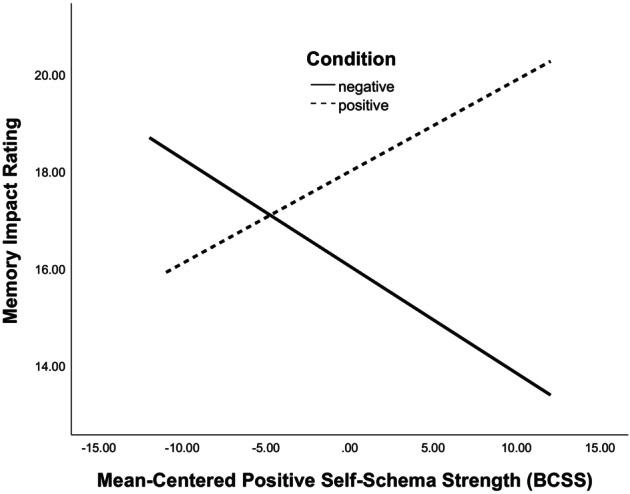
Results demonstrated that participants rated their positive memories as more impactful and meaningful than negative memories overall, but this effect was reversed for participants who endorsed having either stronger negative self-schemas or greater social anxiety symptoms, for whom negative memories were more impactful. Additionally, participants who endorsed having stronger positive self-schemas rated their negative memories as significantly less impactful and their positive memories as nearly more impactful.
Together, these results elucidate how self-schemas and social anxiety are related to autobiographical memory appraisals, paving the way for future research on memory-based therapeutic interventions for social anxiety disorder.
社交焦虑的特征是存在关于在社交方面不受欢迎的适应不良的自我图式。自我图式是源于痛苦社交经历的负面自传体记忆的根深蒂固的信念。与过去大量关于社交焦虑中负面记忆的研究形成对比的是,几乎没有研究客观地调查过积极的社交自传体记忆。在这项预先注册的研究中,我们考察了社交焦虑和自我图式对所提取的积极与消极社交自传体记忆的评估影响及意义的作用。
通过Prolific招募的参与者(最终n = 343)被随机分配到两种条件之一,在这两种条件下,他们被要求回忆、口头叙述并评估一段来自个人过去的特定经历的积极或消极社交自传体记忆,在这些经历中他们分别感到自己被重视或不被重视。
结果表明,总体而言,参与者认为他们的积极记忆比消极记忆更具影响力和意义,但对于那些认可有更强的消极自我图式或更严重社交焦虑症状的参与者来说,这种效应则相反,对他们而言消极记忆更具影响力。此外,认可有更强积极自我图式的参与者认为他们的消极记忆影响力明显更小,而积极记忆几乎更具影响力。
总之,这些结果阐明了自我图式和社交焦虑如何与自传体记忆评估相关,为未来关于社交焦虑障碍基于记忆的治疗干预研究铺平了道路。