Chen Li, Xue Jianbo, He Yukun, Zhao Lili, Zhang Ying, Yin Lu, Fu Shining, Yu Wenyi, Ma Xinqian, Wang Yu, Tang Yanfen, Gao Zhancheng
Department of Respiratory, Beijing Ditan Hospital, Capital Medical University, Beijing, People's Republic of China.
Department of Respiratory & Critical Care Medicine, Peking University People's Hospital, Beijing, China.
Ann Med. 2024 Dec;56(1):2399320. doi: 10.1080/07853890.2024.2399320. Epub 2024 Sep 16.
Patients with bacterial, fungal, and viral community-acquired pneumonia (CAP) were studied to determine their metabolic profiles.
Loop-mediated isothermal amplification technology and nucleic acid sequence-dependent amplification combined with microfluidic chip technology were applied to screen multiple pathogens from respiratory tract samples. Eighteen patients with single bacterial infection (B-CAP), fifteen with single virus infection (V-CAP), twenty with single fungal infection (F-CAP), and twenty controls were enrolled. UHPLC-MS/MS analysis of untargeted serum samples for metabolic profiles. Multiple linear regression and Spearman's rank correlation analysis were used to determine associations between metabolites and clinical parameters. The sensitivity and specificity of the screened metabolites were also examined, along with their area under the curve.
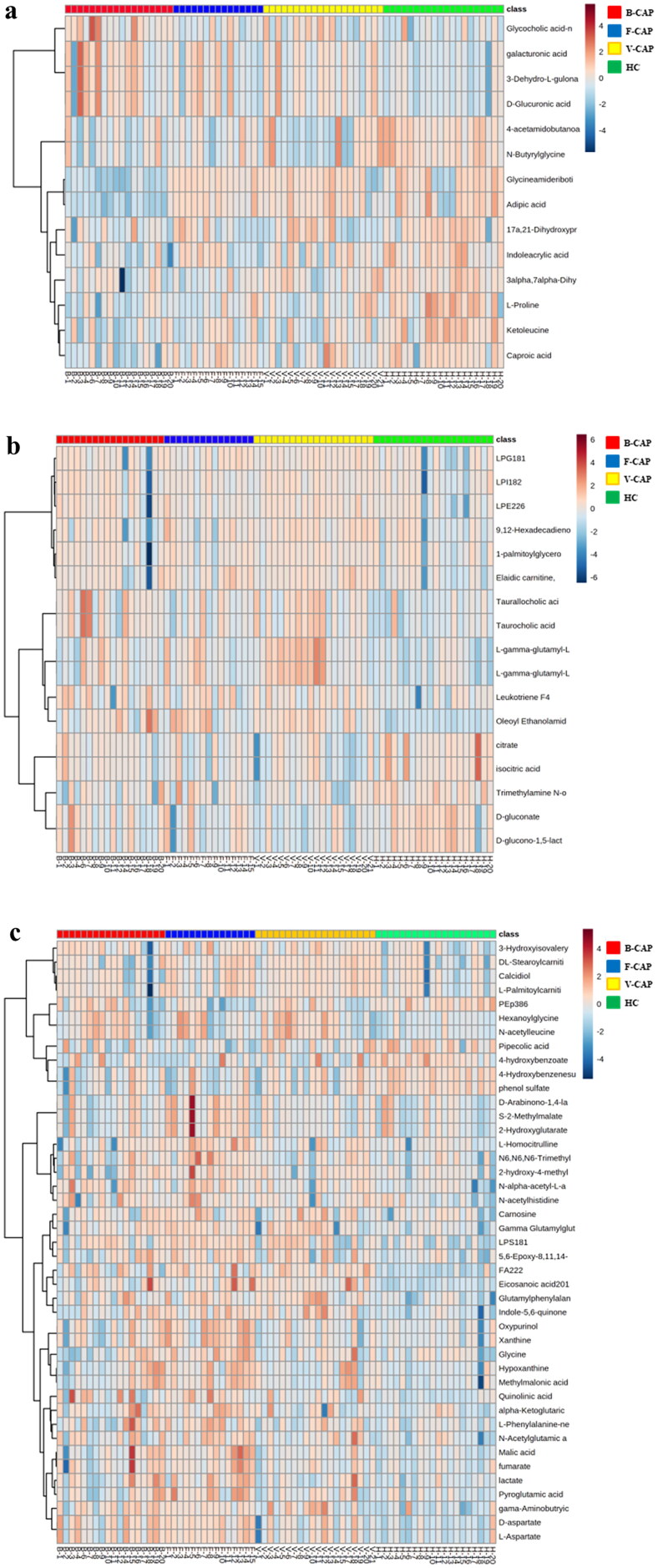
The metabolic signatures of patients with CAP infected by bacteria, viruses, and fungi were markedly different from those of controls. The abundances of 45, 56, and 79 metabolites were significantly unbalanced. Among these differential metabolites, 11, 13, and 29 were unique to the B-CAP, V-CAP, and F-CAP groups, respectively. Bacterial infections were the only known causes of disturbances in the pentose and glucuronate and aldarate and ascorbate metabolism interconversions metabolic pathway.
Serum metabolomic techniques based on UHPLC-MS/MS may identify differences between individuals with CAP who have been infected by various pathogens, and they can also build a metabolite signature for early detection of the origin of infection and prompt care.
对患有细菌、真菌和病毒引起的社区获得性肺炎(CAP)的患者进行研究,以确定他们的代谢谱。
应用环介导等温扩增技术以及核酸序列依赖性扩增与微流控芯片技术相结合的方法,从呼吸道样本中筛选多种病原体。纳入18名单一细菌感染的患者(B-CAP)、15名单一病毒感染的患者(V-CAP)、20名单一真菌感染的患者(F-CAP)以及20名对照。采用超高效液相色谱-串联质谱(UHPLC-MS/MS)分析非靶向血清样本的代谢谱。使用多元线性回归和Spearman秩相关分析来确定代谢物与临床参数之间的关联。还检查了筛选出的代谢物的敏感性和特异性及其曲线下面积。
细菌、病毒和真菌感染的CAP患者的代谢特征与对照组明显不同。45、56和79种代谢物的丰度显著失衡。在这些差异代谢物中,分别有11种、13种和29种是B-CAP、V-CAP和F-CAP组所特有的。细菌感染是戊糖、葡萄糖醛酸和醛糖二酸以及抗坏血酸代谢相互转化代谢途径紊乱的唯一已知原因。
基于UHPLC-MS/MS的血清代谢组学技术可以识别感染各种病原体的CAP个体之间的差异,还可以建立代谢物特征用于早期检测感染源并及时治疗。