You Wenpeng
Adelaide Medical School The University of Adelaide Adelaide South Australia Australia.
Heart and Lung, Royal Adelaide Hospital Adelaide South Australia Australia.
Health Sci Rep. 2024 Sep 16;7(9):e70065. doi: 10.1002/hsr2.70065. eCollection 2024 Sep.
Ambient ultraviolet radiation (UVR) has been found to have a greater cardioprotective effect than previously believed. This study aimed to quantitatively measure the role of UVR in protecting against the progression of cardiovascular disease (CVD) in general on a global and regional scale.
Population-level data on UVR, CVD incidence, aging, economic affluence, CVD genetic background (indexed with the Biological State Index, I), obesity prevalence, and urbanization were collected and analysed. The correlation between UVR and CVD was examined using bivariate correlations, partial correlation, and stepwise multiple linear regression. Countries were grouped to investigate regional correlations between UVR and CVD, and Fisher's r-to-z transformation was used to compare correlation coefficients.
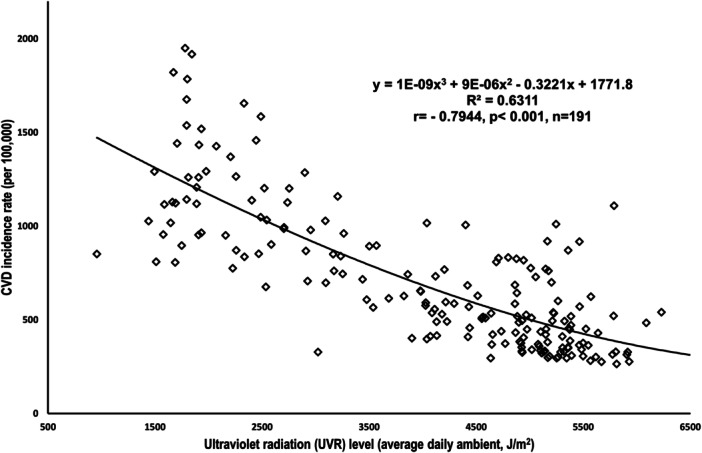
UVR showed a significant inverse correlation with CVD incidence rates in bivariate correlation analyses globally ( = - 0.775 and = - 0.760, < 0.001), as well as within high-income ( = -0.704, < 0.001) and low- and middle-income countries (LMIC) ( = -0.851, < 0.001). These correlations remained significant even after controlling for confounding variables ( = -0.689 to -0.812, < 0.001). In stepwise regression models, UVR was found to be the most significant predictor of CVD incidence. The inverse correlation between UVR and CVD was stronger in LMICs compared to high-income countries ( = -1.96, < 0.050).
Low ambient UVR may be a significant risk factor for the progression of CVD worldwide. The protective effect of UVR appears to be stronger in LMICs than in high-income countries, suggesting a greater impact of UVR on CVD prevention in these regions. These findings emphasize the need for further research into the mechanisms underlying the cardioprotective effects of UVR and the development of public health strategies to mitigate CVD risk associated with low UVR exposure.
已发现环境紫外线辐射(UVR)具有比先前认为的更大的心脏保护作用。本研究旨在在全球和区域范围内定量测量UVR在总体上预防心血管疾病(CVD)进展中的作用。
收集并分析了关于UVR、CVD发病率、老龄化、经济富裕程度、CVD遗传背景(以生物状态指数I为指标)、肥胖患病率和城市化的人群水平数据。使用双变量相关性、偏相关性和逐步多元线性回归来检验UVR与CVD之间的相关性。对国家进行分组以研究UVR与CVD之间的区域相关性,并使用费舍尔r到z变换来比较相关系数。
在全球双变量相关性分析中,UVR与CVD发病率呈显著负相关(r = - 0.775和r = - 0.760,P < 0.001),在高收入国家(r = -0.704,P < 0.001)和低收入和中等收入国家(LMIC)(r = -0.851,P < 0.001)中也是如此。即使在控制混杂变量后,这些相关性仍然显著(r = -0.689至-0.812,P < 0.001)。在逐步回归模型中,发现UVR是CVD发病率的最显著预测因子。与高收入国家相比,LMIC中UVR与CVD之间的负相关性更强(z = -1.96,P < 0.050)。
低环境UVR可能是全球CVD进展的一个重要危险因素。UVR的保护作用在LMIC中似乎比在高收入国家更强,表明UVR对这些地区CVD预防的影响更大。这些发现强调需要进一步研究UVR心脏保护作用的潜在机制,并制定公共卫生策略以减轻与低UVR暴露相关的CVD风险。