
解读护理研究中的机器学习:有效算法的范围综述
Decoding machine learning in nursing research: A scoping review of effective algorithms.
作者信息
Choi Jeeyae, Lee Hanjoo, Kim-Godwin Yeounsoo
机构信息
School of Nursing, College of Health and Human Services, University of North Carolina Wilmington, Wilmington, North Carolina, USA.
Joint Biomedical Engineering Department, School of Medicine, University of North Carolina Chapel Hill, Chapel Hill, North Carolina, USA.
出版信息
J Nurs Scholarsh. 2025 Jan;57(1):119-129. doi: 10.1111/jnu.13026. Epub 2024 Sep 18.
INTRODUCTION
The rapid evolution of artificial intelligence (AI) technology has revolutionized healthcare, particularly through the integration of AI into health information systems. This transformation has significantly impacted the roles of nurses and nurse practitioners, prompting extensive research to assess the effectiveness of AI-integrated systems. This scoping review focuses on machine learning (ML) used in nursing, specifically investigating ML algorithms, model evaluation methods, areas of focus related to nursing, and the most effective ML algorithms.
DESIGN
The scoping review followed the Preferred Reporting Items for Systematic Review and Meta-Analysis Extension for Scoping Reviews (PRISMA-ScR) guidelines.
METHODS
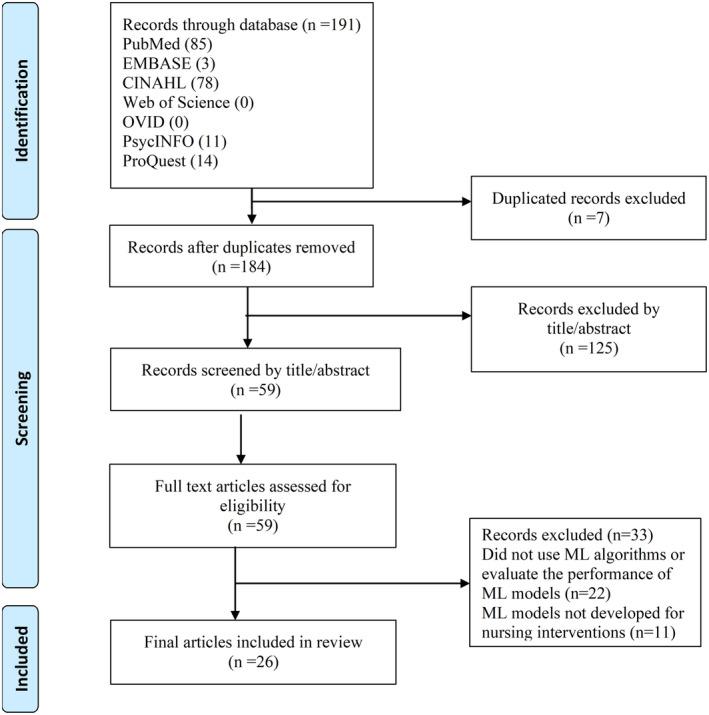
A structured search was performed across seven databases according to PRISMA-ScR: PubMed, EMBASE, CINAHL, Web of Science, OVID, PsycINFO, and ProQuest. The quality of the final reviewed studies was assessed using the Medical Education Research Study Quality Instrument (MERSQI).
RESULTS
Twenty-six articles published between 2019 and 2023 met the inclusion and exclusion criteria, and 46% of studies were conducted in the US. The average MERSQI score was 12.2, indicative of moderate- to high-quality studies. The most used ML algorithm was Random Forest. The four second-most used were logistic regression, least absolute shrinkage and selection operator, decision tree, and support vector machine. Most ML models were evaluated by calculating sensitivity (recall)/specificity, accuracy, receiver operating characteristic (ROC), area under the ROC (AUROC), and positive/negative prediction value (precision). Half of the studies focused on nursing staff or students and hospital readmission or emergency department visits. Only 11 articles reported the most effective ML algorithm(s).
CONCLUSION
The scoping review provides insights into the current status of ML research in nursing and recognition of its significance in nursing research, confirming the benefits of ML in healthcare. Recommendations include incorporating experimental designs in research studies to optimize the use of ML models across various nursing domains.
CLINICAL RELEVANCE
The scoping review demonstrates substantial clinical relevance of ML applications for nurses, nurse practitioners, administrators, and researchers. The integration of ML into healthcare systems and its impact on nursing practices have important implications for patient care, resource management, and the evolution of nursing research.
引言
人工智能(AI)技术的迅速发展给医疗保健带来了变革,特别是通过将AI整合到健康信息系统中。这种转变对护士和执业护士的角色产生了重大影响,促使人们进行广泛研究以评估AI集成系统的有效性。本范围综述聚焦于护理中使用的机器学习(ML),特别研究ML算法、模型评估方法、与护理相关的重点领域以及最有效的ML算法。
设计
本范围综述遵循系统综述和Meta分析扩展的范围综述首选报告项目(PRISMA-ScR)指南。
方法
根据PRISMA-ScR在七个数据库中进行结构化检索:PubMed、EMBASE、CINAHL、科学网、OVID、PsycINFO和ProQuest。使用医学教育研究质量工具(MERSQI)评估最终纳入综述的研究质量。
结果
2019年至2023年发表的26篇文章符合纳入和排除标准,46%的研究在美国进行。MERSQI平均得分为12.2,表明研究质量为中到高。使用最多的ML算法是随机森林。其次使用最多的四种算法是逻辑回归、最小绝对收缩和选择算子、决策树和支持向量机。大多数ML模型通过计算敏感性(召回率)/特异性、准确性、受试者工作特征(ROC)、ROC曲线下面积(AUROC)以及阳性/阴性预测值(精确率)进行评估。一半的研究关注护理人员或学生以及医院再入院或急诊科就诊情况。只有11篇文章报告了最有效的ML算法。
结论
本范围综述提供了对护理中ML研究现状的见解,并认识到其在护理研究中的重要性,证实了ML在医疗保健中的益处。建议包括在研究中纳入实验设计,以优化ML模型在各个护理领域的应用。
临床相关性
本范围综述表明ML应用对护士、执业护士、管理人员和研究人员具有重大临床相关性。将ML整合到医疗保健系统及其对护理实践的影响对患者护理、资源管理和护理研究的发展具有重要意义。
 Zotero 插件