Santiago-Cruz Hosea A, Lou Zimo, Xu Jiang, Sullivan Ryan C, Bowers Bailey B, Molé Rachel A, Zhang Wan, Li Jinghao, Yuan Joshua S, Dai Susie Y, Lowry Gregory V
Department of Civil and Environmental Engineering, Carnegie Mellon University, Pittsburgh, Pennsylvania 15213, United States.
Collaborative Innovation Center of Yangtze River Delta Region Green Pharmaceuticals, Zhejiang University of Technology, Hangzhou 310014, China.
ACS ES T Eng. 2024 Aug 2;4(9):2220-2233. doi: 10.1021/acsestengg.4c00211. eCollection 2024 Sep 13.
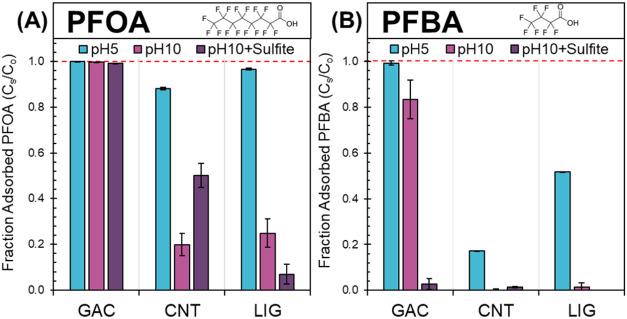
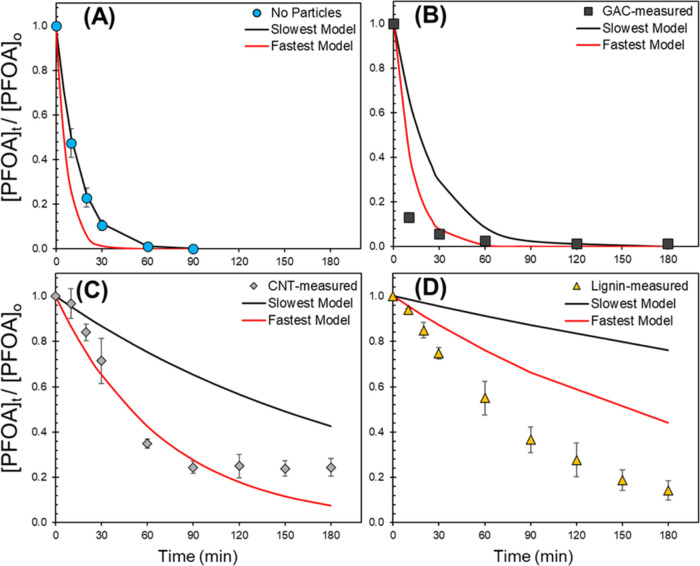
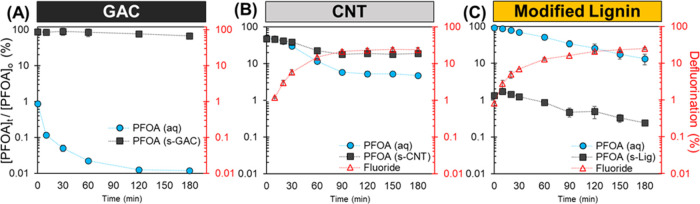
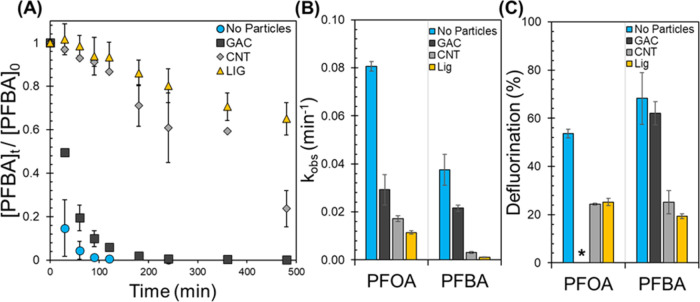
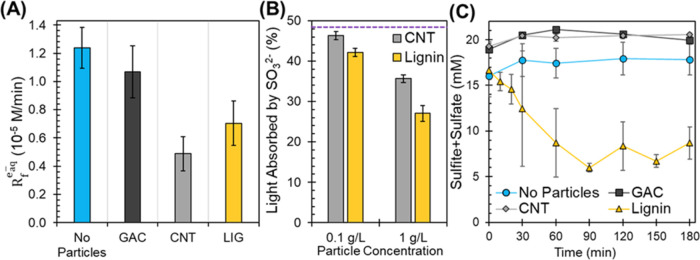
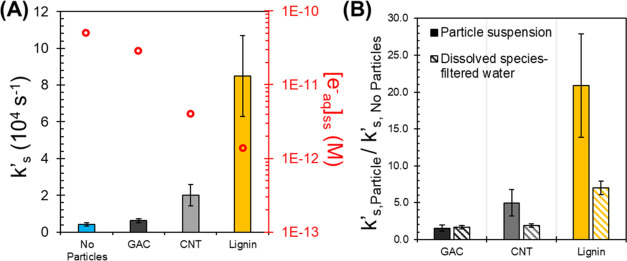
Carbon-based adsorbents used to remove recalcitrant water contaminants, including perfluoroalkyl substances (PFAS), are often regenerated using energy-intensive treatments that can form harmful byproducts. We explore mechanisms for sorbent regeneration using hydrated electrons (e ) from sulfite ultraviolet photolysis (UV/sulfite) in water. We studied the UV/sulfite treatment on three carbon-based sorbents with varying material properties: granular activated carbon (GAC), carbon nanotubes (CNTs), and polyethylenimine-modified lignin (lignin). Reaction rates and defluorination of dissolved and adsorbed model perfluorocarboxylic acids (PFCAs), perfluorooctanoic acid (PFOA) and perfluorobutanoic acid (PFBA), were measured. Monochloroacetic acid (MCAA) was employed to empirically quantify e formation rates in heterogeneous suspensions. Results show that dissolved PFCAs react rapidly compared to adsorbed ones. Carbon particles in solution decreased aqueous reaction rates by inducing light attenuation, e scavenging, and sulfite consumption. The magnitude of these effects depended on adsorbent properties and surface chemistry. GAC lowered PFOA destruction due to strong adsorption. CNT and lignin suspensions decreased e formation rates by attenuating light. Lignin showed high e quenching, likely due to its oxygenated functional groups. These results indicate that desorbing PFAS and separating the adsorbent before initiating PFAS degradation reactions will be the best engineering approach for adsorbent regeneration using UV/sulfite.
用于去除顽固性水污染物(包括全氟烷基物质(PFAS))的碳基吸附剂,通常采用能源密集型处理方法进行再生,而这些处理方法可能会形成有害副产物。我们探索了利用水中亚硫酸盐紫外光解(UV/亚硫酸盐)产生的水合电子(e )进行吸附剂再生的机制。我们研究了UV/亚硫酸盐处理对三种具有不同材料特性的碳基吸附剂的影响:颗粒活性炭(GAC)、碳纳米管(CNT)和聚乙烯亚胺改性木质素(木质素)。测量了溶解态和吸附态的模型全氟羧酸(PFCA)、全氟辛酸(PFOA)和全氟丁酸(PFBA)的反应速率和脱氟情况。采用一氯乙酸(MCAA)对非均相悬浮液中e 的生成速率进行经验性量化。结果表明,与吸附态PFCA相比,溶解态PFCA反应迅速。溶液中的碳颗粒通过引起光衰减、e 清除和亚硫酸盐消耗降低了水相反应速率。这些影响的程度取决于吸附剂的性质和表面化学。由于强吸附作用,GAC降低了PFOA的破坏率。CNT和木质素悬浮液通过减弱光强降低了e 的生成速率。木质素表现出较高的e 猝灭作用,可能是由于其含氧官能团。这些结果表明,在启动PFAS降解反应之前解吸PFAS并分离吸附剂,将是使用UV/亚硫酸盐进行吸附剂再生的最佳工程方法。