Department of Pediatrics and Child Health Nursing, School of Nursing, College of Medicine and Health Sciences, University of Gondar, Gondar, Ethiopia.
Department of Emergency and Critical Care Nursing, School of Nursing, College of Medicine and Health Sciences, University of Gondar, Gondar, Ethiopia.
Front Public Health. 2024 Sep 4;12:1402909. doi: 10.3389/fpubh.2024.1402909. eCollection 2024.
Inappropriate feeding practices are a major contributor to child malnutrition. To monitor the feeding practices of young children, current and frequent studies are required. However, as far as our searches are concerned, there is a scarcity of up-to-date information on attainment of the minimum acceptable diet and its predictors in the study area. Therefore, this study aimed to assess the magnitude of attainment of the minimum acceptable diet and its associated factors among children aged 6-23 in Ghana by using the most recent data.
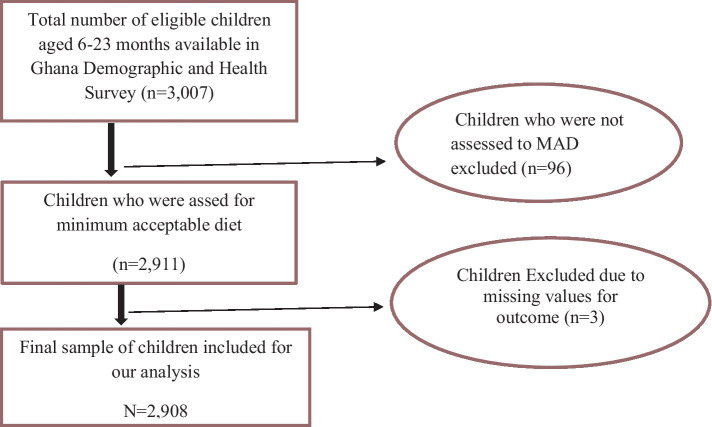
Secondary data analysis was conducted based on the demographic and health survey data conducted in Ghana in 2022. A total weighted sample of 2,621 children aged 6-23 months in the 5 years preceding the survey was included in this study. A multi-level logistic regression model was used to identify the determinants of the minimum acceptable diet. The adjusted odds ratio at 95% Cl was computed to assess the strength and significance of the association between explanatory and outcome variables. Factors with a -value of <0.05 are declared statistically significant.
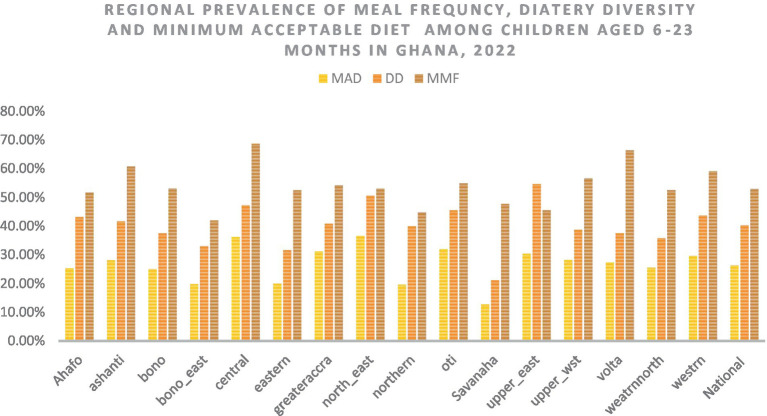
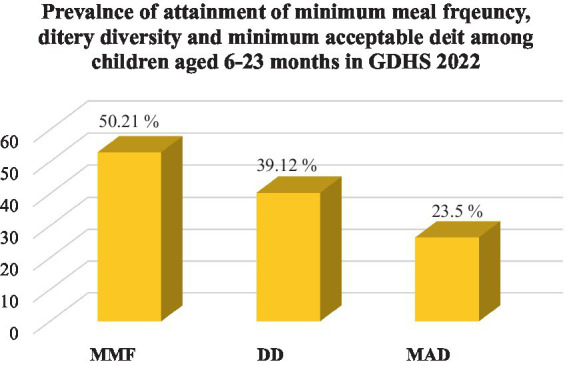
The national prevalence of the attainment of the minimum acceptable diet in Ghana was 26.40% (95% CI: 24.82-28.06). Child from mother with higher education (AOR = 1.96; 95% CI: 1.56-3.31) and father with higher education (AOR = 1.59; 95% CI: 1.04-2.41), Children having postnatal visit (AOR = 1.29; 95% CI: 1.03-1.62), being in the child age of 9-11 months (AOR = 2.09; 95% CI: 1.42-5.03) and 12-23 months (AOR = 3.62; 95% CI: 2.61-5.03), being in a middle (AOR = 1.66; 95% CI: 1.14-3.06), and rich wealth quintile (AOR = 2.06; 95% CI: 1.37-3.10), breastfed children (AOR = 3.30; 95% CI: 2.38-4.56), being in a high-community poverty (AOR = 0.65; 95% CI: 0.44-0.96), and being in the Savannah region (AOR = 0.32; 95% CI: 0.16-0.67) were factors significantly associated with the minimum acceptable diet use.
Many children are still far behind in meeting the minimum acceptable diet in Ghana as per 90% of WHO-recommended coverage. Measures should be taken to optimize the minimum acceptable diet attainment in the country. Thus, policymakers, the government, and other relevant authorities should focus on the early initiation of complementary feeding, the Savannah region, further empowering women, and enhancing breast-feeding and household wealth status.
不恰当的喂养方式是导致儿童营养不良的主要原因之一。为了监测幼儿的喂养方式,需要进行当前和频繁的研究。然而,就我们的搜索结果而言,在研究区域内,关于获得最低可接受饮食及其预测因素的最新信息非常匮乏。因此,本研究旨在利用加纳 2022 年进行的人口与健康调查数据,评估加纳 6-23 个月大儿童获得最低可接受饮食的程度及其相关因素。
本研究基于加纳 2022 年进行的人口与健康调查数据进行二次数据分析。该研究共纳入了 2621 名在调查前 5 年内 6-23 个月大的儿童作为总加权样本。使用多水平逻辑回归模型来确定最低可接受饮食的决定因素。计算调整后的优势比(95%置信区间),以评估解释变量和结果变量之间关联的强度和显著性。-值小于 0.05 的因素被认为具有统计学意义。
加纳全国获得最低可接受饮食的比例为 26.40%(95%置信区间:24.82-28.06)。母亲接受过高等教育的儿童(调整后的优势比(AOR)=1.96;95%置信区间:1.56-3.31)和父亲接受过高等教育的儿童(AOR=1.59;95%置信区间:1.04-2.41)、有产后访视的儿童(AOR=1.29;95%置信区间:1.03-1.62)、9-11 月龄儿童(AOR=2.09;95%置信区间:1.42-5.03)和 12-23 月龄儿童(AOR=3.62;95%置信区间:2.61-5.03)、中等(AOR=1.66;95%置信区间:1.14-3.06)和富裕财富五分位数(AOR=2.06;95%置信区间:1.37-3.10)的儿童、母乳喂养的儿童(AOR=3.30;95%置信区间:2.38-4.56)、处于高社区贫困水平的儿童(AOR=0.65;95%置信区间:0.44-0.96)和位于萨凡纳地区的儿童(AOR=0.32;95%置信区间:0.16-0.67)与最低可接受饮食的使用显著相关。
加纳仍有许多儿童远远未能达到世卫组织建议的最低可接受饮食覆盖率的 90%。应采取措施优化加纳的最低可接受饮食达标率。因此,决策者、政府和其他相关当局应关注早期开始补充喂养、萨凡纳地区、进一步增强妇女权能以及提高母乳喂养率和家庭财富状况。