Department of Child and Adolescent Health and Maternal Care, School of Public Health, Capital Medical University, Beijing 100069, China.
Ministry of Health and Population, Ramshahpath, Kathmandu 44600, Nepal.
Nutrients. 2022 Sep 5;14(17):3669. doi: 10.3390/nu14173669.
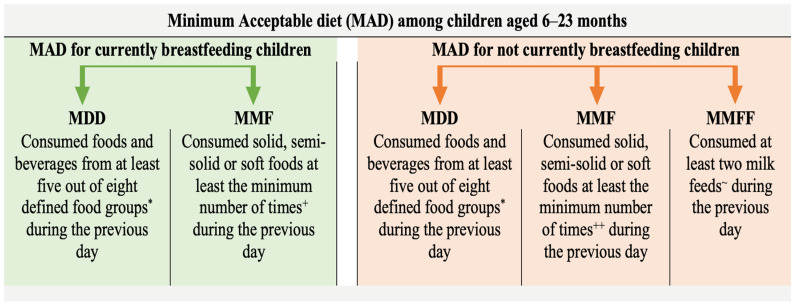
Minimum Acceptable Diet (MAD), developed by the WHO and UNICEF, is a binary indicator of infant and young child feeding practice that assesses the quality and sufficiency of a child's diet between the ages of 6 and 23 months. Identifying factors associated with MAD among children can inform policymakers to improve children's nutritional status.
We extracted data of 1930 children aged 6-23 months from the Nepal Multiple Indicator Cluster Survey 2019. Multilevel analysis was performed to identify factors associated with MAD.
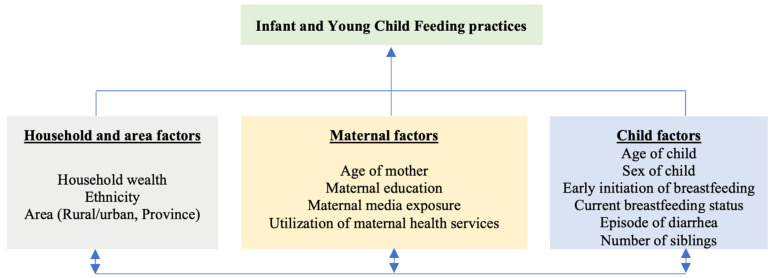
Only 30.1% of the children received MAD. Children aged 13-18 months [aOR (Adjusted odds ratio): 2.37, 95% CI (95% Confidence Interval): 1.77, 3.17] and 19-23 months (aOR: 2.6, 95% CI: 1.95, 3.47) were more likely to receive MAD than children aged 6-12 months. Early breastfed children (aOR: 1.34, 95% CI: 1.05, 1.72), those currently breastfeeding (aOR: 4.13, 95% CI: 2.21, 7.69) and children without siblings aged under five (aOR: 1.33, 95% CI: 1.03, 1.73) were more likely to receive MAD. Younger maternal age (aOR: 0.97, 95% CI: 0.95-1.0), higher level of mother's education (aOR: 1.04, 95% CI: 1.0-1.08) and more media exposure among mothers (aOR: 1.66, 95% CI: 1.24, 2.21) were positive predictors of MAD. Relatively disadvantaged ethnicity/caste (aOR: 0.71, 95% CI: 0.53, 0.94), rural residence (aOR: 1.45, 95% CI: 1.06, 2.00) and residing in Madhesh province (aOR: 0.61, 95% CI: 0.37, 1.0) were also significant predictors of MAD.
Children aged 6-12 months, without appropriate breastfeeding, having under-five years siblings, with older mother or mother without media exposure or low education, from relatively disadvantaged ethnicity/caste, from urban areas and residing in Madhesh Province were less likely to receive MAD. Our findings can inform infant and young child feeding policies and practices in Nepal.
世界卫生组织和儿基会制定的最低可接受饮食(MAD)是评估 6 至 23 月龄儿童饮食质量和充足性的婴儿和幼儿喂养实践的二进制指标。确定与儿童 MAD 相关的因素可以为政策制定者提供信息,以改善儿童的营养状况。
我们从 2019 年尼泊尔多指标类集调查中提取了 1930 名 6-23 月龄儿童的数据。采用多水平分析确定与 MAD 相关的因素。
只有 30.1%的儿童接受了 MAD。13-18 月龄(调整后的优势比[aOR]:2.37,95%置信区间[95%CI]:1.77,3.17)和 19-23 月龄(aOR:2.6,95%CI:1.95,3.47)的儿童比 6-12 月龄儿童更有可能接受 MAD。早期母乳喂养的儿童(aOR:1.34,95%CI:1.05,1.72)、目前正在母乳喂养的儿童(aOR:4.13,95%CI:2.21,7.69)和没有 5 岁以下兄弟姐妹的儿童(aOR:1.33,95%CI:1.03,1.73)更有可能接受 MAD。母亲年龄较小(aOR:0.97,95%CI:0.95-1.0)、母亲受教育程度较高(aOR:1.04,95%CI:1.0-1.08)和母亲更多接触媒体(aOR:1.66,95%CI:1.24,2.21)是 MAD 的正预测因素。相对不利的种族/种姓(aOR:0.71,95%CI:0.53,0.94)、农村居住(aOR:1.45,95%CI:1.06,2.00)和居住在马德西省(aOR:0.61,95%CI:0.37,1.0)也是 MAD 的显著预测因素。
6-12 月龄、未接受适当母乳喂养、有 5 岁以下兄弟姐妹、母亲年龄较大或未接触媒体或教育程度较低、来自相对不利的种族/种姓、来自城市地区和居住在马德西省的儿童不太可能接受 MAD。我们的研究结果可为尼泊尔的婴儿和幼儿喂养政策和实践提供信息。