College of Physical Education, Southwest University, Chongqing, China.
Front Public Health. 2024 Sep 4;12:1408988. doi: 10.3389/fpubh.2024.1408988. eCollection 2024.
Unhealthy lifestyles during adolescence are significant factors leading to chronic diseases in the future. Enhancing health-promoting lifestyles among young adults in China is crucial for preventing and reducing the risk factors of chronic diseases.
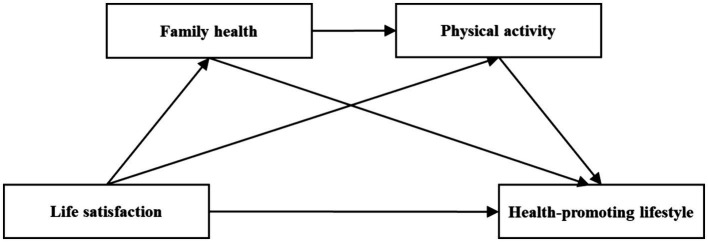
This study aims to explore the relationships between life satisfaction, family health, physical activity, and health-promoting lifestyles among young adults in China. It also seeks to confirm the chain mediation role of family health and physical activity in the influence of life satisfaction on health-promoting lifestyles in this population.
This study, conducted from August 2023 to November 2023, employed a random sampling method to recruit young adult participants aged 18-40 in the southwestern region of China. Variables were measured using the Satisfaction with Life Scale (SWLS), the Family Health Scale-Short Form (FHS-SF), the Physical Activity Rating Scale-3 (PARS-3), and the Health-Promoting Lifestyle Profile II Revised (HPLP-IIR). Data analysis was performed using SPSS 27.0 and the PROCESS macro version 4.1.
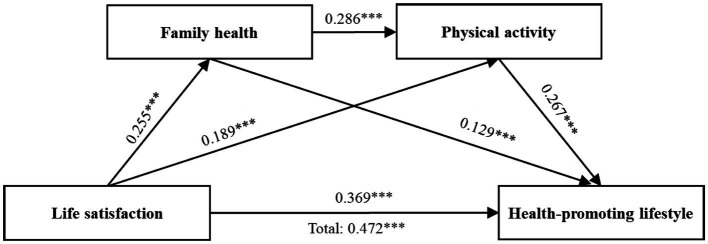
The results indicated that life satisfaction was positively correlated with family health ( = 0.225), physical activity ( = 0.245), and health-promoting lifestyles ( = 0.506). Family health was positively correlated with physical activity ( = 0.320) and health-promoting lifestyles ( = 0.312). Physical activity was positively correlated with health-promoting lifestyles ( = 0.429). Additionally, life satisfaction could influence health-promoting lifestyles directly (effect = 0.369) and through three mediation pathways: (a) family health (effect = 0.033); (b) physical activity (effect = 0.050); (c) family health and physical activity (effect = 0.020).
This study supports the mediating role of family health and physical activity in the influence of life satisfaction on health behaviors among young adults in China. Therefore, we recommend that future public health initiatives place greater emphasis on family health and create conditions that facilitate physical activity for this group. This could be an important direction for further enhancing health-promoting lifestyles among young adults in China.
青少年时期的不良生活方式是导致未来慢性病的重要因素。提高中国青年的健康促进生活方式对于预防和减少慢性病的危险因素至关重要。
本研究旨在探讨中国青年的生活满意度、家庭健康、身体活动与健康促进生活方式之间的关系,并验证家庭健康和身体活动在生活满意度对健康促进生活方式的影响中的链式中介作用。
本研究于 2023 年 8 月至 11 月采用随机抽样方法,招募中国西南部地区 18-40 岁的青年成年人作为研究对象。使用生活满意度量表(SWLS)、家庭健康量表-短式(FHS-SF)、身体活动等级量表-3(PARS-3)和健康促进生活方式量表 II 修订版(HPLP-IIR)测量变量。采用 SPSS 27.0 和 PROCESS 宏版本 4.1 进行数据分析。
结果表明,生活满意度与家庭健康( = 0.225)、身体活动( = 0.245)和健康促进生活方式( = 0.506)呈正相关。家庭健康与身体活动( = 0.320)和健康促进生活方式( = 0.312)呈正相关。身体活动与健康促进生活方式( = 0.429)呈正相关。此外,生活满意度可以直接影响健康促进生活方式(效应 = 0.369),也可以通过三个中介途径产生影响:(a)家庭健康(效应 = 0.033);(b)身体活动(效应 = 0.050);(c)家庭健康和身体活动(效应 = 0.020)。
本研究支持家庭健康和身体活动在生活满意度对中国青年健康行为的影响中的中介作用。因此,我们建议未来的公共卫生计划更加重视家庭健康,并为这一群体创造促进身体活动的条件。这可能是进一步提高中国青年健康促进生活方式的一个重要方向。