Department of Medical Psychology, Amsterdam UMC Location University of Amsterdam, Amsterdam, the Netherlands.
Amsterdam Public Health, Quality of Care, Amsterdam, the Netherlands.
Support Care Cancer. 2024 Sep 20;32(10):676. doi: 10.1007/s00520-024-08847-y.
Tobacco and alcohol use influence cancer risk as well as treatment outcomes, specifically for esophageal and gastric cancer patients. Therefore, it is an important topic to discuss during consultations. This study aims to uncover medical, radiation, and surgical oncologists' communication about substance use, i.e., tobacco and alcohol use, in simulated consultations about curative and palliative esophagogastric cancer treatment.
Secondary analyses were performed on n = 40 standardized patient assessments (SPAs) collected in three Dutch clinical studies. Simulated patients with esophagogastric cancer were instructed to ask about smoking or alcohol use during treatment. The responses of the 40 medical, radiation, and surgical oncologists were transcribed verbatim, and thematic analysis was performed in MAXQDA.
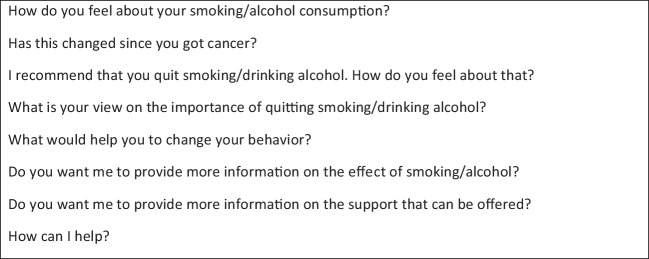
Oncologists consistently advocated smoking cessation during curative treatment. There was more variation in their recommendations and arguments in the palliative compared to the curative setting and when addressing alcohol use instead of smoking. Overall, oncologists were less stringent regarding behavior change in the palliative than in the curative setting. Few oncologists actively inquired about the patient's perspective on the substance use behavior, the recommended substance use change, or the support offered.
Clear guidelines for oncologists on when and how to provide unequivocal recommendations about substance use behavior change and support to patients are needed. Oncologists might benefit from education on how to engage in a conversation about smoking or alcohol.
吸烟和饮酒会影响癌症风险和治疗结果,特别是食管癌和胃癌患者。因此,在咨询中讨论这个问题很重要。本研究旨在揭示医学、放射和外科肿瘤医生在关于食管癌和胃癌根治性和姑息性治疗的模拟咨询中关于物质使用(即吸烟和饮酒)的沟通情况。
对在三项荷兰临床研究中收集的 40 例标准化患者评估(SPA)进行二次分析。患有食管癌和胃癌的模拟患者被指示在治疗期间询问吸烟或饮酒情况。40 名医学、放射和外科肿瘤医生的回答被逐字转录,并在 MAXQDA 中进行主题分析。
肿瘤医生一致主张在根治性治疗期间戒烟。在姑息性治疗与根治性治疗相比,以及在讨论饮酒而不是吸烟时,他们的建议和论据存在更多差异。总体而言,肿瘤医生在姑息性治疗中对行为改变的要求不如根治性治疗严格。很少有肿瘤医生主动询问患者对物质使用行为的看法、建议的物质使用改变或提供的支持。
需要为肿瘤医生制定明确的指南,说明何时以及如何向患者提供关于物质使用行为改变和支持的明确建议。肿瘤医生可能会受益于关于如何进行关于吸烟或饮酒的对话的教育。