Vikulova O К, Zheleznyakova A V, Serkov A A, Isakov M A, Vagapova G R, Valeeva F V, Trubicina N P, Melnikova O G, Aleksandrova V K, Smirnova N B, Egorova D N, Artemova E V, Sorokina K V, Shestakova M V, Mokrysheva N G, Dedov I I
Endocrinology Research Centre.
Kazan State Medical Academy.
Probl Endokrinol (Mosk). 2024 Sep 15;70(4):65-74. doi: 10.14341/probl13426.
Patients with diabetes mellitus (DM) are at risk for a higher incidence and severity of COVID-19, as well as its adverse outcomes, including post-Covid syndrome.
to assess the incidence of cardiorenal complications in patients with type 1 and type 2 diabetes (T1DM/T2DM) who have had COVID-19, and to analyze the structure and severity of disorders according to examination data at the Diamobil mobile medical diagnostic and treatment center.
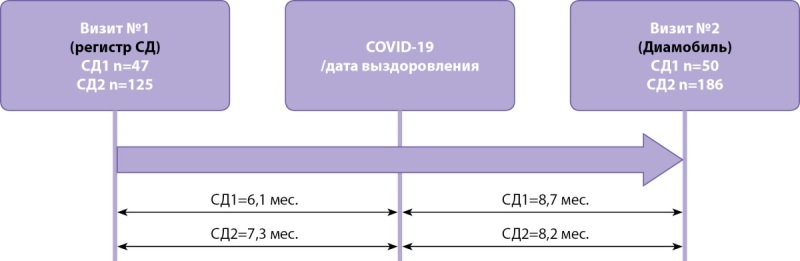
a cohort of T1DM and T2DM patients examined in Diamobil (n=318), with a confirmed anamnesis of COVID-19 (n=236). The time interval between COVID-19 and the visit to Diamobil was 8.7/8.2 months for T1DM/T2DM. The parameters of the last visit before COVID-19 recorded in the Federal Register of Diabetes (FRD) were used as initial data.
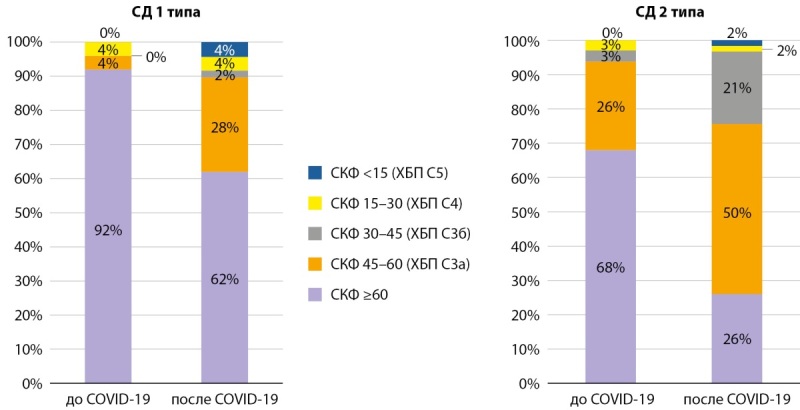
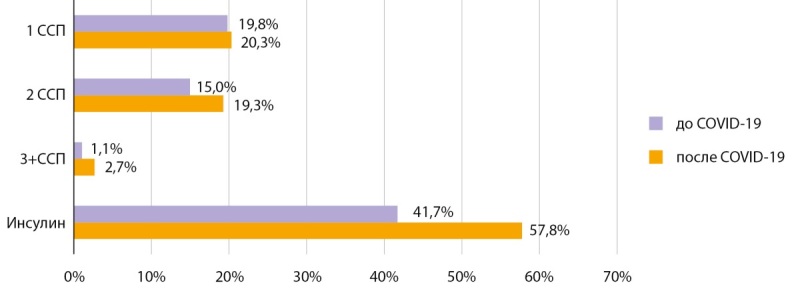
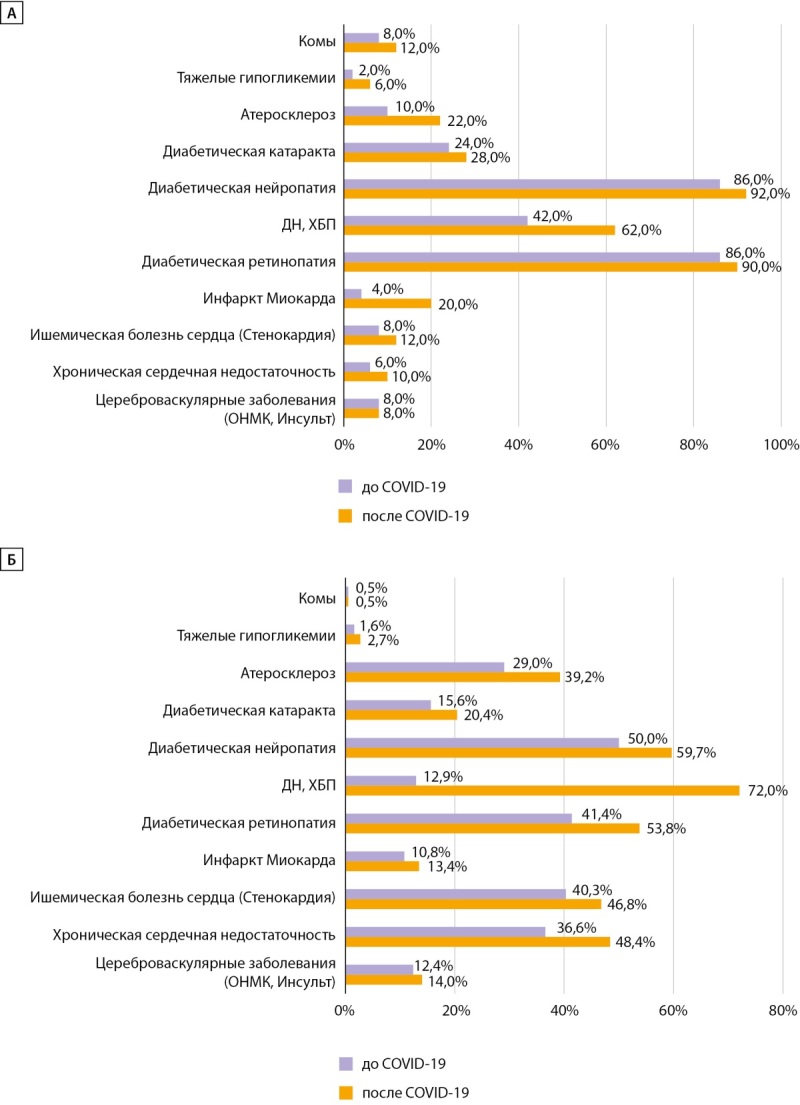
Clinical characteristics of patients with T1DM/T2DM: age - 49.2/64.5 years, duration of DM - 22/11 years, proportion of women - 64/73%, respectively. After analysis the data from visits before and after COVID-19 there weren't statistically significant differences in HbA1c levels for both types of DM (before 9.0/8.3%; after 8.4/8.2%, respectively), there was the intensification of glucose lowering therapy (the proportion of patients with T2DM on 2 and 3 component therapy increased by 4.3% and 1.6%, the proportion of patients on insulin therapy by 16%). After COVID-19, there was a statistically significant decrease in glomerular filtration rate (GFR) in T1DM from 88.1 to 62 ml/min/1.73 m2; with T2DM from 74.7 to 54.1 ml/min/1.73 m2. When assessing acute diabetic complications, there was an increase in the frequency of coma in T1DM by 1.5 times, severe hypoglycemia in T1DM by 3 times, and in T2DM by 1.7 times. Analysis of the frequency of cardiorenal complications before and after COVID-19 showed a total increase of 8.5% in T1DM, by 13.2% in T2DM, of which myocardial infarction, ischemic heart disease, and CHF increased in T1DM in the range from 1.5 to 5 times, with T2DM by 1.3 times, the frequency of CKD with T1DM by 1.5 times, with T2DM by 5.6 times.
There was a decline of kidney filtration function (decrease in GFR) and an increase in the frequency of cardiovascular complications in both types of diabetes in post-Covid period while patients achieved a stable HbA1c levels by intensifying therapy during the COVID-19 infection. This fact reflects combined damage to the kidney and cardiovascular system as a part of the post-Covid syndrome and determines a key set of measures for the development of preventive strategies.
糖尿病(DM)患者感染2019冠状病毒病(COVID-19)的发病率和严重程度较高,且其不良后果(包括新冠后综合征)的风险也更高。
评估1型和2型糖尿病(T1DM/T2DM)患者感染COVID-19后心脏和肾脏并发症的发生率,并根据Diamobil移动医疗诊断和治疗中心的检查数据分析疾病的结构和严重程度。
在Diamobil接受检查的T1DM和T2DM患者队列(n = 318),其中有确诊COVID-19病史的患者(n = 236)。T1DM/T2DM患者感染COVID-19至前往Diamobil就诊的时间间隔为8.7/8.2个月。将联邦糖尿病登记册(FRD)中记录的COVID-19之前最后一次就诊的参数用作初始数据。
T1DM/T2DM患者的临床特征:年龄分别为49.2/64.5岁,糖尿病病程分别为22/11年,女性比例分别为64/73%。分析COVID-19前后就诊的数据后发现,两种类型糖尿病的糖化血红蛋白(HbA1c)水平无统计学显著差异(之前分别为9.0/8.3%;之后分别为8.4/8.2%),降糖治疗有所强化(接受二联和三联治疗的T2DM患者比例分别增加了4.3%和1.6%,接受胰岛素治疗的患者比例增加了16%)。COVID-19后,T1DM患者的肾小球滤过率(GFR)从88.1降至62 ml/min/1.73 m²,具有统计学显著性;T2DM患者的GFR从74.7降至54.1 ml/min/1.73 m²。在评估急性糖尿病并发症时,T1DM患者昏迷频率增加了1.5倍,严重低血糖在T1DM中增加了3倍,在T2DM中增加了1.7倍。分析COVID-19前后心脏和肾脏并发症的发生频率,T1DM总体增加了8.5%,T2DM增加了13.2%,其中T1DM中心肌梗死、缺血性心脏病和慢性心力衰竭(CHF)增加了1.5至5倍,T2DM中增加了1.3倍,T1DM中慢性肾脏病(CKD)的发生频率增加了1.5倍,T2DM中增加了5.6倍。
在新冠后时期,两种类型糖尿病患者的肾脏滤过功能均下降(GFR降低),心血管并发症的发生频率增加,而患者在COVID-19感染期间通过强化治疗使HbA1c水平达到了稳定。这一事实反映了作为新冠后综合征一部分的肾脏和心血管系统的联合损伤,并确定了制定预防策略的关键措施组。