
卵巢癌类器官研究:从基础研究到临床转化
Exploration of organoids in ovarian cancer: From basic research to clinical translation.
作者信息
Li Siyu, Lei Ningjing, Chen Mengyu, Guo Ruixia, Han Liping, Qiu Luojie, Wu Fengling, Jiang Shan, Tong Ningyao, Wang Kunmei, Li Yong, Chang Lei
机构信息
Department of Gynecology, The First Affiliated Hospital of Zhengzhou University, No. 1 East Jianshe Road, Erqi District, Zhengzhou, Henan 450000, China.
School of Basic Medical Sciences, Zhengzhou University, Zhengzhou, Henan, China.
出版信息
Transl Oncol. 2024 Dec;50:102130. doi: 10.1016/j.tranon.2024.102130. Epub 2024 Sep 19.
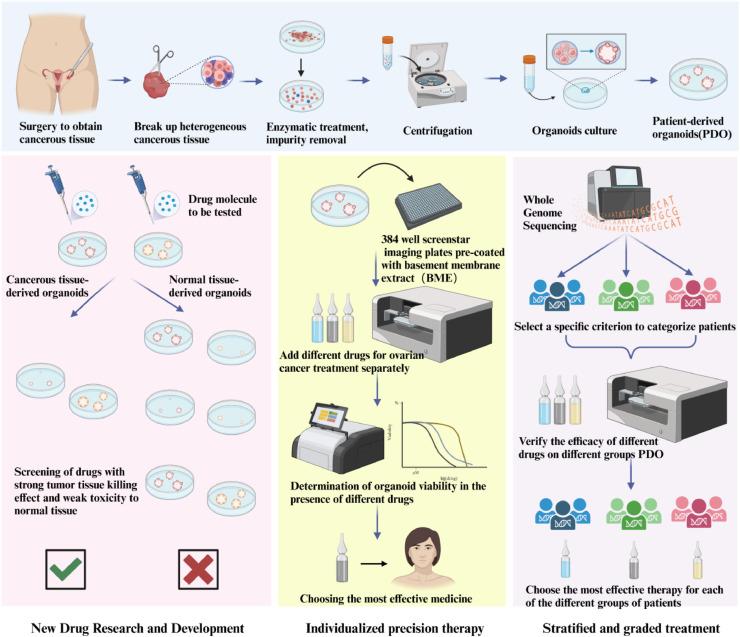
Ovarian cancer is a highly heterogeneous tumor with a poor prognosis. The lack of reliable and efficient research models that can accurately mimic heterogeneity has impeded in-depth investigations and hindered the clinical translation of research findings in ovarian cancer. Organoid models have emerged as a promising in vitro approach, demonstrating remarkable fidelity to the histological, molecular, genomic, and transcriptomic features of their tissues of origin. In recent years, organoids have contributed to advancing our understanding of ovarian cancer initiation, metastasis, and drug resistance mechanisms, as well as facilitating clinical screening of effective therapeutic agents. The establishment of high-throughput organoid culture systems, coupled with cutting-edge technologies such as organ-on-a-chip, genetic engineering, and 3D printing, has tremendous potential for accelerating ovarian cancer research translation. In this review, we present a comprehensive overview of the latest exploration of organoids in basic ovarian cancer research and clinical translation. Furthermore, we discuss the prospects and challenges associated with the use of organoids and related novel technologies in the context of ovarian cancer. This review provides insights into the application of organoids in ovarian cancer.
卵巢癌是一种高度异质性的肿瘤,预后较差。缺乏能够准确模拟异质性的可靠且高效的研究模型阻碍了深入研究,并妨碍了卵巢癌研究结果的临床转化。类器官模型已成为一种很有前景的体外方法,对其起源组织的组织学、分子、基因组和转录组特征表现出显著的忠实度。近年来,类器官有助于推进我们对卵巢癌起始、转移和耐药机制的理解,并促进有效治疗药物的临床筛选。高通量类器官培养系统的建立,再加上芯片器官、基因工程和3D打印等前沿技术,在加速卵巢癌研究转化方面具有巨大潜力。在这篇综述中,我们全面概述了类器官在卵巢癌基础研究和临床转化方面的最新探索。此外,我们讨论了在卵巢癌背景下使用类器官及相关新技术的前景和挑战。这篇综述为类器官在卵巢癌中的应用提供了见解。


 Zotero 插件