Independent researcher.
Department of Immunology and Microbiology, The Scripps Research Institute, La Jolla, San Diego, CA 92037, USA.
Cell. 2024 Sep 19;187(19):5468-5482.e11. doi: 10.1016/j.cell.2024.08.010.
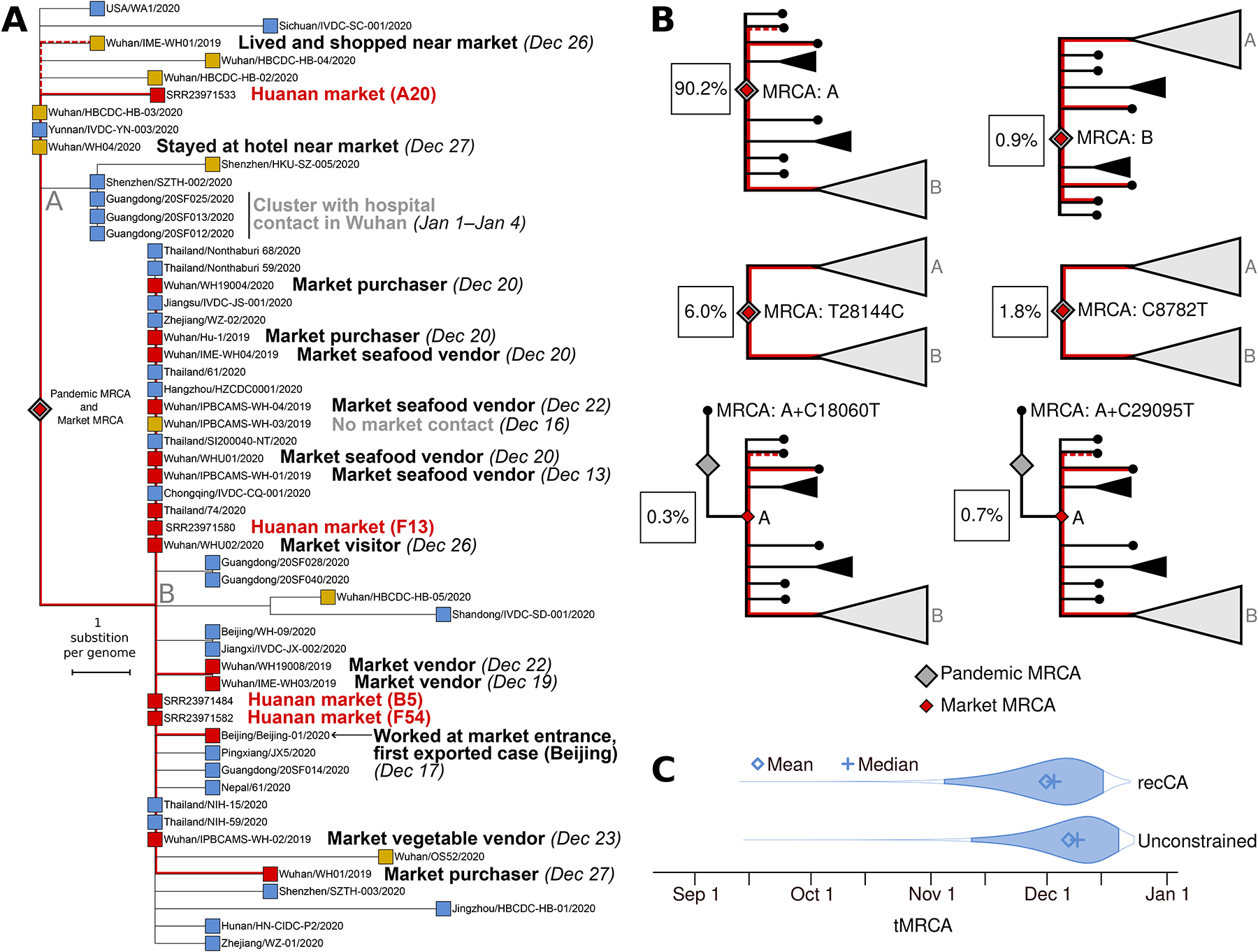
Zoonotic spillovers of viruses have occurred through the animal trade worldwide. The start of the COVID-19 pandemic was traced epidemiologically to the Huanan Seafood Wholesale Market. Here, we analyze environmental qPCR and sequencing data collected in the Huanan market in early 2020. We demonstrate that market-linked severe acute respiratory syndrome coronavirus 2 (SARS-CoV-2) genetic diversity is consistent with market emergence and find increased SARS-CoV-2 positivity near and within a wildlife stall. We identify wildlife DNA in all SARS-CoV-2-positive samples from this stall, including species such as civets, bamboo rats, and raccoon dogs, previously identified as possible intermediate hosts. We also detect animal viruses that infect raccoon dogs, civets, and bamboo rats. Combining metagenomic and phylogenetic approaches, we recover genotypes of market animals and compare them with those from farms and other markets. This analysis provides the genetic basis for a shortlist of potential intermediate hosts of SARS-CoV-2 to prioritize for serological and viral sampling.
病毒的动物源溢出已在全球范围内通过动物贸易发生。COVID-19 大流行的开始在流行病学上可追溯到华南海鲜批发市场。在这里,我们分析了 2020 年初在华南市场收集的环境 qPCR 和测序数据。我们证明,与市场相关的严重急性呼吸系统综合征冠状病毒 2(SARS-CoV-2)遗传多样性与市场出现一致,并在野生动物摊位附近和内部发现 SARS-CoV-2 阳性率增加。我们在该摊位的所有 SARS-CoV-2 阳性样本中都发现了野生动物 DNA,包括此前被确定为可能的中间宿主的果子狸、竹鼠和貉等物种。我们还检测到感染貉、果子狸和竹鼠的动物病毒。通过组合宏基因组学和系统发育学方法,我们从市场动物中回收了基因型,并将其与农场和其他市场的基因型进行了比较。该分析为 SARS-CoV-2 的潜在中间宿主提供了遗传基础,以便优先进行血清学和病毒采样。