Herranz Mochales Andrea, Picchio Camila A, Nicolàs Aina, Macià María Dolores, Fernández-Baca María Victoria, Serrano Joaquín, Bonet Lucía, Trelles Marita, Sansó Andreu, Rubí Alicia R, Zamora Antonio, García-Gasalla Mercedes, Buti Maria, Vilella Àngels, Lazarus Jeffrey V
Barcelona Institute for Global Health (ISGlobal), Hospital Clínic, University of Barcelona, Barcelona, Spain.
Microbiology Service, Hospital Universitari Son Espases, Palma, Spain.
JHEP Rep. 2024 Jun 13;6(10):101145. doi: 10.1016/j.jhepr.2024.101145. eCollection 2024 Oct.
BACKGROUND & AIMS: An estimated 50 million individuals have chronic hepatitis C virus (HCV) infection worldwide and people who use drugs (PWUD) are disproportionately affected. Persistent stigma and discrimination make it challenging for PWUD to access healthcare, potentially hindering HCV elimination progress in this population. To mitigate healthcare access barriers in PWUD, an HCV care model that simplified screening and linkage to care pathways was developed and rolled out in the Balearic Islands, Spain.
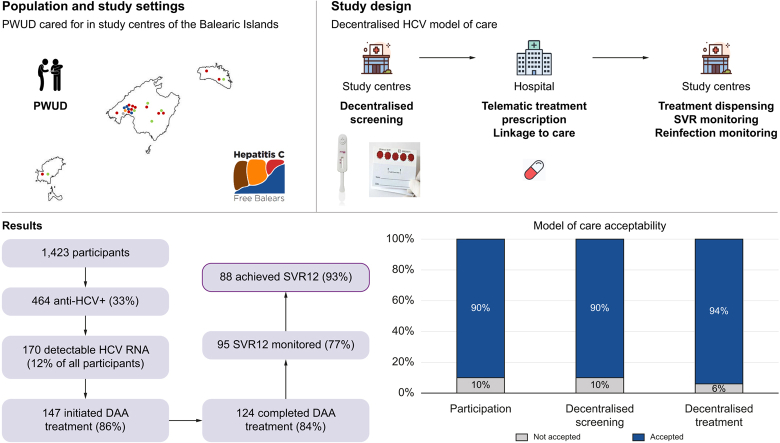
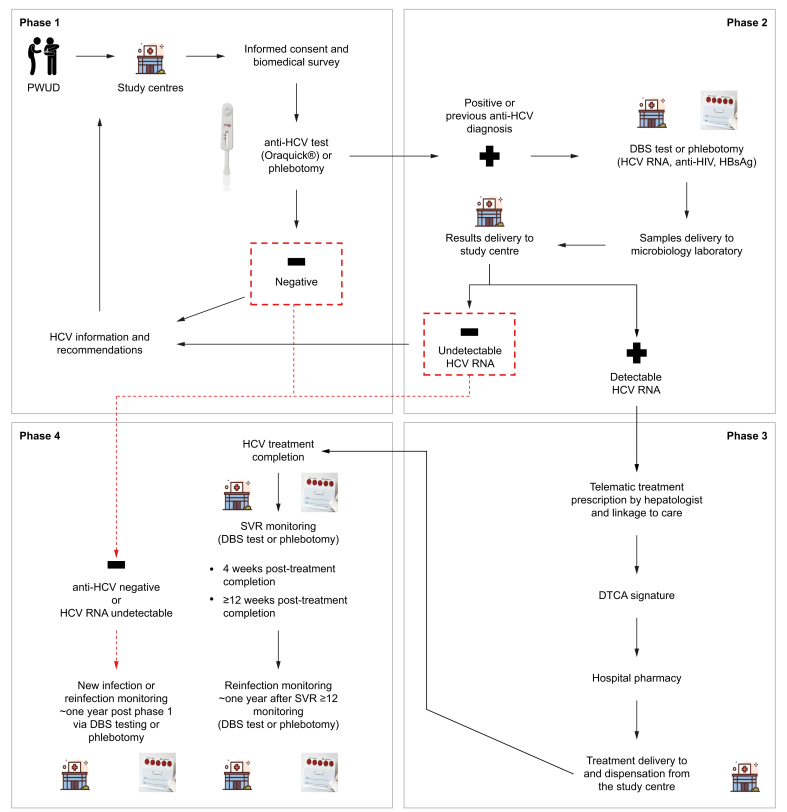
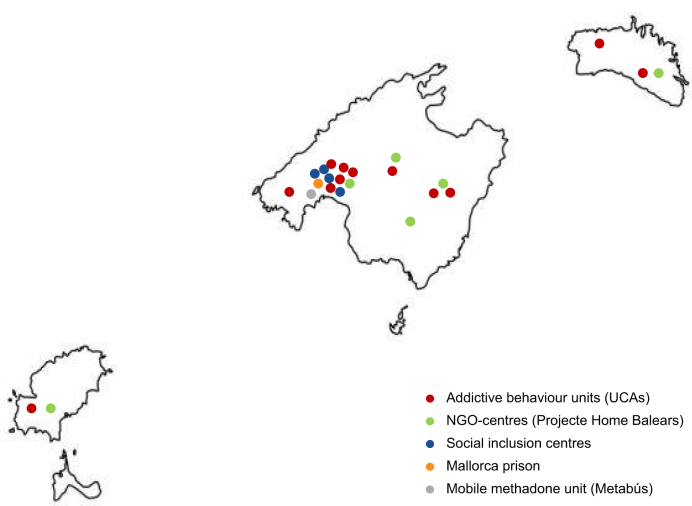
The prospective multicentre community model of care was implemented in 21 centres serving PWUD. This model involved: (1) participant recruitment and HCV antibody screening onsite via a point-of-care anti-HCV test, phlebotomy, or laboratory records; (2) HCV RNA, HBsAg and anti-HIV testing via a dried blood spot or phlebotomy; (3) linkage to specialist care and treatment prescription via telemedicine, when required; and (4) onsite monitoring of: (a) sustained virologic response (SVR) 4 and ≥12 weeks after treatment completion and; (b) potential new HCV infection or reinfection ∼1 year after phase 1 or SVR ≥12 monitoring. Care model acceptability was assessed.
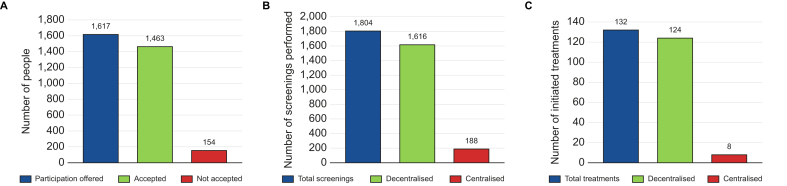
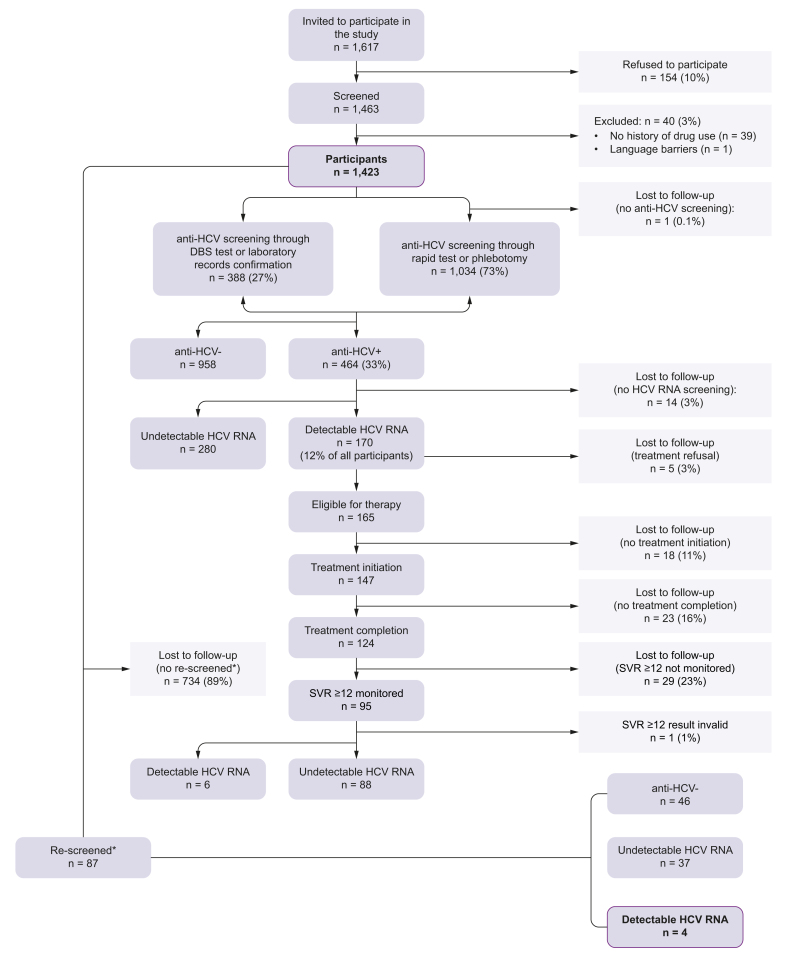
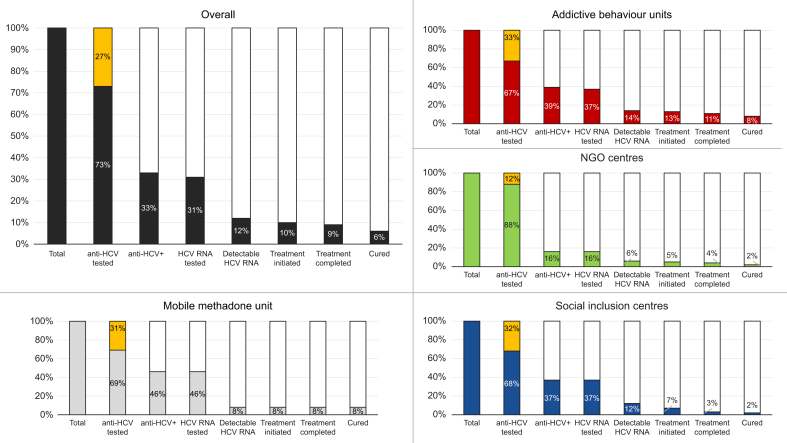
Between April 2021 and April 2023, 1,423 participants were recruited, of whom 464 (33%) were anti-HCV+ and 170 (12%) had detectable HCV RNA. Of the latter, 147 (86%) initiated therapy, of whom 124 (84%) completed it. SVR ≥12 monitoring was performed in 95 (77%) of these, of whom 88 (93%) had undetectable HCV RNA. Upon re-screening, four HCV reinfections were detected. Over 90% accepted study participation and screening and treatment decentralisation.
This adapted care model, which decentralised screening, diagnosis, and treatment, effectively increased healthcare access among PWUD, improving progress towards HCV elimination in this population in Spain.
People who use drugs (PWUD) are among the most affected by chronic hepatitis C virus (HCV) infection globally. A simplified model of care was implemented in 21 centres serving this population across the Balearic Islands, Spain, to offer HCV care to 1,423 PWUD in 2021-2023. This decentralised screening, diagnosis, and treatment model resulted in an HCV cure rate of 93% of those who both completed therapy and were monitored post treatment completion. The model can guide the HCV elimination efforts of regional health authorities and other stakeholders in the rest of Spain and other parts of the world.
全球估计有5000万人感染慢性丙型肝炎病毒(HCV),吸毒者受影响的比例尤其高。持续的污名化和歧视使得吸毒者难以获得医疗保健,这可能会阻碍该人群中丙型肝炎病毒的消除进程。为了减轻吸毒者获得医疗保健的障碍,西班牙巴利阿里群岛开发并推出了一种简化筛查和与护理途径联系的丙型肝炎病毒护理模式。
在为吸毒者服务的21个中心实施了前瞻性多中心社区护理模式。该模式包括:(1)通过即时检验抗HCV检测、静脉穿刺或实验室记录在现场招募参与者并进行HCV抗体筛查;(2)通过干血斑或静脉穿刺进行HCV RNA、HBsAg和抗HIV检测;(3)必要时通过远程医疗与专科护理和治疗处方建立联系;(4)在现场监测:(a)治疗完成后4周和≥12周的持续病毒学应答(SVR);(b)在第1阶段或SVR≥12监测后约1年潜在的新HCV感染或再感染。评估了护理模式的可接受性。
2021年4月至2023年4月期间,招募了1423名参与者,其中464人(33%)抗HCV呈阳性,170人(12%)可检测到HCV RNA。在后者中,147人(86%)开始治疗,其中124人(84%)完成了治疗。对其中95人(77%)进行了SVR≥12监测,其中88人(93%)HCV RNA检测不到。重新筛查时,检测到4例HCV再感染。超过90%的人接受了研究参与以及筛查和治疗的去中心化。
这种经过调整的护理模式将筛查、诊断和治疗去中心化,有效增加了吸毒者获得医疗保健的机会,改善了西班牙该人群中丙型肝炎病毒消除的进展。
吸毒者是全球受慢性丙型肝炎病毒(HCV)感染影响最严重的人群之一。在西班牙巴利阿里群岛为该人群服务的21个中心实施了一种简化的护理模式,在2021 - 2023年为1423名吸毒者提供丙型肝炎病毒护理。这种去中心化的筛查、诊断和治疗模式使完成治疗并在治疗完成后接受监测的患者中丙型肝炎病毒治愈率达到93%。该模式可为西班牙其他地区和世界其他地方的地区卫生当局及其他利益相关者的丙型肝炎病毒消除工作提供指导。