Fragassi Agnese, Greco Antonietta, Palomba Roberto
Department of Pharmaceutical and Pharmacological Sciences, University of Padova, Via F. Marzolo 5, 35131 Padova, Italy.
Department of Medicine and Surgery, NanoMedicine Center (NANOMIB), University of Milano-Bicocca, Via Follereau 3, 20854 Vedano al Lambro, Italy.
J Xenobiot. 2024 Sep 19;14(3):1268-1292. doi: 10.3390/jox14030072.
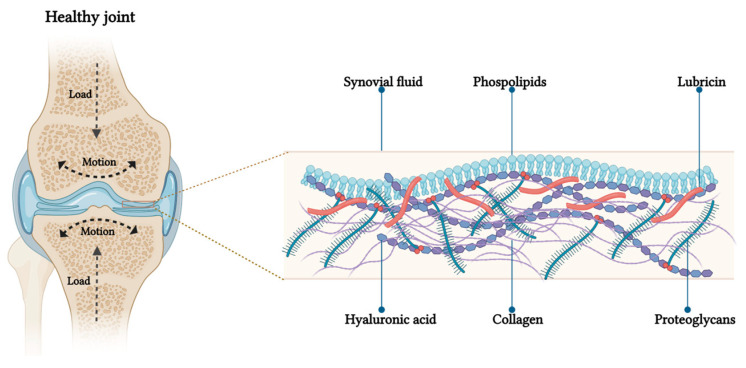
Osteoarthritis (OA) is a debilitating joint disease characterized by cartilage degradation, leading to pain and functional impairment. A key contributor to OA progression is the decline in cartilage lubrication. In physiological conditions, synovial fluid (SF) macromolecules like hyaluronic acid (HA), phospholipids, and lubricin play a crucial role in the boundary lubrication of articular cartilage. In early OA, cartilage damage triggers inflammation, altering SF composition and compromising the lubrication layer. This increases friction between mating interfaces, worsening cartilage degradation and local inflammation. Therefore, early-stage restoration of lubrication (by injecting in the joint different classes of compounds and formulations) could alleviate, and potentially reverse, OA progression. In the light of this, a broad variety of lubricants have been investigated for their ability to reduce friction in OA joints and promote cartilage repair in clinical and preclinical studies. This review examines recent advancements in lubricant-based therapy for OA, focusing on natural, bioinspired, and alternative products. Starting from the currently applied therapy, mainly based on natural lubricants as HA, we will present their modified versions, either in hydrogel form or with specific biomimetic moieties with the aim of reducing their clearance from the joint and of enhancing their lubricating properties. Finally, the most advanced and recent formulation, represented by alternative strategies, will be proposed. Particular emphasis will be placed on those ones involving new types of hydrogels, microparticles, nanoparticles, and liposomes, which are currently under investigation in preclinical studies. The potential application of particles and liposomes could foster the transition from natural lubricants to Drug Delivery Systems (DDSs) with lubricant features; transition which could provide more complete OA treatments, by simultaneously providing lubrication replacement and sustained release of different payloads and active agents directly at the joint level. Within each category, we will examine relevant preclinical studies, highlighting challenges and future prospects.
骨关节炎(OA)是一种使人衰弱的关节疾病,其特征是软骨退化,导致疼痛和功能障碍。OA进展的一个关键因素是软骨润滑作用的下降。在生理条件下,滑液(SF)中的大分子,如透明质酸(HA)、磷脂和润滑素,在关节软骨的边界润滑中起关键作用。在早期OA中,软骨损伤引发炎症,改变滑液成分并破坏润滑层。这会增加配对界面之间的摩擦力,加剧软骨退化和局部炎症。因此,早期恢复润滑(通过向关节内注射不同类型的化合物和制剂)可以缓解并可能逆转OA的进展。鉴于此,在临床和临床前研究中,人们对各种各样的润滑剂进行了研究,以考察它们减少OA关节摩擦和促进软骨修复的能力。本综述探讨了基于润滑剂的OA治疗的最新进展,重点关注天然、仿生和替代产品。从目前主要基于天然润滑剂(如HA)的治疗方法开始,我们将介绍其改良版本,无论是水凝胶形式还是带有特定仿生部分的版本,目的是减少它们从关节中的清除并增强其润滑性能。最后,将提出以替代策略为代表的最先进和最新的制剂。将特别强调那些涉及新型水凝胶、微粒、纳米颗粒和脂质体的制剂,目前它们正在临床前研究中接受考察。颗粒和脂质体的潜在应用可能促进从天然润滑剂向具有润滑特性的药物递送系统(DDS)的转变;这种转变可以通过同时提供润滑替代以及在关节水平直接持续释放不同的有效载荷和活性剂,提供更全面的OA治疗。在每个类别中,我们将考察相关的临床前研究,突出挑战和未来前景。