Lv Caixia, Mittal Usha, Madaan Vishu, Agrawal Prateek
Smart City College of Beijing Union University, Beijing, China.
Computer Science and Engineering, Lovely Professional University, Phagwara, Punjab, India.
PeerJ Comput Sci. 2024 Aug 13;10:e2233. doi: 10.7717/peerj-cs.2233. eCollection 2024.
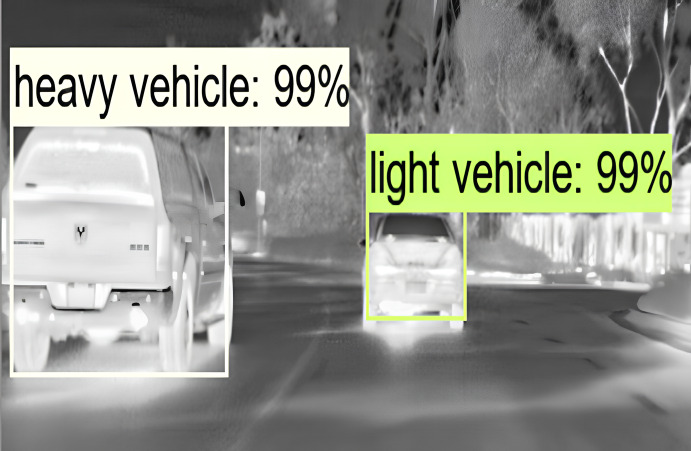
With the rapid increase in vehicle numbers, efficient traffic management has become a critical challenge for society. Traditional methods of vehicle detection and classification often struggle with the diverse characteristics of vehicles, such as varying shapes, colors, edges, shadows, and textures. To address this, we proposed an innovative ensemble method that combines two state-of-the-art deep learning models EfficientDet and YOLOv8. The proposed work leverages data from the Forward-Looking Infrared (FLIR) dataset, which provides both thermal and RGB images. To enhance the model performance and to address the class imbalances, we applied several data augmentation techniques. Experimental results demonstrate that the proposed ensemble model achieves a mean average precision (mAP) of 95.5% on thermal images, outperforming the individual performances of EfficientDet and YOLOv8, which achieved mAPs of 92.6% and 89.4% respectively. Additionally, the ensemble model attained an average recall (AR) of 0.93 and an optimal localization recall precision (oLRP) of 0.08 on thermal images. For RGB images, the ensemble model achieved mAP of 93.1%, AR of 0.91, and oLRP of 0.10, consistently surpassing the performance of its constituent models. These findings highlight the effectiveness of proposed ensemble approach in improving vehicle detection and classification. The integration of thermal imaging further enhances detection capabilities under various lighting conditions, making the system robust for real-world applications in intelligent traffic management.
随着车辆数量的迅速增加,高效的交通管理已成为社会面临的一项严峻挑战。传统的车辆检测和分类方法往往难以应对车辆的各种特征,如不同的形状、颜色、边缘、阴影和纹理。为了解决这一问题,我们提出了一种创新的集成方法,该方法结合了两种最先进的深度学习模型EfficientDet和YOLOv8。所提出的工作利用了前视红外(FLIR)数据集的数据,该数据集提供了热图像和RGB图像。为了提高模型性能并解决类别不平衡问题,我们应用了几种数据增强技术。实验结果表明,所提出的集成模型在热图像上的平均精度均值(mAP)达到了95.5%,优于EfficientDet和YOLOv8的个体性能,它们的mAP分别为92.6%和89.4%。此外,集成模型在热图像上的平均召回率(AR)为0.93,最佳定位召回精度(oLRP)为0.08。对于RGB图像,集成模型的mAP为93.1%,AR为0.91,oLRP为0.10,始终超过其组成模型的性能。这些发现突出了所提出的集成方法在改进车辆检测和分类方面的有效性。热成像的集成进一步增强了在各种光照条件下的检测能力,使该系统在智能交通管理的实际应用中具有鲁棒性。