Department of Global Public Health, Karolinska Institutet, Stockholm 17177, Sweden.
Centre for Epidemiology and Community Medicine, Stockholm County Council, Stockholm 17129, Sweden.
Int J Epidemiol. 2021 May 17;50(2):459-474. doi: 10.1093/ije/dyaa212.
Maternal diabetes has been associated with a risk of neurodevelopmental disorders (NDDs) in offspring, though the common co-occurrence of autism spectrum disorders (ASD), attention-deficit/hyperactivity disorder (ADHD) and intellectual disability (ID) is rarely considered, nor is the potential for confounding by shared familial factors (e.g. genetics).
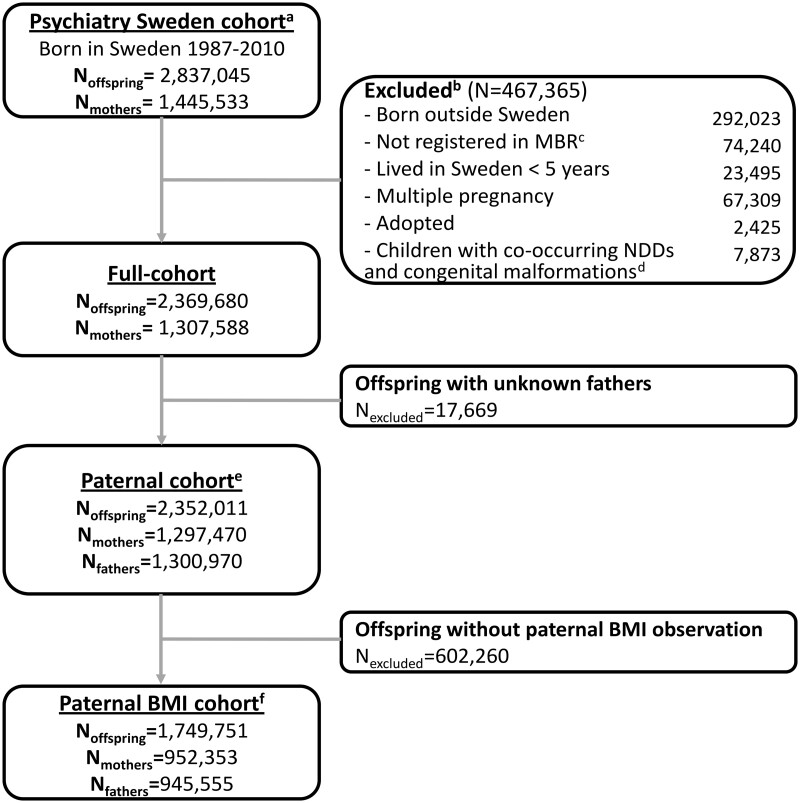
This population-based cohort study used data from Psychiatry Sweden, a linkage of Swedish national registers, to follow 2 369 680 individuals born from 1987 to 2010. We used population-averaged logit models to examine the association between exposure to maternal type 1 diabetes mellitus (T1DM), pre-gestational type 2 diabetes mellitus (T2DM) or gestational diabetes mellitus (GDM), and odds of NDDs in offspring. Subgroup analysis was then performed to investigate the timings of GDM diagnosis during pregnancy and its effect on the odds of NDDs in offspring. We compared these results to models considering paternal lifetime T1DM and T2DM as exposures.
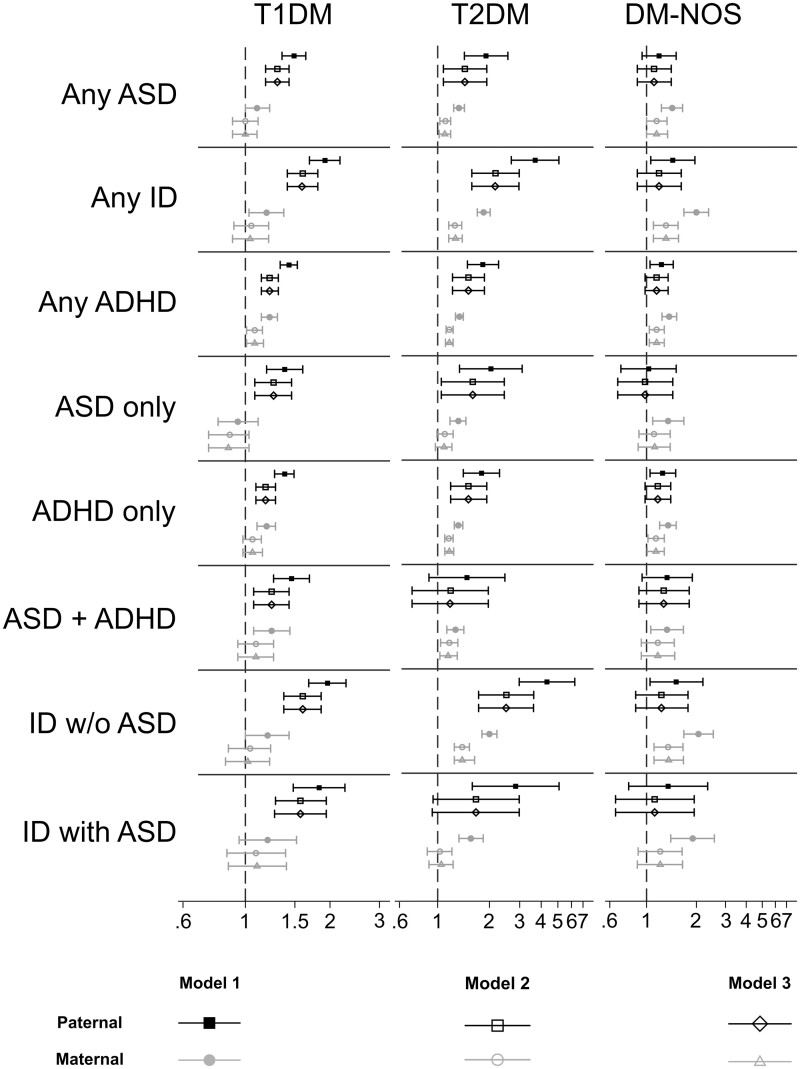
Overall, 45 678 individuals (1.93%) were diagnosed with ASD, 20 823 (0.88%) with ID and 102 018 (4.31%) with ADHD. All types of maternal diabetes were associated with odds of NDDs, with T2DM most strongly associated with any diagnosis of ASD (odds ratioadjusted 1.37, 95% confidence interval 1.03-1.84), ID (2.09, 1.53-2.87) and ADHD (1.43, 1.16-1.77). Considering common co-morbid groups, the associations were strongest between maternal diabetes and diagnostic combinations that included ID. Paternal T1DM and T2DM diagnoses were also associated with offspring NDDs, but these associations were weaker than those with maternal diabetes. Diagnosis of GDM between 27 and 30 weeks of gestation was generally associated with the greatest risk of NDDs in offspring, with the strongest associations for outcomes that included ID.
The association of maternal diabetes with NDDs in offspring varies depending on the co-morbid presentation of the NDDs, with the greatest odds associated with outcomes that included ID. Results of paternal-comparison studies suggest that the above associations are likely to be partly confounded by shared familial factors, such as genetic liability.
母体糖尿病与后代神经发育障碍(NDDs)的风险有关,但通常很少考虑自闭症谱系障碍(ASD)、注意缺陷/多动障碍(ADHD)和智力障碍(ID)的共同发生,也很少考虑共同的家族因素(如遗传)可能造成的混杂。
本基于人群的队列研究使用了瑞典精神病学的数据集,这是一个瑞典国家登记册的链接,对 1987 年至 2010 年期间出生的 2369680 人进行了随访。我们使用人群平均对数模型来检验暴露于母体 1 型糖尿病(T1DM)、妊娠前 2 型糖尿病(T2DM)或妊娠期糖尿病(GDM)与后代 NDDs 发病风险之间的关联。然后进行亚组分析,以研究怀孕期间 GDM 诊断的时间及其对后代 NDDs 发病风险的影响。我们将这些结果与考虑父系终身 1 型糖尿病和 2 型糖尿病作为暴露因素的模型进行了比较。
总体而言,有 45678 人(1.93%)被诊断为 ASD,20823 人(0.88%)为 ID,102018 人(4.31%)为 ADHD。所有类型的母体糖尿病都与 NDDs 的发病风险相关,其中 T2DM 与 ASD 的任何诊断最相关(调整后的比值比为 1.37,95%置信区间为 1.03-1.84)、ID(2.09,1.53-2.87)和 ADHD(1.43,1.16-1.77)。考虑到常见的共病群组,母体糖尿病与包括 ID 的诊断组合之间的关联最强。父系 T1DM 和 T2DM 的诊断也与后代 NDDs 相关,但与母体糖尿病的关联较弱。27 至 30 孕周之间的 GDM 诊断通常与后代 NDDs 的风险最大,与包括 ID 的结局的关联最强。
母体糖尿病与后代 NDDs 的关联因 NDDs 的共病表现而不同,与包括 ID 的结局的关联最强。父系比较研究的结果表明,上述关联可能部分由共同的家族因素(如遗传易感性)造成混杂。