Huang Wei-Hong, Zheng Yuan-Liang
Department of Thoracic Surgery, The Dingli Clinical College of Wenzhou Medical University, Wenzhou Central Hospital, The Second Affiliated Hospital of Shanghai University, Wenzhou, 325000, China.
Heliyon. 2024 Sep 14;10(18):e37947. doi: 10.1016/j.heliyon.2024.e37947. eCollection 2024 Sep 30.
Prolonged length of stay (LOS) increases the economic burden on patients, therefore, optimizing LOS is a critical clinical challenge for physicians. This study aims to examine the correlation between the postoperative LOS and surgery-related adverse events after bullectomy. We defined prolonged postoperative LOS after bullectomy and analyzed the preoperative risk factors linked to prolonged LOS.
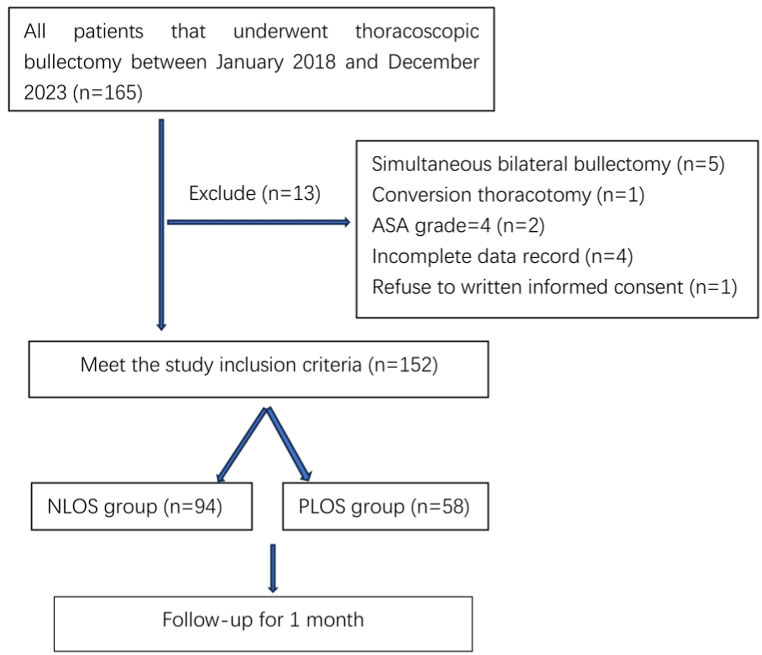
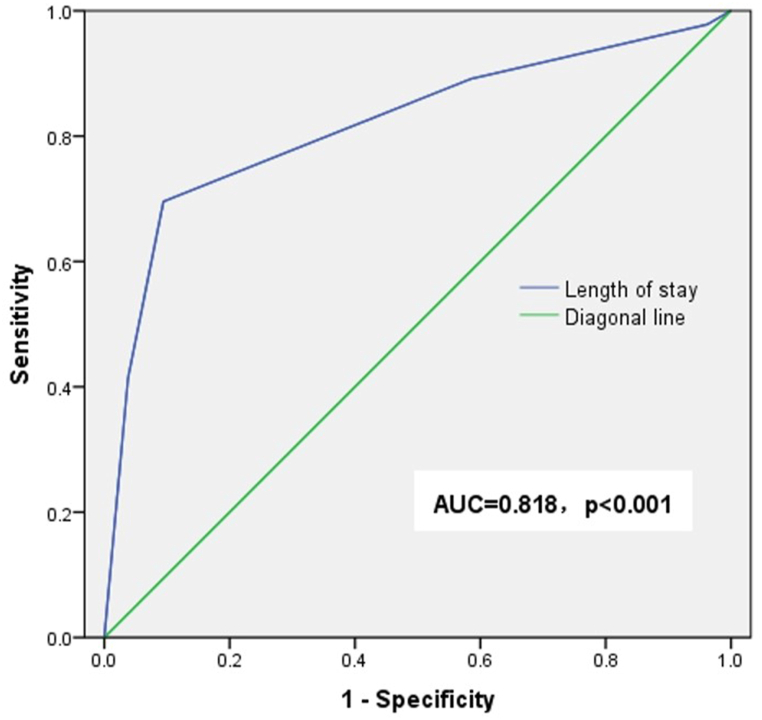
In this retrospective study, we analyzed patient data from thoracoscopic bullectomy performed at our hospital between January 2018 and December 2023. The receiver operating characteristic (ROC) curve was used to identify the optimal cut-off values defining prolonged LOS after bullectomy. It was then characterized as prolonged LOS. Patients were divided into prolonged and normal LOS groups based on their postoperative duration. Further, univariate and multivariate logistic regression analyses were performed to identify preoperative risk factors associated with prolonged postoperative LOS after bullectomy.
Among the 152 patients analyzed, binary logistic regression revealed a significant effect of surgery-related adverse events after bullectomy on the LOS (P < 0.001). A postoperative LOS exceeding 3 days was considered prolonged. Among the 152 patients, 38.2 % (58/152) experienced a prolonged LOS out of which 20.4 % (31/152) developed surgery-related adverse events. Multivariate regression analysis revealed that preoperative risk factors associated with prolonged LOS included age ≥60 years (OR = 3.052, 95%CI 1.226-7.586, P = 0.016), current smoking status (OR = 2.754, 95%CI 1.482-6.346, P = 0.025), and ASA grade 3 (OR = 4.783, 95%CI 2.356-9.131, P = 0.003).
In summary, the postoperative length of stay beyond 3 days after bullectomy was considered prolonged. The preoperative risk factors associated with prolonged postoperative stays after bullectomy included age (over 60), current smoking, and grade 3 ASA. Therefore, quick identification and intervention in patients with these high-risk factors may promote rapid recovery.
住院时间延长会增加患者的经济负担,因此,优化住院时间是医生面临的一项关键临床挑战。本研究旨在探讨肺大疱切除术后住院时间与手术相关不良事件之间的相关性。我们定义了肺大疱切除术后延长的住院时间,并分析了与延长住院时间相关的术前风险因素。
在这项回顾性研究中,我们分析了2018年1月至2023年12月在我院进行的胸腔镜肺大疱切除术患者的数据。采用受试者工作特征(ROC)曲线确定定义肺大疱切除术后延长住院时间的最佳临界值。然后将其表征为延长的住院时间。根据术后持续时间将患者分为延长住院时间组和正常住院时间组。此外,进行单因素和多因素逻辑回归分析,以确定与肺大疱切除术后延长住院时间相关的术前风险因素。
在分析的152例患者中,二元逻辑回归显示肺大疱切除术后手术相关不良事件对住院时间有显著影响(P < 0.001)。术后住院时间超过3天被认为是延长的。在152例患者中,38.2%(58/152)经历了延长的住院时间,其中20.4%(31/152)发生了手术相关不良事件。多因素回归分析显示,与延长住院时间相关的术前风险因素包括年龄≥60岁(OR = 3.052,95%CI 1.226 - 7.586,P = 0.016)、当前吸烟状态(OR = 2.754,95%CI 1.482 - 6.346,P = 0.025)和ASA 3级(OR = 4.783,95%CI 2.356 - 9.131,P = 0.003)。
总之,肺大疱切除术后住院时间超过3天被认为是延长的。与肺大疱切除术后延长住院时间相关的术前风险因素包括年龄(60岁以上)、当前吸烟和ASA 3级。因此,对这些高危因素患者进行快速识别和干预可能促进快速康复。