O'Keefe Jennifer M K, Pound Matthew J, Romero Ingrid C, Nuñez Otaño Noelia B, Gibson Martha E, McCoy Jessica, Alden Margaret E, Fairchild C Jolene, Fitzpatrick Julia, Hodgson Emily, Horsfall Taylor, Jones Savannah, Lennex-Stone June E, Marsh Christopher A, Patel Alyssa A, Spears Tyler M, Tarlton Laikin, Smallwood Liberty F, VanderEspt O L, Cabrera Jeremyah R, Eble Cortland F, Rember William C, Starnes James E, Alford Mac H, Brink Alyson, Warny Sophie
Department of Engineering Sciences, Morehead State University, Morehead, KY, USA.
Department of Geography and Environmental Sciences, Northumbria University, Newcastle upon Tyne, UK.
Research (Wash D C). 2024 Sep 24;7:0481. doi: 10.34133/research.0481. eCollection 2024.
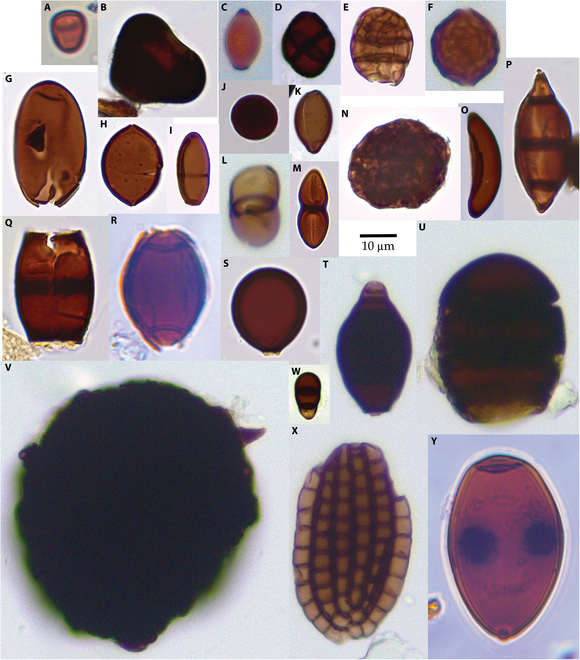
Hydrologic reconstructions from North America are largely unknown for the Middle Miocene. Examination of fungal palynomorph assemblages coupled with traditional plant-based palynology permits delineation of local, as opposed to regional, climate signals and provides a baseline for study of ancient fungas. Here, the Fungi in a Warmer World project presents paleoecology and paleoclimatology of 351 fungal morphotypes from 3 sites in the United States: the Clarkia Konservat-Lagerstätte site (Idaho), the Alum Bluff site (Florida), and the Bouie River site (Mississippi). Of these, 83 fungi are identified as extant taxa and 41 are newly reported from the Miocene. Combining new plant-based paleoclimatic reconstructions with funga-based paleoclimate reconstructions, we demonstrate cooling and hydrologic changes from the Miocene climate optimum to the Serravallian. In the southeastern United States, this is comparable to that reconstructed with pollen and paleobotany alone. In the northwestern United States, cooling is greater than indicated by other reconstructions and hydrology shifts seasonally, from no dry season to a dry summer season. Our results demonstrate the utility of fossil fungi as paleoecologic and paleoclimatic proxies and that warmer than modern geological time intervals do not match the "wet gets wetter, dry gets drier" paradigm. Instead, both plants and fungi show an invigorated hydrological cycle across mid-latitude North America.
北美中新世中期的水文重建情况大多未知。对真菌孢粉组合的研究,再加上传统的基于植物的孢粉学,有助于描绘局部而非区域的气候信号,并为古代真菌的研究提供基线。在此,“温暖世界中的真菌”项目展示了来自美国3个地点的351种真菌形态类型的古生态学和古气候学:克拉克亚化石库遗址(爱达荷州)、明矾崖遗址(佛罗里达州)和布伊河遗址(密西西比州)。其中,83种真菌被鉴定为现存分类群,41种是中新世新报道的。将基于新植物的古气候重建与基于真菌的古气候重建相结合,我们证明了从中新世气候适宜期到塞拉瓦尔期的降温及水文变化。在美国东南部,这与仅用花粉和古植物学重建的结果相当。在美国西北部,降温幅度大于其他重建结果所示,且水文状况季节性变化,从无旱季变为夏季干旱。我们的结果证明了化石真菌作为古生态学和古气候代理指标的效用,以及比现代地质时间间隔更温暖的时期并不符合“湿的更湿,干的更干”范式。相反,植物和真菌在北美中纬度地区均显示出活跃的水文循环。